|
|
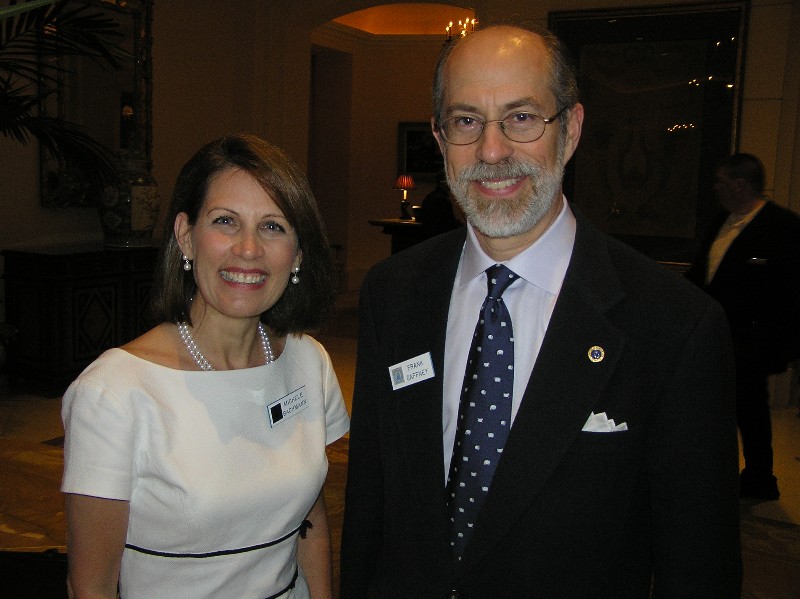
Bachmann responds to Krinkie
Today the Bachmann campaign responded to a letter sent out yesterday by Phil Krinkie concerning some literature from the Bachmann campaign comparing their respective ratings from the Taxpayers League. Wingman has the text of Krinkie's letter here: Senator Bachmann:
I am writing today to call attention to false information in your campaign literature concerning our voting records. I trust you will immediately stop disseminating this false information in radio interviews, your speeches and in your campaign literature.
The false claim you have repeatedly made is that you have the highest rating from the Taxpayers League of Minnesota from 2000 through 2004. This claim is patently false.
My rating from the Minnesota Taxpayers League for each year from 2000 to 2004 was 100%. My average rating over that time period is, of course, 100%. This can be easily verified by visiting the Taxpayers League Website at www.taxpayersleague.org. Visitors to this site will also see my 100% rating in 2005 compared to your 77% rating, due to the fact that you broke your written pledge not to raise taxes.
Your most recent literature, handed out at the BPOU conventions last weekend, states that my average is 95%. This is false and you need to stop repeating it.
You first made this claim in a radio interview on February 18th on the Patriot Radio Show. You are now repeating it in your campaign speeches and in your literature.
Since this is a campaign between Republicans, I would respectfully ask that you destroy any literature with this false claim and cease and desist from repeating it in your speeches. Your quick action will prevent us from having to pursue legal action.
Running for Congress is much different than running for the State Legislature, and the Democrats in Washington D.C. are going to do everything they can to steal this seat back in November – including taking legal action against such distortions.
I would appreciate immediate compliance with my request. The Delegates to the 6th District Convention will benefit from a thorough and open discussion of our voting records – but only if we stick to the facts.
Sincerely,
Phil Krinkie The claims in question can be seen here, courtesty of a statement from David Strom of the Taxpayers League. Bachmann said: Bachmann's Taxpayers League voting record, 2000-2004, of 96% outperformed Knoblach's 77% and Krinkie's 95%. Those numbers can be found in this document from the TL. In the reply today from the Bachmann campaign, their letter says: See for yourself that my lifetime rating through 2004 was 96% and Rep. Krinkie’s lifetime score was 95%. Now, that is a true statement. However, if that is what the Bachmann campaign intended to say by their literature, they were not at all clear on that point. They certainly seemed to say that they were comparing the years 2000-2004, and not lifetime ratings. If just those years are compared, David Strom’s statement on the TL website is accurate. The Bachmann campaign should have been more specific about what precisely they were comparing. (Though, as stated in the comments in a post at Residual Forces, it’s understandable Bachmann would not include 2005, as she had a decision to make on whether to swallow a poison pill. That she sided with a pro-life issue is not in any way an indication of how she votes on fiscal matters.) Also, it is true that Krinkie said this in his letter: “My rating from the Minnesota Taxpayers League for each year from 2000 to 2004 was 100%.” However, as the Taxpayers League documents show, Krinkie’s rating in 2000 was not 100%, but was, rather, 92%. I now sit back and await the chorus that Krinkie is a liar, a slimeball, has no integrity, etc… (Now, I in no way think Krinkie is those things. Just wondering if those who are so venomous towards Bachmann will hold Krinkie to their same standard of truth.)
Roundup on African conflicts
ChadA senior commander in Chad's army has been killed in the fighting around the border between Chad and Sudan. Chad's senior army commander has been killed in fighting with rebels on its border with Sudan, army officials say.
Gen Abakar Itno - the nephew of Chad's President Idriss Deby - died of injuries in clashes in the Moudeina area, south of the border town of Adre.
Chad alleges Rally for Democracy and Liberty rebels receive support from the Janjaweed militia operating in the neighbouring Sudanese region of Darfur.
Aid officials say the fighting involved about 1,000 men on each side.
Gen Itno was commanding the military operation launched 10 days ago against the rebels.
"Gen Abakar Youssouf Mahamat Itno has died of his injuries," an unnamed military source told Reuters news agency.
"Caught without communications, the general was surprised by the rebels who seriously wounded him," the source added.
The start of the operation came a week after the Chadian government said it had foiled a coup attempt against President Deby. UgandaThe fighting in northern Uganda has created terrible conditions. Some 146 people die each week in the northern region where rebels of the Lord's Resistance Army (LRA) have waged war against the Uganda government for two decades, charity groups said in a report published on Wednesday.
War-related deaths in the region are three times higher than the number of killings in Iraq since the United States-led invasion that toppled the regime of Saddam Hussein in 2003 - a death rate that represents 0.17 deaths per 10,000 people, compared with 0.052 per 10,000 in Iraq, according to the report, entitled "Counting the Cost: 20 years of war in northern Uganda". It was prepared by 50 aid agencies working in the region.
"Twenty years of conflict have had a devastating impact on children," said the Civil Society Organisations for Peace in Northern Uganda (CSOPNU) report, which was released as Jan Egeland, United Nations Under Secretary-General for humanitarian affairs, arrived in the country to discuss with Ugandan officials a new approach to the situation before visiting camps for the internally displaced in the north.
"Twenty five thousand children have been abducted during the course of the war, 41 percent of all deaths in the camps are amongst children under five [and] 250,000 children in northern Uganda receive no education, despite Uganda's policy of universal primary education.
"An estimated 1,000 children have been born in LRA captivity to girls abducted by the rebel army. At the times of heightened insecurity up to 45,000 children 'night commute' each evening and sleep in streets or makeshift shelters in town centres to avoid being abducted by the rebel LRA," the report added. LiberiaCharles Taylor will at last answer for his crimes. UN peacekeepers delivered handcuffed former Liberian president Charles Taylor into the custody of a UN-backed Special Court in Sierra Leone on Wednesday where he will be the first former African head of state to face prosecution for war crimes before an international tribunal.
A UN helicopter brought Taylor from the Liberian capital Monrovia directly to the landing pad of the Special Court in Freetown where officials whisked him directly to his waiting cell.
Nigerian police captured Taylor, who is indicted on 17 counts of war crimes, on Tuesday after he disappeared from the mansion where he was living in exile in the south of the country.
Taylor was detained Tuesday night in Borno state in northeastern Nigeria, Information Minister Frank Nweke told reporters. Authorities immediately informed Nigerian President Olusegun Obasanjo who is on a visit to the United States and the Nigerian leader ordered Taylor's immediate deportation to Liberia. DR of CongoThe awful practice of using children as soldiers is not that uncommon, but steps are being taken to combat the practice. The United Nations and international human rights organisations have long campaigned against recruiters of child soldiers, urging their prosecution as war criminals.
But the first break came only last week when the International Criminal Court (ICC) in The Hague decided to arrest Thomas Lubanga, a founder and leader of the Union des Patriotes Congolais (UPC), on charges of conscripting children in the current insurgency against the government of the Democratic Republic of Congo (DRC).
....
Unicef has estimated that up to 300 000 children globally are being used by armed rebels and military forces in a variety of roles, including as combatants, cooks, porters, messengers, spies and for sexual purposes. SomaliaThe lack of a strong central government in that country is allowing chaos to flourish. Talks between militias who unleashed the worst clashes in years in Mogadishu collapsed on Wednesday, fuelling fears last week's fighting could resume and spread to the seat of government.
Islamist militia seized a seaport and airstrip formerly controlled by warlord Bashir Raghe in four days of clashes with the town's most powerful warlords. Between 70 and 90 people were killed.
Since the fighting ended on Sunday, religious leaders and elders have been trying to broker a full ceasefire, but the warlord alliance -- which dubbed itself the "Anti-terrorism Coalition" -- has not taken part.
The Democrats confirm they are not serious about national security
Yesterday the Democrats put forth their new national security strategy. (The 123 page document can be read here in PDF.) The document encompasses five main areas. * 21st Century Military * War on Terror * Homeland Security * Iraq * Energy Independence Not all of it is a complete waste of paper. For instance, in discussing the 21st Century Military, their plan calls for getting our troops the best possible equipment, for securing good pay and benefits for our troops and their families and veterans, and the document discusses the dangers of wearing down almost all of our combat troops in Iraq through multiple rotations. These are all things I agree with to one extent or another, and are perfectly reasonable. However, large chunks of the document are little more than wishes and slogans on par with what you might find in a high school yearbook. "Loved sitting next to ya in English class! Keep on restoring our leadership in the world!" For instance, you'll be surprised to know that the "foremost threat to U.S. national security today comes from violent extremists who are willing to use catastrophic terror", and that the Bush Administration has "has failed to grasp the nature of this mounting threat." Hmmm. You may disagree with Bush's foreign policy, but there is absolutely no basis for claiming Bush has failed to recognize the danger posed by militant Islamic terrorists. Here's one way the Dems would defeat terrorists: Eliminate Osama Bin Laden, destroy terrorist networks like al Qaeda, finish the job in Afghanistan and end the threat posed by the Taliban. Get bin Laden? Dang, I wish I'd thought of that one. I would've been a world-wide blog star. Fine, we all want bin Laden to be filling a pine box somewhere. But how to the Dems propose to get bin Laden? What is the magic answer that Bush has been missing these past five years? They don't say. Do they want to invade Pakistan? Musharraf is quite opposed to the open presence of US troops in his country. It makes him look weak, and like the puppet of the US, not a pleasing image to the radical elements in his country. So, Dems, perhaps reality is a bit more complicated than just saying we should eliminate bin Laden, bang end of story? Here's another nice wish: Double the size of our Special Forces Terrific. If only we had more of the best of the best. But do the Dems think they can wave a magic wand? Do they have any idea what it takes to create an SF soldier? Are they proposing we relax standards in order to lessen the signicant drop out rate in training? The Dems say nothing about the challenges involved in reaching this goal. W. Thomas Smith Jr. has a good article talking about just this issue with the Navy SEALs. He writes, The problem is, transforming a good man into a Navy SEAL is not cheap - about $350,000 a copy - nor is it easy. Sure, there are lots of schoolyard scrappers, gym rats, competitive swimmers, and adrenaline junkies who believe they have what it takes to become SEALs. But few pack the gear to endure-to-completion BUD/S (Basic Underwater Demolition/SEAL) training. Some are injured. Many fail to measure up during various training evolutions. Most simply quit, concluding that the wet, miserably cold life of a frogman is not for them.
None of this, however, changes the U.S. Defense Department's requirement for more special operators, including SEALs.
The Pentagon's just-released Quadrennial Defense Review (QDR) is calling for a 15-percent increase in the number of U.S. special operations forces to fight terrorism and other unconventional threats worldwide. That's a huge demand for senior SEAL officers and petty officers who know that increasing SEAL numbers means proactive recruiting for fresh "talent" and getting a handle on the staggering 80-percent wash-out (attrition) rate without reducing standards.
Special operations experts contend that to lessen costs and to lower training standards would produce a commando that is not quite a SEAL in the purest sense. After bashing Bush around for three years over invading Iraq, here's how the Dems would handle things: Eliminate terrorist breeding grounds by combating the economic, social, and political conditions that allow extremism to thrive And just how do they propose to combat these conditions? Again, they don't say. Are they going to ask politely, and voila, brutal regimes like that in Iran will just relinquish power and go home? Perhaps Bush has figured out that the most effective way to combat the conditions that allow extremism to thrive is through actual combat? You get in the face of a terrorist and you kick it in. It's about the only thing these murderers really understand. The document goes on at some length like this, but you get the idea. Jim Geraghty has a series of posts on this at his TKS blog. My fellow briefer C.S. Scott also has an excellent post on this Democratic strategy at Security Watchtower. He writes, In the end, "Real Security" isn't much more than a plan to look like Democrats have a plan, which is a better alternative in most people's mind to not having a plan at all. Did you get all that? All plans aside, the inescapable fact remains that much of the Democratic leadership is beholden to a voting constituency that is further left then they are on a host of issues, generally opposes the war in Iraq and favors some form of disengagement, supports smaller military budgets to offset larger social spending, and heavily advocates a U.S. foreign policy operating at the behest of the United Nations.
Publicly, few Congressional Democrats can afford to represent the voice of Cindy Sheehan or Michael Moore (there are a few who can) and expect to survive politically. By the same token, they have to walk a political tightrope with their voting constituency and be seen as disapproving and critical of current security and defense policies, without looking weak and what you end up with is a slogan. What "tough and smart" really translates into is a broad appeal that says "we're convicted enough to act on threats if necessary, but we're smart enough not to get involved in wars." Just to reinforce their lack of seriousness, the Democrats presented their plan with former Secretary of State Madeleine K. Albright and retired Army Gen. Wesley Clark present. Perhaps no American diplomat has ever looked as weak as Albright did when she went running after Yassir Arafat in Paris in 1997 begging him to return to the "peace talks". (A close second might be Warren Christopher allowing himself to be kept waiting on a Damascus tarmac for hours before getting to meet with Assad. Now, hmm, which President did these two work for again?) Wesley Clark called the war in Iraq a strategic blunder, and said it isn't connected to the war on terror. Perhaps these two weren't the best image to present when trying to sound tough on national security.
Nigeria, Iran and China
David McCormack has a terrific analysis on Nigeria over at the Warfooting blog. He brings up something I've mentioned here, namely the Islamic elements that exist in Nigeria. It was hoped by many that President Bush's meeting today with Nigerian President Olusegun Obasanjo augurs a stronger relationship between the United States and Africa's most populous country. The reality, however, is that a situation exists in Nigeria in which threats to U.S. interests are creating tremendous impediments to a viable partnership. If the U.S. does not act quickly, these challenges will become insurmountable.
Most significantly, Nigeria -- home to 60 million Muslims, roughly half the country's population -- has become the central battleground of Islamofascism's war on Africa. Over the course of the last 30 years, foreign sponsors -- namely Saudi Arabia, but including Iran and Libya -- backed by treasuries overflowing with petrodollars have systematically exported extremist interpretations of Islam to the African subcontinent, significantly corroding the region's temperate and progressive Islamic traditions.
Nowhere has the impact of this campaign been felt more greatly than in Nigeria. In the shake-up that followed liberation from military rule in 1999, twelve predominantly Muslim states in northern Nigeria took advantage of the central government's weakened position and adopted legal codes based on full Shari'a. Characteristics of these Shari'a states include the severe marginalization of women and the institutionalization of punishments such as flogging and death by stoning. The new laws, moreover, are often applied regardless of a citizen's faith and enforced by vigilante organizations modeled on those of Saudi Arabia and Iran. I've also mentioned in passing that China is certainly interested in Nigeria, too, given Nigeria's oil industry. But McCormack adds some interesting details. Absent communal friction, Nigeria's energy sector would still prove highly problematic for American interests. Communist China's global drive to dominate strategic energy resources has naturally attracted it to sub-Saharan Africa, from which it currently imports nearly 30 percent of its oil and natural gas. The PRC's presence, unfortunately, has greatly abetted the scourge of Africa -- corruption. As Mustafa Bello, head of the Nigerian Investment Promotion Commission, recently admitted, "The U.S. will talk to you about governance, about efficiency, about security, about the environment....The Chinese just ask, 'How do we procure this license?'"
Not surprisingly, then, Nigeria has been increasingly receptive to PRC energy forays. For instance, in its first major investment since its failed bid to take over Unocal last year, the Chinese state-controlled oil company CNOOC announced last month it will pay $2.3 billion for a 45 percent stake in a Nigerian oil field. As Iheanyi Ohiaeri, head of business development for Nigeria's National Petroleum Corporation, explains, "We haven't been totally invaded by China yet, but it will come." In a comment to his post, I asked him if he had any information on Iranian involvement in Nigeria, as I talked about in this post. He replied by email and added some additional interesting details. Here's his reply: I'm afraid I just don't know enough to definitively say whether or not Iran is involved in the Niger Delta. They have, however, been involved in the advance of Islamism in the northern region - for example, they sponsor an Islamist publication called Sakon Islam, and the leader of the Nigerian Ikhwan was trained in and is suspected to have received money from Iran.
I've spent a great deal of time chronicling Saudi activity in Africa in general and in Nigeria more specifically (http://www.centerforsecuritypolicy.org/Af_Vortex.pdf).
If the opportunity ever arises, I'd love to do the same with Iran. A casual glance seems to suggest they're a lot more involved in eastern and southern Africa, but I'm sure some research would turn up a lot more in western Africa as well.
Restraining the tiger with paper chains
Vital Perspective, which is an excellent blog, has some disappointing but not surprising news concerning the UN Security Council's talks on Iran: Vital Perspective has obtained the text of the Security Council presidential statement on Iran agreed to today. This is a watered-down statement which - at Russia's demand - dropped any reference to Chapter 7 ("threat to international peace and security"), and therefore is not binding. Iran was given thirty days to comply instead of the original fourteen. The five specific IAEA demands were watered-down to just one. This is the result of nearly a month of negotiations, meaning that Iran essentially enjoys nearly sixty days of unimpeded enrichment activities which continue unabated. This assumes, however, that action is taken after thirty days - experience shows otherwise. As we reported exclusively, Iran's enrichment progress is advancing more rapidly than previously assumed. Once again, the diplomatic process is completely out of sync with the pace of Iran's technological progress. You wouldn't know that though from reading the press.
UPDATE @ 8:02pm: John Bolton is not a happy camper: "The Security Council can and should work with other UN bodies [the IAEA], but if the Iranians take steps as they have repeatedly over the last four years that show a continuing desire to get nuclear weapons that poses and has posed a threat to international peace and security that the Security Council has a responsibility to act on. I don't know what steps the Council will take, I've said before and I'll say it again - this is a test for the Security Council. The threat of the proliferation of weapons of mass destruction and international terrorism are the greatest threats to international peace and security we face in the world today. How the Council handles those threats, will be a determining factor in the role of the Council in the future." Indications all along have been that Russia and China were not likely to support taking stringent measures against Iran. The situation, though, is similiar to Iraq in that going the diplunacy route through the UN at least gives the US cover to be able to say we exhausted all peaceful means before any military action became necessary. But, also like Iraq, the endless dithering simply buys more time for Iran, as it did for Iraq to prepare plans for a post-war insurgency and perhaps spirit its WMD program away to Syria. As VP points out however, the clock is ticking. Iran is charging ahead with its nuclear program, and Iran is more than happy to see endless droning in the UN. This article from Iran Focus highlights Iran's preparations. Iran’s Islamic Revolutionary Guards Corps (IRGC) will begin large-scale naval exercises in the Persian Gulf and Sea of Oman on Friday by firing a Shahab-2 missile “to show Iran’s desire for peace and friendship with neighbouring countries”, the IRGC naval chief said on Wednesday. Ah, we should celebrate cultural differences, and appreciate those societies where firing missiles is a sign of peace. In a crisis, the Persian Gulf could become a flashpoint if Iran decides to try and stop the flow of oil through the Straits of Hormuz, and this naval exercise and missile firing is a not-so-subtle reminder of exactly that. Iran is not immune from pressure. With unrest in the southwest in the province of Khuzestan, and in the southeast in the province of Sistan-Baluchistan, student protests, unemployment, and so on, Iran might well respond to serious international action. Just today there was another example of violence inside Iran: Three agents of Iran’s Islamic Revolutionary Guards Corps were killed in a gun-battle in the north-west town of Salmas, the state-run news agency ISNA reported on Wednesday.
The IRGC agents were from the towns of Khoy, Maku, and Marand, the report said.
Salmas, close to the Turkish border, is situated in the province of West Azerbaijan. However, with Russia and China running interference for them, Iran must be chuckling at the lack of Western fortitude. Some in the US government and in other governments seem to have decided that we can live with a nuclear-armed Iran. But, we shouldn't mistake wishful thinking for analysis. Regime Change Iran points to an article in Haaretz which says the following: Former Spanish prime minister Jose Maria Aznar said Tuesday that Iran's Ayatollah Ali Khamenei told him five years ago that "setting Israel on fire" was the first order of business on the Iranian agenda.
Aznar, in Israel as the guest of the Interdisciplinary Center in Herzliya, related the story to Major General (Res.) Professor Yitzhak Ben-Israel, who later confirmed to Haaretz that the remarks had been made.
Aznar's aides refused to give Haaretz the exact quote, but mentioned an article Aznar has written in the past on his meeting with Khamenei.
"He received me politely," Aznar wrote, "and at the beginning of the meeting he explained to me why Iran must declare war on Israel and the United States until they are completely destroyed. I made only one request of him: that he tell me the time of the planned attack. When someone threatens us with such blunt language, shouldn't we take it seriously? Tick tick tick...
Darfur is heading for a cliff
The just-concluded Arab League Summit in Khartoum has produced an empty gesture with regards to Darfur. Arab leaders have agreed to pay for the African Union (AU) peacekeeping force in the Sudanese region of Darfur.
Sudanese President Omar al-Bashir had asked the Arab League to meet the cost of the mission from October this year, when its current funding runs out.
Agreement on payment was reached at a summit in Khartoum but it is unlikely the Arab leaders will have to pay out.
The AU has agreed in principle to hand over peacekeeping to the United Nations from September. The Sudanese government is quite opposed to having UN troops in Sudan. In fact, on March 10 the African Union decided to kick the can down the road and extend its mission in Darfur till the end of September in part because of Sudanese opposition. However, the African Union is indeed in need of funds, as even the AU itself admits. An Arab offer to fund African Union forces in Sudan’s Darfur region from October is too late as troops need immediate cash to help stop escalating violence there, an AU official said on Wednesday.
"This is medicine after death," said Baba Gana Kingibe, the head of the AU mission in Sudan. "We need the assistance now in order to be able to resolve the crisis." Worse, the African Union troops in Darfur are woefully inadequate to the task of monitoring the ceasefire there, a ceasefire which is falling apart like wet tissue paper. The AU troops don't have the firepower nor the mobility to be effective. Hostilities between Chad and Sudan are escalating, with both sides using militias and rebels in the Darfur region against the other. Again, AU troops are powerless. The humanitarian crisis in Darfur is growing worse, with civilians at the mercy of marauding gangs. The Arab Janjaweed militia receives support from the Sudanese government. The Sudanese government uses these militias against rebel groups and non-Arab ethnic groups in Sudan, so it has an interest in letting these militias continue to operate. Sudan also has an interest in letting its proxy fight against Chad continue. For these reason, Sudan is reluctant to let UN troops in, and the crisis worsens. The UN and NATO, and along with them Europe and the United States, are not sending strong signals that they will force the issue with the AU and Sudan. Here is a view of the situation from Eric Reeves: Security has essentially collapsed in large areas of Darfur, and as a result humanitarian operations cannot reach hundreds of thousands of desperate civilians; ethnically targeted destruction is expanding unchecked into eastern Chad; and remaining rural populations are completely vulnerable to ongoing predations by Khartoum’s regular and militia forces. The prideful yet cowardly African Union decision to maintain its control of the current mission in Darfur for another six months ensures that conditions will deteriorate rapidly and precipitously.
The consequences of the AU decision, which effectively forecloses robust international humanitarian intervention for the foreseeable future, are also implicitly articulated by Egeland:
“As a result of [deteriorating insecurity], Egeland said, UN relief officials and relief organizations cannot reach more than 300,000 people on the Chad border in western Darfur and the central mountainous region of Jebal Marra because they are too dangerous. These unreachable areas, he said, ‘will soon get massively increased mortality because there is nothing else but international assistance.’ He expected deaths to increase markedly within weeks.” (Associated Press [dateline: United Nations], March 13, 2006)
Additional hundreds of thousands of civilians are inaccessible in South Darfur and North Darfur states. Egeland declared that “Darfur is returning to ‘the abyss’ of early 2004 when the region was ‘the killing fields of this world.’ ‘We're losing ground every day in the humanitarian operation which is the lifeline for more than 3 million people.’” In fact, aggregated UN estimates for the conflict-affected population in Darfur and eastern Chad now total approximately 4 million human beings. Tens of thousands of these people will certainly die in the coming weeks and months; the number of deaths could easily range into the hundreds of thousands over the full course of this rapidly accelerating catastrophe. Darfur cannot afford to have the status quo continue till October. It is going to be a long summer in Darfur.
Politics is not war by other means
Though, I suppose it can seem like it. No, politics is the expressed will of the people. It is the means by which we decide how we will govern ourselves. And because important things are at stake, politics often involves passion and even rancor. Over at Always Right Usually Correct, Tony has worked himself into a good head of steam. He is not exactly a fervent support of Michele Bachmann. I'm not familiar with all his reasons for his opposition, but some of it seems to stem from the fact Bachmann has not appeared on his radio show a time or two. In his post that starts with a link to my account of the SD51 convention, Tony uses some language that you don't usually hear on the conservative side of the aisle. I will next point out I have been consistently against using the grey area of "unethical yet legal" in campaigns.
What is a shame is the number of Republicans who are blinded by the need to win. More accurately is the number of Republicans who are blinded by the need for THEIR candidate to win. When it is their candidate then "it is the system we have".
I find the practice of fixing the endorsement a sign of weakness. Bachmann knows that she is the weaker of the candidates and cannot risk allowing the endorsement in the hands of a group of individually thinking people. Instead she has to find people who cannot think independently, cannot stand up in the convention when running for delegate and speak their mind ("vote for me because I'm a Bachmann robot supporter"), who have to be told exactly who to vote for because they lack the cognitive ability to decide for themselves. As he says, among other things Tony is not in favor of the practice of letting delegates know who other like-minded delegates are so they can support their candidate by voting for delegates who will also vote for their candidate. I am quite in favor of that practice. I think it is good politics. Yet Tony refers to those who do support the use of slates as "blinded", people who "cannot think independently", and who "have to be told exactly who to vote for because they lack the cognitive ability to decide for themselves." Gracious. I suppose I cannot speak for everyone, but I am quite certain I am not blinded. I am quite capable of thinking and deciding for myself which candidate I support and why. In fact, trusting people and their own judgment is a hallmark of conservative ideology. Tony continues: What is more sickening is that people cannot see through the fact that the game is rigged and standing ovations at the end of Bachmann's empty rhetoric is a part of the scam. I regret that Tony has become physically ill over the issue, but again, how is the game rigged. People are perfectly free to support whichever candidate they wish. At the SD51 convention last Saturday, people voted for delegates with no threat of punishment if they didn't vote a certain way. No one was standing over us with cattle prods making us vote for certain delegates. Nobody dumped a bucket filled with prewritten ballots into the teller's lap. So how was anything rigged? I willingly voted for other delegates who support Bachmann because I want to see Bachmann get the endorsement. I, as a private citizen, completely of my own accord, took steps to participate in the process and try and do what I could for the candidate of my choice. Would Tony rather I vote for delegates at random? There is more, but Tony concludes: I am disappointed in the party's members for not recognizing this for what it is. The moral character of the party is disintegrating before my eyes this year. I don't know that the free and fair practice of politics really deserves such histrionics. But, I think a danger in local politics is that for those who like to participate in the process, it's like a hobby. They enjoy it, it's what they spend time on, they get to know other people in the hobby, and after awhile they tend to have a feeling of ownership about the whole thing. Again, just speaking in general terms, the trap for officers in local districts is to see their district as their fiefdom, and candidates coming in to seek support as intruders. At the convention last Saturday just before we voted for delegates, one such local official argued that we shouldn't refer to any "slates", but instead we should vote for people who have worked in the process, who have done the legwork, etc... I don't deny those who work in the local district deserve commendation for their service. But, the right to be a delegate should not be a perk conveyed upon political bosses. That elitist attitude has no business in conservative circles. When neighbors get together and in the open and above board vote for whomever they wish, that's not "stuffing the ballot", it's politics in its noblest form.
China's rural pressures
A couple weeks ago Stratfor had an insightful analysis pointing out the growing pressures in China's rural regions. Unemployment and economic struggles are putting tensions among China's rural poor on a slow and steady simmer. But [China's] growth has been anything but even. Urban growth continues to outpace rural growth, despite income increases across the board. In 2005, per capita disposable income reached $1,310 in urban areas, compared to just $405 in rural net income. Income disparity in 1984 was about a 2 to 1 ratio; now it is 3 to 1. Overall, the poorest 10 percent of China's citizens hold only 1 percent of the nation's wealth, and the wealthiest 10 percent claim 50 percent of the money. Even in urban areas, there are massive disparities: The poorest 20 percent of urban-dwellers control just 2.75 percent of private income; the top 20 percent control 60 percent of the total.
The gaps manifest in other ways as well. China's registered urban unemployment stands at 4.2 percent, but rural unemployment -- which isn't measured officially -- is anecdotally much higher, and even Beijing admits that some 200 million rural workers have migrated to cities recently in search of employment. That represents a substantial portion of the total rural population, which numbers 800 million to 900 million. In the cities, these migrants are treated as second-class citizens at best. In the countryside, they fare little better: Measures of education and health care are substantially lower. Moreover, there has been little legal recourse for farmers, who technically don't even own the land they work, when local officials confiscate the land for new industrial and housing projects.
The central government is well aware of these problems and, perhaps ironically, began issuing public cautions about social and economic tensions years before the international business community bothered to notice. Unrestrained economic growth no longer is viewed as a viable or sustainable option, and Beijing has begun to reassert more centralized control over economic development, with a particular emphasis on reducing the rural-urban gap. Stratfor suggested a not entirely obvious solution. This means Beijing needs to allow, if not subtly encourage, more localized demonstrations.
And that apparently is where Hu and Wen intend to go. The central government's response to stories of rural unrest has remained rather low-key thus far. In reference to the Dongzhou protests in December 2005, where at least three were killed when local security forces opened fire on the crowd, officials on the sidelines of the NPC session recently made it a point to say the officers in question are under detention and did not follow orders. In other uprisings, there even have been suggestions of sympathy from the center. In the cost-benefit analysis, Beijing apparently has determined that the risks of allowing the current trend of growing regionalized power to continue outweigh the risks of trying to manipulate popular sentiment against local officials.
This, perhaps more than anything, underscores the severity of the economic and governing problems facing China's central leadership.
The strategy of unleashing the rural masses, allowing and even subtly encouraging protests could quickly get out of hand. However, given the wide array of localized concerns, there is a natural disunity that could be expected to constrain protesters -- keeping demonstrations locally significant but nationally isolated. So long as protesters don't join across provinces and regions, so long as no interest is able to link the disparate demonstrations, the central leadership will retain some leeway to implement its policies.
But as history bears witness, any attempt to harness protests and mass movements is a very risky strategy indeed. In a March 14 WoC article, Joe Katzman linked to an article that described the "rural time bomb": A peasant "time bomb" threatens to stunt China's rise to global economic superiority unless immediate measures are taken to fix the problem, say experts. The Chinese state has lost much of its legitimacy with the country's rural majority, a turnaround that could have increasingly adverse effects on the long-term socio-economic development of the country, according to Joshua Muldavin, an Asian studies expert at Sarah Lawrence College in New York.
With greater land seizures by the state and reduced levels of rural subsistence, more peasants are having to migrate to urban areas in search of work where disappointment often awaits, making "peasant landlessness ... a time bomb for the state," Muldavin told an audience Thursday at the Carnegie Endowment for International Peace.
"There are two Chinas," he said. One is for investors, and the other is the "rural hinterlands," where official corruption, a growing gap between rich and poor and unemployment led to some 87,000 incidents of unrest in China last year, said Muldavin. It is believed that many more go unreported. I bring this up because the Financial Times just had an article pointing out a factor that can be overlooked as we ponder China's rise and its implications for our security. China is vulnerable to the high prices of oil on the world market, too, and passing those higher costs on to the rural sectors might increase tensions to a dangerous level. China on Sunday announced its first rise in domestic oil product prices in eight months, but promised to soften the blow to farmers, fishermen and urban transportation companies with a new system of subsidies.
...The increases are too small to make up for the steep increase in global oil prices during the past year, but will ease the pain imposed by Beijing’s pricing regime on domestic refiners such as Sinopec, the internationally listed market leader. The commission did not give comparative figures for most state-set petrol and diesel prices, but said Sunday’s move raised the ex-refinery cost of oil products for military use by 5.1-6.8 per cent.
China’s refining sector lost a reported Rmb30bn in 2005, and refiners’ lack of enthusiasm for supplying the domestic oil products market led to severe shortages in some parts of the country last summer. In spite of China’s increasing reliance on imported oil, Beijing has been unwilling to pass price increases on to the pump out of concern over the impact on already hard-pressed farmers and vocal urban groups such as taxi drivers.
Analysts say the gap between market and state-set prices had been becoming increasingly unsustainable, with Beijing forced to give Sinopec a windfall payment of Rmb9.42bn at the end of last year to compensate for its refining losses. It's one reason why China is so reluctant to be a part of UN sanctions against Iran. Not only does China need Iranian oil, but if sanctions or military action against Iran cause a spike in oil prices, China will feel it, and might exacerbate internal problems China doesn't need.
Krinkie fires back
A press release from the Krinkie campaign today addresses two charges made in recent days by the Knoblach campaign. Incoming! It appears that "Silly Season" has started in full force in the race for Congress in the Sixth Congressional District. (Note: Silly Season is the term used in campaigns when candidates begin to throw anything they can at the wall in the hope that something will stick) Phil’s opponents in the race have launched two recent attacks that warrant a response.
At the conventions last weekend and now in the mail, one of the campaigns put out a "hit piece" insinuating that Phil Krinkie is not tough on sex offenders because he voted against the Omnibus Crime Prevention Bill in 2000. To say Phil Krinkie voted against "Katie’s Law" is simply not true.
The reason Phil voted against this huge omnibus bill had nothing to do with “Katie’s Law” or sex offenders. The bill contained the creation of a huge government computer database called CRIMNET that cost millions of dollars to implement and put the privacy rights of individual citizens in jeopardy. In fact, private information about regular citizens was collected and stored in this government database, even the names of suspects, witnesses and people who sought handgun permits.
The last thing Phil wanted was for state government to compile a database that would track gun owners!
The bottom line: Phil Krinkie votes against boondoggles and government intrusion into our lives, even when it’s not politically expedient. That’s just what we need in Congress.
On Monday, Rep. Knoblach tried issued a press release charging that Phil’s vote against the House Budget Resolution authorizing $88 million in new spending was actually a vote to increase spending. Nothing could be further from the truth. The vote against Jim Knoblach’s budget resolution means that state government will have to spend the same amount next year as this year. No new spending!
As we continue through the Silly Season, don’t believe everything you read, check the facts, and call the Krinkie Campaign with any questions at 763-717-2222.
Another one falls out of the sky
Certainly accidents happen, and we shouldn't see mysterious hands in absolutely everything, but given the last two paragraphs in this story, I'm sure certain folks will be trying to find out who and what exactly was on that plane. From Iran, An Iranian cargo plane carrying 12 passengers crash-landed close to the city of Karaj, west of Tehran, on Tuesday, state television reported.
None of the 12-man crew on board was killed according to the report, which quoted the head of Payam Airport. The airport is three miles away from the crash site.
The Russian-made Antonov plane crash-landed into farmland at 16:40 Tehran time after one of its engines failed.
On January 9, a dozen senior commanders of the Revolutionary Guards (IRGC) died in a plane crash in northwest Iran. The Falcon jet belonging to the IRGC crashed 13 kilometres southeast of Lake Orumieh, killing all 15 passengers on board including Brigadier General Ahmad Kazemi, commander of the IRGC Ground Forces and a rising star in Iran’s radical Islamist military.
On December 6, another military aircraft, a C-130 cargo plane, crashed in southern Tehran killing more than 100 people on board.
The nature of the enemy
One of the overlooked aspects of the cooperation of American and Iraqi forces in Iraq is the trust that must be involved. It takes trust for an American soldier to be around an armed Iraqi, to overcome quiet but lingering suspicions about whether that Iraqi is really an insurgent infiltrator who will start shooting Americans in the back first chance he gets. Here is a story of an insurgent infiltrator in a different, unexpected setting. (I would think the victims here are Iraqis. Surely US military casualties are treated in a US military facility, not in a Kirkuk hospital.) When policemen, soldiers and officials in Kirkuk who were injured in insurgent attacks arrived in the emergency room of the hospital, they hoped their chances of surviving had gone up as doctors tended their wounds.
In fact, many of the wounded were almost certain to die because one of the doctors at the Republic Hospital was a member of an insurgent cell. Pretending to treat the injured men, he killed 43 of them by secretly administering lethal injections, a police inquiry has revealed.
"He was called Dr Louay and when the terrorists had failed to kill a policeman or a soldier he would finish them off," Colonel Yadgar Shukir Abdullah Jaff, a senior Kirkuk police chief, told The Independent. "He gave them a high dosage of a medicine which increased their bleeding so they died from loss of blood."
Dr Louay carried out his murder campaign over an eight to nine-month period, say police. He appeared to be a hard working assistant doctor who selflessly made himself available for work in any part of the hospital, which is the largest in Kirkuk.
He was particularly willing to assist in the emergency room. With 272 soldiers, policemen and civilians killed and 1,220 injured in insurgent attacks in Kirkuk in 2005, the doctors were rushed off their feet and glad of any help they could get. Nobody noticed how many patients were dying soon after being tended by their enthusiastic young colleague.
Dr Louay was finally arrested only after the leader of the cell to which he belonged, named Malla Yassin, was captured and confessed. "I was really shocked that a doctor and an educated men should do such a thing," said Col Jaff.
The race for the MN SD51 delegates
I've been informed I was elected as a 20th alternate to the MN 6th Congressional District convention. Since there are 21 delegates, I take this to mean I have no shot at being a seated delegate to the convention. More importantly though, out of the 21 elected delegates, 13 were from Michele Bachmann's slate. (And of the top nine alternates, five were from Bachmann's slate.) I think the Bachmann campaign will be pleased with the results. If the trend continues in other senate districts, she could win the endorsement on the first ballot. Wingman has a post about a Knoblach press release going after Krinkie's vote on a budget resolution. (HT: KvM) Wingman asks: When Michele Bachmann is the perceived frontrunner, why is Knoblach going after Phil Krinkie? In the comments there I suggested the following answer: Perhaps he doesn't want to push on a stone that's already going downhill.
If all the other campaings constantly go after Bachmann Bachmann Bachmann, they are acknowledging she is the frontrunner, and help make her look like it.
By talking about another candidate, perhaps Knoblach is trying to give the impression it is still very much a race.
24 Day 5 9:00 PM - 10:00 PM
Ooh, I just felt the graphic violence warning kick! In the recaps from last week, Vice President Hal still refuses to open the pod bay doors. RunLoganRun is on tv, even though last week we saw his presser live and in person at Budokan. Jack looks like he's groping Collette up against her car. As we get into hot steaming fresh episode this week, Bill asks Chloe to check out Audrey for the past 18 months. Then, Bill goes and takes Audrey into custody. She is understandably flummoxed. Then, Bill utters the words no one inside CTU ever wants to hear. "Prep Ms. Raines for interrogation." Gaahh. CTU is the most torture happy outfit I've ever seen. Audrey asks if Jack knows about this. Bill says Jack sanctioned it. Ex-boyfriends can be so vindictive sometimes. Yowzer, Jack and Collette and Curtis are walking into CTU already?!? Did they bleem over here? They were at the Van Nuys airport less than five minutes ago! Were they really out in the CTU parking lot? I tell ya, with this curfew in place, you can get around LA in seconds. Some nameless CTU agent helpfully points out Collette ID'd Audrey from photos on the way over. For you and me, that would be mighty quick work to send photos of Audrey within minutes to the agents in the vehicles coming back to CTU, but for CTU it's child's play. Jack says to put Collette in Holding. I assume they've gotten Lynn and Harry out of there by now, and mopped up? Audrey is frog-marched into a room, and rather rudely held tightly by the arm by some uniformed agent. Oh. No. Here comes The Cart! Death on Wheels, as they call it around the CTU watercooler. CTU's Torturer-In-Residence the past few seasons, Richards, must have snapped under the strain of all that constant gruesome work. So, this season Burke is our eager torturer. Bill asks Karen, "So we can torture our own people but we can't touch a criminal?" Yup, Bill has got CTU pegged! Bill also says "I trust her implicitly." I've never quite understood that saying. Wouldn't it be a stronger endorsement to say you trust someone explicitly? Implicitly sounds like a backhanded compliment. Miles gets all righteous with Karen and says the decision to put Audrey on the rack is hers, but if she's wrong she'll take the blame. Jack is mad. He wants to be the one to interrogate Audrey. Oh sure, Karen throws Nina Meyers in his face. Bring that up again. Make one mistake with a homicidal maniac spy and you can never live it down. But now it's Jack's turn to pressure Karen. He points out Audrey is the daughter of the SecDef, and if Karen is wrong about Audrey, Dad will eat Karen alive. Jack gets his ten minutes with Audrey. Suddenly we cut to a scene from Escape from LA. Snake Plissken is wrestling with some hoods. Nope, wait, this is a staged fight. The terrorists jump the cops and get their squad car. Chloe has already come up with a connection between Walt Cummings and Audrey. They stayed in the same hotel room in Maryland. And how did she confirm this? Well, she emailed photos to the hotel manager! And he sent back phone bills and receipts! All in about seven minutes! That is some service! And good memory, Hotel Manager Guy! Do you remember the faces of all your guests months later? Chloe speaks truth to power and blurts that this doesn't exactly look that good for Audrey. Going into the first commercial break, clocks are at :10 to :10. But coming back, clocks are at :14 to :13. Simon the Heretic, the mysterious hermit who lives in a cave on the top floor of CTU, cackles and rubs his glowing blue stone. A Shari Rothenberg from Section 5 reports to her new boss, a hunched over twitchy Chloe. I say, more than anyone else in CTU, Chloe's body language always says "Welcome, friend!" Shari is there to replace Edgar. Of course, no one can replace Edgar. No one person, I mean. Maybe three people glued together would be enough to replace Edgar. With each one holding an anvil. Wearing lead boots. And having just had three Big Macs apiece. Chloe sends Shari over to Station Six, Edgar's old stomping grounds. But wait, isn't Miles working over there? He took Chloe's key card so he could work there. Chloe asks Shari, "Are you familiar with the Gavilan matrix analyzer?" Shari flips a coin in her head and says Yeah. Chloe then tells her to make sure the databases are current. I wonder if Shari will end up having to rekey them. Oh brother. Shari and Miles exchange A Look. Do we have to give every character on this show a Wacky Backstory, a Dark Past, a Sinister Secret? Jack goes into the room where Audrey must surely be trying hard not to lose control of her bodily functions. Jack says "Sit. Down." And a tough scene proceeds, which the actors handle deftly. Jack asks if Daddy is involved. Audrey suggests he ought to know better than to ask. Jack asks if she's seen Walt. She dissembles and says a couple times, at briefings. Then, Jack busts her with Chloe's file from the helpful hotel manager. Audrey admits she was on the rebound and found temporary solace in Walt. But she broke it off because Walt wasn't Jack. Jack then decides to try the intimidation tactic, and tosses the table aside and grabs Audrey by the throat. He shouts right in her face. Not very gentlemanly, Jack. Audrey maintains her innocence, and Jack believes her. He then yells at a monitor "This is over!" What, is he mad he missed an episode of Seinfeld because he had to waste time talking to Audrey? Karen says, and not without good reason, "She broke him, not the other way around." But, Karen has been waiting years for this chance to torture someone, She says "Send Burke in." Chloe tells Shari that an agent at Bierko's safe house found the place empty. Um, he should've found the place torched, since that's what Sgt. Bierko ordered. Shari has a look that says "that's nice", and Chloe harrumphs "so upload the information to the subnets." This Shari isn't much of a replacement, is she. Miles decides to bring sunshine to Shari's life and reams her for not having Level 3 clearance. Shari says she has provisional clearance. Miles says one mistake and it's bang pow to the moon. Chloe asks what that was all about, and Shari says she and Miles used to work in SanFran together, and there was a sexual harassment episode. She reported him, but didn't go to trial. He only received a warning. OK, enough Days of Our Lives. Burke is taking Audrey somewhere. Not sure why Audrey wasn't still back in the room. Maybe Jack let her out. Anyway, Burke says he has orders to take Audrey. Jack says through clenched teeth "Get out of my way." Then, he Jack-fu's a White Shirt. (White? What happened to the Red Shirts? They haven't been White Shirts since Season Three.) Goodness, Jack is just out of control. Thankfully, Burke tasers Jack. Audrey is shrieking "Bill! Do something!" Jack is handcuffed. Since Jack just assaulted a uniformed officer, he'll be court martialed now, right? Right? Surely there will be some punishment? Right? Right? Coming back from commercial, clocks are at :27 to :25. Henderson is driving somewhere. Hmm. So after ditching his first car a block from CTU, he got another car somewhere? "Gone in 60" they used to call Henderson in high school. And, he also managed to find a cell phone. Because he is calling a guy in the woods and asks "Is Wayne Palmer dead yet?" Guy says no. Buckaroo says "You had better make it right, you know what's at stake." (A trip to the Final Four? Tell us!) It's been less than an hour since Palmer called Aaron. So Vice President BOB somehow got in contact with Henderson and heard the news that Palmer was coming to the presidential retreat? Henderson must have called BOB, because with a stolen cell phone, BOB wouldn't know how to reach Henderson. Aaron, now sporting a dapper patch on his head, says he'll go out and look for Palmer. Back at CTU, Jack thinks Collette must have gotten Audrey's name from Henderson. (Don't know why he doesn't think it could be Walt, since Walt was involved in this plot and slept with Audrey.) Jack thinks this is Henderson's attempt to make Jack lose focus. Karen says "These plans must have been made some time ago when Henderson had every reason to believe you would be killed." Ya know, the actors must read this stuff and say to themselves "I have no idea what's going on, but I'll just use my actorly training and try to sound authoritative." If you recall, Henderson didn't even know Jack was alive until earlier in the day. Today. The current day. So the plans made "some time ago" means plans made several hours ago? So, according to Karen, expecting Jack would be dead, Henderson left his office and called Collette and gave her Audrey's name, even though he thought Jack was about to be blowed up? And this woman is in a position of authority at Homeland Security? Jack says this is Henderson's contingency plan. It sure is a doozy. Karen finally gets around to something that makes sense and points out they can't touch Collette because Jack made the immunity deal, Jack knows she got him on that one, and says he and Chloe will work to find proof that Collette is lying. Another scene with Miles and Shari. Chloe covers for Shari, and makes a friend. Miles retreats from the women with his masculinity hanging in shreds. Jack tells Chloe they need to find proof Collette and Henderson were together more than once. I guess they had better start calling hotel managers. And then just wait five minutes. We cut to some facility called Wilshire Gas Distribution Center. The baddies roll up to the gate. A hapless guard says there was no delivery scheduled and he'll have to call it in. I guess he assumes that with all the terrorist attacks today and martial law declared, there'd still be people out doing deliveries. And the cop car accompanying the van doesn't seem strange to him. For all his trouble, the guard gets a few slugs in the back. The baddies bust in, shoot a plant worker, and tell the Leader to take them to the control room. Bierko says "Cooperate and no more of your friends will die, understand?" The Leader says "Yes, sir." I don't think Bierko really deserves to be called "sir", but I suppose when someone is holding a gun and has just shot your coworker, you tend to be more polite. Bierko says he wants to release something into the pipelines and needs the pressure dropped in the pipes. Another worker in the control room says "Sam, don't do it!" *pow* He gets a few slugs for his insubordination. Now this becomes an episode of Star Trek. Sam says he might be able to drop the pressure in the pipes in an hour. Bierko gives him the motherly raised eyebrow look. Sam says he might be able to do it in 30 minutes. Bierko says he has 15. Or the Klingons will kill us all! Sam should've said "I canna change the laws of physics!" Clocks are at :38 to :36. Aaron is out in the woods somewhere. Where, I have no idea. Why isn't he near a road? Wayne is there too, and yikes, he has a big honking gun. But where did this rifle come from? When his car crashed, he ran, and he wasn't holding anything. Again, this is like that Star Trek episode with the vacation planet where everything you imagined became real. Perhaps Wayne imagined Tawny Kitain in a leopard skin bikini holding this gun in a forest clearing, and he grabbed it as he went running by. But if this is how he got it, he probably should've imagined an M1 tank. He'd be safer. At CTU, we finally get down to the torturing. Burke is working Audrey over, and she is in distress. Again, a tough scene nicely handled by the actress. Didn't go overboard with it. And yet, conveyed her extreme discomfort and fear. Chloe finds evidence Henderson called Collette several times. Jack says that is enough to rescind the immunity deal. He heads off to Holding Room 3. Collette reminds Jack of her immunity deal, and a guard says "She's right." Oh, what does he know? Oh my, Jack is out of control. He punches the guard and takes his gun. Surely Jack will be arrested for this, right? CTU can't allow an out of control psycho like Jack to be running this investigation, right? Right? Surely there will be consequences, right? Jack says to Collette through clenched to teeth "You do not want to try me." Collette agrees, and says Henderson told her to use Audrey's name if she got in trouble. Jack says "Now I'm...upset." Collette knows there is a gas distribution center involved, but not which one. Jack says there are dozens. (That's an obscure fact to immediately recall. Jack must be a bear at Trivial Pursuit.) And, Jack immediately zens that the gas pipelines are to be used as delivery system. He needs Chloe on it. Bill says the rescinding order will be there in 15 minutes. It only took about 2 minutes to get the immunity deal. I suppose they have to go track down Logan, since he, Martha and BOB aren't in this episode at all. In the torture room, Audrey screams. poor girl. Jack busts in and manages not to punch Burke. Audrey says "I survived because I knew you would come." Then some kissy kissy. Jack tells Audrey she was set up to make him lose focus. I suppose it worked. For about 40 minutes. Henderson will have to do better than this. Jack heads back to the main room. The krazy kaptions have Bill saying "Jack, the medic is on his way." But we don't hear anything. Shari comes over and says she was a chem major. She says the pressure in the pipes will have to be dropped in order to transport the nerve gas without rendering it inert. So, they immediately start looking at gas pressures all over LA. So CTU has an interface to gas pressures why? They find one where the pressure has dropped to 75% in ten minutes. (How do they know it's been ten minutes?) Bill says "Great work, Shari." (But this time, the krazy kaptions spell her name as "Sherry.") After Bill leaves, Shari says "Did you see how he brushed across my shoulder? That was wrong." Ay yi yi. What's wrong is this whole kooky thread. Is Shari crazy? Do we really care? Why is this even in here? Is the thundering conclusion to this season going to be Bill attending diversity training? Out in the woods, it looks like Wayne and Aaron are hanging around Wayne's wrecked car. What are they doing there? Wayne took off running. Why is he still in the vicinity? And indeed, there is a gunfight with the baddies. Who apparently have rockets. They came prepared. In the fight, Wayne is hit. As Aaron drives them away from the scene. Wayne slumps over unconscious. Since he is in next week's previews, he too must have amazing recuperative powers. Clocks are at :52 to :48. Jack is flying in a helo. The baddies have the Evil Canisters of Death on a floor somewhere. Chloe has given the helo an approach vector so guards won't see them. The pilot says the noise from the plant will mask the sound of the helo. Must be one noisy plant. For we see a guard looking around while the helo is hovering behind him dropping the CTU team on the roof of the plant. The team makes their way to the control room. A Nameless CTU Agent Guy looks through the window and sees Bierko and some baddies directly across from the door. They open the door and go in and... apparently step into another room, because they are in some little hall, and Bierko is nowhere in sight. In fact, he is around a corner. Even though the agent just saw the baddies straight through the window seconds before. There is a gunfight. Bierko takes out his remote doohickey and releases the gas. The canisters start opening up like the pods in Alien. Perhaps the real plan is to release face huggers into the pipes. The gas just starts drifting up into the air. Now just what kind of an injection system is this? The gas is just floating around this room. What is going to take the gas and inject it into the pipes? Why would such a system have been built in the first place? Who would've planned to get stuff into the pipes by sucking it in from this room? And if the pressure in the pipes is still greater than the pressure in this room, the gas will not get into the pipes. The pressure difference will keep it out. So what is going on??? After Sam the Leader tells them that apparently no one thought to put a valve on these pipes, and that they can't prevent the nerve gas from getting to the main pipelines, Jack says they have to blow up the pipes. Remember they are in a natural gas distribution center. It's a good thing the team remembered to bring some C4 explosives with them. Chloe somehow knows Jack only has 60 seconds to stop the gas. Jack sets a timer for 30 seconds. Everybody runs. Goodness, back at CTU Audrey is already suited up again and ready for work. Nothing can keep characters on this show down for long. The pipes blow, and Jack does his homage to Luke Skywalker escaping from the Death Star and outruns the gas explosions behind him. (I would think that with all that gas, an explosion would be like a small thermonuclear detonation.) Jack says "I have a visual on Bierko." Nobody just "sees" things on this show. An explosion knocks Bierko to the ground. Back at CTU everyone is yelling "Jack, get out!" Gee, they could show some love and concern for Curtis and the other agents. Jack goes over and grabs Bierko. Who, naturally, instantly revives and fights with Jack. Everyone on this show is superhuman! Jack pulls Bierko into the cop car just as there is a big explosion. Some debris falls on the car. With the clocks at :60 to :57, the episode ends. Has Jack survived? Will he escape so he can punch out more federal agents? Tune in next week. Guest critic Paul won't be joining us this week. The pressure in his cappuccino machine was a bit wonky, so he went outside to his backyard and blew up his propane tank. We're not sure yet if he survived.Number of times Jack says "Now!": 17 Number of times Jack says "No!": 8 Number of times a "protocol" is mentioned: 31 Number of times someone says a variation of "Go!": 22 Number of moles: 3 Approximate Body Count: 65 (plus three rats, plus one human nerve gas guinea pig, plus 11 in the mall food court (and no, not from food poisoning), plus one security camera, plus 56 in CTU) <-8:00 PM - 9:00 PM 10:00 PM - 11:00 PM ->
That'll be convenient
Foreign Ministers from the UN Security Council will meet this week to discuss Iran. Foreign ministers from the five U.N. Security Council permanent members and Germany will meet in Berlin on Thursday for talks about Iran's nuclear program, Britain's foreign secretary said Monday.
Talks in New York aimed at drafting a Security Council statement on Tehran's nuclear enrichment program stalled. The diplomats' meeting in Berlin would seek to push that process forward, Foreign Secretary Jack Straw said.
Germany's Foreign Ministry confirmed plans for the meeting. Oh what fun those talks should be. Britain, France and Germany wasted two years dancing around with Iran, when anyone with a modicum of sense would have known Iran wasn't going to be talked out of its nuclear weapons program. Russia and China are trying to provide cover for Iran, each for its own reasons. In the middle of all this is the United States. It's convenient that they'll all be together in Berlin, because then the ministers can ask the Germans and the Russians about this. Seven people are being investigated over exports of German equipment that could be useful to Iran's nuclear program, prosecutors said on Monday.
Benedikt Welfens, spokesman for the prosecutors' office in Potsdam, near Berlin, said investigators wanted to question the seven, most of them Russians, after seizing cash, equipment and records in raids on 41 sites across Germany last week.
He said they were not under arrest but declined to comment on their whereabouts.
Welfens said German-made electronic components, transformers and special cables and pumps worth 2 million to 3 million euros ($2.4 million to $3.6 million) were found to have been delivered to Iran via Russia. Between this, and reports that Russia gave Saddam Hussein highly sensitive information regarding the US war plans ahead of the Iraq invasion, I'm hoping President Bush takes another deep look into Putin's eyes when they meet later this summer at the G8 summit. Russia is bucking to become an alternate member to the Axis of Evil.
Monday Winds of War Briefing
Welcome! Our goal at Winds of Change.NET is to give you one power-packed briefing of insights, news and trends from the global War on Terror that leaves you stimulated, informed, and occasionally amused every Monday & Thursday. Monday's Winds of War briefings are given by Peace Like a River and Security Watchtower. Top Topics* A Los Angeles Times report on Saturday indicated that Iran could have a nuclear weapon within three years, an estimate previously put forth by former nuclear weapons inspector David Albright. In a speech in southern Iran on Saturday, Mahmoud Ahmadinejad declared that the "threats and intimidations by the West against Iran's nuclear programme will not hinder the final victory to be that of the Iranian nation." * Israeli security forces were placed on high alert on Sunday, 48 hours before the Israeli elections take place. According to Israeli radio "more than 70 warnings of planned terror attacks were registered, 16 of them 'focused' warnings." In the latest poll, Kadima still enjoys a large lead over Labor and Likud. * Pakistani forces using helicopter gunships killed up to 20 pro-Taliban militants near the Afghan border today, after an attack on a security post left one soldier dead, officials said. The fighting in the restive district of North Waziristan came a day after President Pervez Musharraf ordered foreign al-Qaeda militants to quit Pakistani tribal areas bordering Afghanistan or be killed. * British citizens were shocked to hear that a terrorist cell linked to Al-Qaeda plotted to bomb pubs, nightclubs and trains in an intense, coordinated terrorist attack in the United Kingdom. These reports emanated from the trial of terror suspects in London's courthouse, the Old Bailey. One alleged member of the terrorist cell, Mohammed Babar, a Pakistani-born American citizen who has pleaded guilty in New York to a role in the British bomb plot, is expected to testify against the British defendants. Other topics today include: Blank check for Palestinian terrorists; Iranian oil interests; US and Iran to talk; Airstrike in Gaza; Hamas fighting with Fatah; Turkish forces clash with Kurds; majority Palestinians support terrorism & train their kids to do the same; UN wants Hezbollah to join Lebanon's army; PFLP-GC pressured to move operations to Syria; Sharm el-Sheikh suspects charged; Moussaoui trial; update on Lodi trial; more on NSA wiretaps; Terror attacks down in Chechnya; al Qaeda recruiting Azeri girls; Qu'ran controversy in Dagestan; Protests in Belarus; Tamil Tigers still kidnapping and arming children; More fighting in Nepal; ETA ceasefire; Taliban hideout in Uruzgan attacked; Fighting continues in Helmand province; Taliban vow suicide bombings; Clashes in Baluchistan; Bioterror threat in Asia; US bases in Bulgaria ok'd; fighting in Somalia; Libya to stay on terror list; GSPC kills mayor; and more. Iran & the Middle East* Incoming Palestinian interior minister Saeed Seyam, chosen by Hamas to oversee three security services, essentially handed Palestinian terrorists a blank check to attack Israel when he said "the day will never come when any Palestinian would be arrested because of his political affiliation or because of resisting the occupation," adding that "the file of political detention must be closed." * Palestinian Authority Chairman Mahmoud Abbas is warning Hamas that without recognition of Israel they have no future and the Palestinian government would fail. * Despite terror warnings, Israel agreed to reopen the Karni crossing between Gaza and Egypt this past weekend. The move is one of several steps taken by Israel under pressure from the United States. * Israeli Chief of Staff Dan Halutz indicated on Friday that he believes Hamas may soften their stance with the obligations and responsibilities that come with governing, but currently they "present themselves as an enemy of Israel." * According to Olivier Guitta, the Iranian Revolutionary Guard is angry over Qatar's alliance to the US and Israel. In the event of war between the United States and Iran the "Revolutionary guards are threatening to attack Qatari oil and gas facilities by sea and air. They plan to use suicide boats and air missiles." * On Sunday, the al-Rashideen Army in Iraq released a seven-minute video with an open letter to President Bush included. * David R. Francis writes in the Christian Science Monitor that any move by Iran to cut off oil supplies would be economic suicide for a government that receives 90 percent of their revenues from the sale of oil. * There are growing indications that the United States and Iran may hold direct talks over issues in Iraq, a move that Amir Taheri says may be a major mistake. On Saturday, Ayatollah Ali Khamenei accused the British of plotting against Iran. * Israeli aircraft fired two missiles at a carload of al Aqsa Martyrs Brigade members on Monday morning in Gaza city, missing their target and wounding two. * Hamas leaders in Kalkilya have been targeted in assassination attempts in what many describe as continued fighting between Hamas and Fatah. One Hamas official complained that "ever since we won the municipal election, we have been subjected to a campaign of intimidation and incitement by Fatah activists." How ironic. * Turkish army soldiers backed by helicopter gunships are carrying out large operations in the Mur province, near the Iraqi border. On Saturday, 11 Kurdish militant members of the PPK were killed in clashes with the army. * Hamas continues to promote terrorism and violence among Palestinian children, with the latest display taking place at the Palestinian Children's Festival. A poll released on Sunday indicates that 60 percent of Palestinians are opposed to Hamas recognizing the state of Israel. * UN envoy Terje Roed-Larsen doesn't believe it is possible to disarm Hezbollah in Lebanon, as outlined in UNSC 1559 and stated "Our goal is to integrate Hezbollah into the Lebanese army." * According to Lebanese sources, the Popular Front for the Liberation of Palestine-General Command (PFLP-GC) is being pressured to move operations from Lebanon to Syria in an effort to reduce international pressure on Prime Minister Fuad Siniora. * The High State Security Prosecutor in Egypt has charged 13 terror suspects of involvement in a series of blasts in Sharm el-Sheikh in July last year. America Domestic Security & the Americas* Prosecutors concluded their case for executing Zacarias Moussaoui with a step-by-step account of how they possibly could have identified most of the Sept. 11 hijackers if the al-Qaida conspirator had confessed when he was arrested a month before the suicide attacks. * The Sacramento, Calif., trial of accused terrorist Hamid Hayat isn't going well for prosecutors six weeks along, a juror who was excused told reporters. Andrea Clabaugh, 39, said on leaving the court the case wasn't "very clear-cut," and if she had to decide now she would vote to acquit Hayat. * The government does not have to tell three men accused of illegally sending $3.5 million to Yemen whether secret wiretaps were used to investigate them, a judge has ruled. Without explanation, U.S. District Judge William Skretny denied the defense request for information in a one-page decision dated Tuesday. He said he had reviewed the government's classified response to the January request in private. * The National Security Agency could have legally monitored ordinarily confidential communications between doctors and patients or lawyers and their clients, the Justice Department said yesterday of its controversial warrantless surveillance program. Responding to questions from Congress, the department also said it sees no prohibition to using information collected under the NSA's program in court. * Trina Magi, a UVM librarian, has traveled across the country, publicly fighting the law that opponents say infringes on free speech and abuses Americans' rights to privacy. This month's reauthorization of the Patriot Act, Magi said, does little to appease critics, despite revisions in the law that were meant to improve safeguards on civil liberties. Magi's stance is backed by local librarians and the American Library Association, which has battled for reforms in the act since it was passed four years ago in the wake of Sept. 11. * The U.S. Justice Department's indictment of 50 individuals allegedly tied to Colombia's largest narco-trafficking group could backfire, according to a policy expert from American University, by increasing the chances that Colombia's current president - an American ally - will lose his re-election bid. Emilio Viano, a professor in the School of Public Affairs at American University in Washington, D.C., added that the indictments, announced Wednesday by U.S. Attorney General Alberto Gonzales, "could just be a propaganda gesture" on the part of the Bush administration. * An American said he had "done nothing" wrong as a Bolivian judge formally charged him and his Uruguayan lover with murder Thursday in the hotel bombings that killed two people and wounded seven in La Paz. Triston Jay Amero, 24, and his pregnant partner, Alda Ribeiro, 45, were ordered held in preventive detention by Judge Williams Davila, who said he would consider a psychiatric evaluation for Amero and a medical exam for Ribeiro. * Argentina's president grimly shouted "Never Again!" as he marked Friday's 30th anniversary of a military coup by remembering the thousands of people killed during the ensuing seven-year dictatorship. The country somberly recalled the March 24, 1976 coup that toppled the constitutional government of Maria Estela Martinez de Peron, widow of former strongman Juan Domingo Peron, and ushered in a "Dirty War" against dissidents. * The murder conspiracy trial of the incarcerated leader of the Jamaat al Muslimeen, Imam Yasin Abu Bakr, was adjourned last week for a third time this year without a date being fixed for the matter to begin. Russia, Caucasus & Central Asia* A large weapons cache was discovered in Chechnya on Sunday, containing a large amount of explosives, two mines, a self-made explosive device, a flame thrower, 16 82-mm artillery shells, 13 rounds for grenade launchers, nine grenades and 3,800 cartridges of various caliber weapons. * Azerbaijani National Security Minister Eldar Mahmudov says that al Qaeda is attempting to recruit Azeri girls to carry out suicide attacks. * According to Chechen President Alu Alkhanov, the number of terrorist attacks has been on the decline, saying "only two serious terrorist acts were committed last year, and 70 terrorist acts were averted." * Muslim leaders in the Russian Federation are demanding that the Russian government punish militia officers responsible for the desecration of a Koran in a Dagestani village earlier this month - or face the prospect of protests across the country and the expansion of violence in the northern Caucasus. * Hundreds of Belarusian opposition activists were still in jail yesterday, and the location of one of their top leaders remained unknown one day after mass crackdowns by the government. Gateway Pundit has a run down of the protests and photos. * On Saturday authorities discovered a fragmentation mine in Shtyba Square in downtown Vladikavkaz, and disarmed the explosive before it detonated by an attached timer. * The Russian Interior Ministry announced they will use unmanned aerial drones to help provide security for the July G8 summit in St. Petersburg. It will mark the first time Russian police units have deployed UAVs. Afghanistan & Southern Asia* Children are still being kidnapped by Sri Lanka's Tamil Tigers to train as fighters, the UN children's agency Unicef says, but the abductions appear to be less frequent four years into a ceasefire. The number of children taken by the Tigers has fallen every year since a 2002 ceasefire halted two decades of civil war, Unicef senior programme co-ordinator Yasmin Ali Haque said, but child recruitment was still continuing at an unacceptable level. * Six Tamil Tiger rebels have died after blowing up their vessel off Sri Lanka's north-west coast, the military says. The blast came as the navy approached the rebel boat which was suspected of gun-running, a military spokesman said. * Insisting that it did not habour terrorists, Bangladesh on Wednesday said ties with India could not improve as long as this 'erroneous impression' remained. "This is an erroneous impression. As long as this erroneous impression remains, relations between India and Bangladesh cannot improve", Bangladesh Finance Minister M Saifur Rahman said on the last day of a three-day visit by Prime Minister Khaleda Zia. * In Nepal, the Supreme Court (SC) on Thursday upheld Section 9 of the Terrorists and Disruptive Activities (Control and Punishment) Ordinance of 2005 that authorises the government to slap a person in preventive detention for up to a year without prosecution or trial. * Thirteen civilians have been killed in a landmine blast carried out by suspected Maoists in the central Indian state of Chattisgarh, police say. Four others are said to be seriously injured in the blast which took place in the state's Kanker district. * For the second day in a row, government forces clashed with Maoist insurgents in this Himalayan kingdom on Tuesday, leaving at least 33 people dead. The Nepalese Army shot dead about 20 people believed to be Maoist guerrillas in the Dhading district, about 45 miles southwest of this capital, an army spokesman said. * Here are the daily updates from the South Asia Terrorism Portal for Friday, Saturday and Sunday. * Growing international pressure on Afghanistan to respect the religious freedom of a Christian convert was met in Afghanistan on Friday by a clamour of calls for the man to be executed for denying Islam. The controversy over 40-year-old Abdur Rahman, whose trial is due to begin next week, threatens to drive a wedge between Afghanistan and Western countries that are ensuring its security and bankrolling its development. There are reports Rahman could be released soon. * An Afghan court on Sunday dismissed a case against a man who converted from Islam to Christianity because of a lack of evidence and he will be released soon, officials said. The announcement came as U.S.-backed President Hamid Karzai faced mounting foreign pressure to free Abdul Rahman, a move that risked angering Muslim clerics here who have called for him to be killed. * According to the report of Radio Kabul, Gen Rehmatullah Yousafi said that the Afghan National army carried out an attack on a hideout of the Taliban in Rahton area of the Uruzgan province that resulted in killing four of them. He said that ANA seized huge quantity of arms and communication devices from the Taliban. While another Talib was killed in a clash with the motorway police of the Uruzgan province. * A U.S. soldier has been killed and another wounded in a battle with about 20 Taliban fighters in southern Afghanistan, the U.S. military says. An Afghan National Army Soldier was also wounded in Saturday's fight, the military said. The battle, which included small arms fire and close-air support aircraft, took place in the Sangin District of Helmand Province in southern Afghanistan, the military said. * Several militants and soldiers are feared dead as fierce fighting erupted between Taliban and government forces in the Sangin district of the southern Helmand province Saturday morning. Akhtar Mohammad, eye-witness and resident of the area, told Pajhwok Afghan News he had seen six coalition helicopters bombing the Khwaja Ali village. However, he had no reports about casualties. * The senior Taliban commander in Afghanistan's lawless Helmand province has vowed to unleash a brigade of 600 suicide bombers against the British Army when it arrives in the area this summer. In a rare interview given at a hideout on the Pakistani border, Mullah Razayar Noorzai said the chance to take on British troops was a "great honour". * Pakistan's military airdropped pamphlets this week over towns in restive tribal regions near the Afghan border urging tribesmen to shun "foreign terrorists", saying they were part of a Hindu and Jewish plot. * Police said Saturday they had arrested 57 tribesmen in connection with a string of bomb and rocket attacks in southwest Pakistan that killed more than 250 people in just over a year. The arrests began Friday and the suspects were being held for questioning. * At least three people are said to have died in Pakistan's Balochistan province during clashes between security forces and suspected tribal militants. An official in Dera Bugti district said the violence broke out when a group of armed tribesmen tried to take over a security post. * Sayed Salahuddin, the leader of Pakistan-based terror outfit Hizbul Mujahideen who was reportedly detained early this month by Pakistani authorities, has appeared in public in the country's Northwest Frontier Province (NWFP). Local channel Geo TV showed a brief footage of him addressing an international conference. * Members of the special taskforce for interrogation (TFI) continued quizzing the chief of banned JMB Shaikh Abdur Rahman and second in command of JMB and JMJB chief Siddiqul Islam alias Bangla Bhai at Uttara RAB-1 office in the city. Sources said both Shaikh and Bangla Bhai have given some important clues to TFI members during the interrogation. Meanwhile, Comilla police has raided some 100 houses following the confessional statements of three arrested JMB terrorists, but police failed to nab any JMB militants during the drive. * Bangladesh’s militant leader Shaikh Abdur Rahman, who is in police custody, established international links of his militant outfit Jamaatul Mujahideen Bangladesh (JMB) with the help of chief of yet another outfit Ahle Hadith Andolan, Bangladesh (Ahab) Dr Asadullah al Galib, intelligence sources said in Dhaka * Lashker-e-Taiba militants on Sunday attacked an Army convoy on the Srinagar-Jammu national highway killing a jawan and wounding six while one of the ultras was killed in the return fire. Heavily-armed militants hurled grenades and fired indiscriminately at the convoy, on way to Jammu, near Drangbal-Pampore, some 14 kms from Srinagar, at around 9.15 am, a Defence spokesman said. Far East & Southeast Asia* Philippine President Gloria Macapagal Arroyo is vowing to "sweep disloyalty out of our house once and for all" in response to recent coup attempts launched by officers in the Filipino military. The Army recommended 20 officers face court-martial for their role in conspiring with communist rebels to overthrow Arroyo's government. * Hot weather, crowded communities, and weak public health systems have turned Southeast Asia into a breeding ground for SARS and bird flu. Experts are now warning that the region’s vulnerability to infectious disease "could prove devastating in the event of a bioterror attack." Some of the region’s Islamic terrorists are believed to be interested in acquiring disease-causing agents or toxins, and any nation allied with the United States is said to be a potential target. * While the Australian federal budget isn't due out until May 9th, government sources are reporting that the military is slated to received an additional $ 430 million to the military budget to fund new weapons purchases, assist in recruitment and create an elite force of 3,000 highly skilled ready-reservists that can deploy abroad in thirty days and act in support of the Australian Defense Force (ADF). * According to Papua New Guinean Catholic bishop Giles Cote, foreign extremists from the Philippines and other locations are moving into Papua with the blessing of the Indonesian military. Cote said their information indicated that "jihad militants are in Papua to do the dirty work of the police and military." * North Korean dictator Kim Jong Il has visited his military troops six times in the last week in an apparent response to joint military exercises with South Korea and the United States. On Saturday the despot said "Our army and people are turning out as one in the sacred anti-U.S. struggle with burning hatred for the U.S. imperialist aggressors and the unshakable resolution to take revenge upon them." Europe* Bulgaria will allow the United States to use several military bases in the country, giving American forces a jumping-off point closer to potential hotspots in the Middle East, officials said Friday. Ambassador Lyubomir Ivanov, Bulgaria's chief negotiator, and U.S. Ambassador John Beyrle told reporters the new agreement will go for a last review by both governments. The deal is expected to be signed by Secretary of State Condoleezza Rice when she visits Bulgaria during an informal meeting of NATO foreign ministers at the end of April. * One of the men accused of plotting bomb attacks in the UK discussed poisoning football fans by contaminating beer cans and burgers, a witness has said. Babar earlier told the court he had given three computers to Waheed Mahmood after meeting him in Pakistan because he was told they were needed by al-Qaeda. * The first permanent ceasefire called by the militant Basque separatist group ETA has come into effect. A column at NRO by Rafael L. Bardají argues we shouldn't put too much stock in this ceasefire. "ETA has made this declaration because it believes it can best obtain its aims by leaving its weapons silenced for the time being. The terrorists have left violence aside, but not their weapons — nothing has been said about handing those over." * For almost two years, intelligence services around the world tried to uncover the identity of an Internet hacker who had become a key conduit for al-Qaeda. The savvy, English-speaking, presumably young webmaster taunted his pursuers, calling himself Irhabi -- Terrorist -- 007. Only later, according to our sources familiar with the British probe, was Tsouli's other suspected identity revealed. British investigators eventually confirmed to us that they believe he is Irhabi 007. * In the third and final part of his series about young Muslims in Europe, Roger Hardy visits a reputed hub of Islamic radicalism. Africa* Heavy fighting between rival Somali militia linked to Islamic courts and a new "anti-terror" alliance has killed about 90 people in the last three days in the capital, Mogadishu, residents and local radio said on Friday. * The United States is keeping Libya on its list of state sponsors of terrorism, even though the North African country has become a good partner on security matters, a senior U.S. official said on Thursday. Next month when the State Department publishes its annual Patterns of Global Terrorism report, Libya will remain on the list, Henry Crumpton, the U.S. State Department's coordinator for counterterrorism, told Reuters while in Colombia for a regional security conference. * Libyan leader Muammar Gaddafi has pledged his support to Hamas after meeting with Hamas leader Khaled Meshaal in Tripoli late on Thursday. Earlier in the day he gave a lecture via video link to an audience at Columbia University and declared that Libya was the only real democracy in the world. * Algerian militants killed five civilians, including a mayor, stepping up attacks days after the start of an amnesty for rebels aimed at ending more than a decade of strife, residents and newspapers said overnight. Suspected members of al Qaeda-linked group the Salafist Group for Preaching and Combat (GSPC) shot dead mayor Brahim Jellab outside his house on Friday night in Boumerdes province, 50 km east of the capital Algiers, residents said. * On Saturday, Nigeria announced that they will transfer former Liberian leader Charles Taylor back to Liberia where he has been indicted on war crimes for his role in a 14-year civil war that took 250,000 lives. * On Tuesday, Sudan is expected to appeal to other Arab nations to support opposition of foreign intervention in Darfur. Sudanese President Omar el-Beshir vowed that Darfur would become "a cemetery" for any foreign troops deployed without Khartoum's permission. The Global War* The war on terror will continue long after Iraq and Afghanistan are stable, Gen. Peter Pace, chairman of the U.S. Joint Chiefs of Staff, told military officials from around the world Friday. Speaking at the Global Terrorism and International Cooperation Symposium, Pace called for patience and collaboration, repeating U.S. assertions that it will be a long campaign. * By using contract employees for intelligence work, government agencies lose control over those doing this sensitive work, and an element of profit is inserted into what is being done. The office of Director of National Intelligence John Negroponte has quietly begun to study the contracting issue because "it already is a problem," a senior intelligence official said in a recent interview. A related concern for intelligence agencies inside and outside the Pentagon is that the government is training people and granting them security clearances, and they then leave for better pay offered by contractors, sometimes to do the same work. * The First Family of Jihad takes a look at the ideological divide between Abu Musab al-Zarqawi and Huthaifa Azzam, which resembles the divide in the late 1980s that existed between Osama bin Laden and Azzam's father, Abdullah. * A meeting of more than 300 prominent Islamic scholars and muftis in Bahrain has proposed an international organization to defend the Prophet Mohammad against defamatory attacks, with legal, economic, media and liaison offices. The International Conference for Defending the Prophet also recommended the establishment of an international fund to support conferences to be held annually in Islamic countries and at least once in Europe. * Following the US Treasury Departments freezing of al-Manar assets this past Thursday, the Hezbollah television station shrugged it off and said they could still broadcast into US homes. The station manager called it "an assault on an objective and professional media group" and claimed he had "information that the Zionist lobby in the United States is behind it." * A U.S. delegation led by Senator John Warner visited Turkey and met with Prime Minister Recep Tayyip Erdogan for discussions on several issues, including the Iranian nuclear program, the situation in Iraq, and the PPK. * Madeline Albright is calling on President Bush to disavow any plans for regime change in Iran, saying "U.S. endorsement of that goal only makes it less likely." Daniel McKivergan points out the inconsistency of her position. Thanks for reading! If you found something here you want to blog about yourself (and we hope you do), all we ask is that you do as we do and offer a Hat Tip hyperlink to today's "Winds of War". If you think we missed something important, use the Comments section to let us know. For ongoing tips, email "MondayWindsOfWar", over here @windsofchange.net.
Follow the money
One aspect of the war against terrorism is the concerted effort to stop the financing that is the life blood for the terrorists. It is not as sexy as kinetic warfare, but money fuels these terrorist movements and organizations, and clamping down on the flow of money to the terrorists is vital. In this progress report on the GWOT from last fall, the White House said this about efforts to eradicate terrorist financing. The United States continues to work with friends and allies to disrupt the financing of terrorism by identifying and blocking the sources of funding, freezing the assets of terrorists and those who support them, denying terrorists access to the international financial system, protecting legitimate charities from being abused by terrorists, and preventing the movement of assets through alternative financial networks.
* On September 23, 2001, President Bush signed Executive Order 13224, freezing the U.S.- based assets of individuals and organizations involved with terrorism, and authorizing the Secretaries of State and Treasury to identify, designate, and freeze the U.S-based assets of terrorists and their supporters.
* Since September 11, 2001, 209 of the 212 countries and jurisdictions in the world have expressed their support for the financial war on terror; 173 countries have issued orders to freeze the assets of terrorists; terror networks have lost access to nearly $200 million, which have been frozen or seized in more than 1,400 terrorist-related accounts around the world; of that total, over $73 million has been seized or frozen due to the efforts of the United States. Over 100 countries have introduced new terrorist-related legislation, and 84 countries have established Financial Intelligence Units.
* U.S. authorities have issued blocking orders on the assets of more than 300 terrorist organizations and terrorist supporters, effectively denying them access to the U.S. financial system. The arrests of key financial facilitators and fundraisers have resulted in a significant decline in monetary contributions to terrorist organizations.
* The United States welcomes the September 6, 2003, political decision of European Union Foreign Ministers to designate the leadership and institutions of HAMAS as a terrorist organization and to freeze their financial assets.
* Since September 28, 2001, all 191 UN Member States have submitted first-round reports to the United Nations Security Council Counterterrorism Committee on actions they have taken to suppress international terrorism, including blocking terrorist finances, as required under United Nations Security Council Resolution 1373.
* On November 7, 2002, the Treasury Department issued voluntary best practices guidelines for all U.S.-based charities to address concerns that charitable distribution of funds abroad might reach terrorist-related entities and thereby trigger a blocking action on the part of the Treasury Department.
* The FBI has aggressively pursued groups, individuals, and networks that provide financing for terrorism worldwide. The FBI uncovered facts showing that the Benevolence International Foundation (BIF) and Global Relief Foundation (GRF), Islamic charities holding themselves out to be conduits for directing aid to the poor and needy of the Islamic world, were actually conduits for funding Islamic fighters engaged in battle throughout the world, including Chechnya. BIF and GRF have been designated as global terrorist entities, and their international organizations have been successfully disrupted and dismantled. I note with interest that other countries are also conducting their own efforts. No doubt there have been discussions with the US on these matters, as the US seeks to enroll as many allies as possible in this effort. It does little good to tighten laws in one area, if other countries remain a veritable spigot of terrorist financing. Here are just some of those efforts from the past few months. BangladeshA new law having provisions for the prevention of 'terrorist financing' will soon replace the existing Anti-Money Laundering Act 2002.
The final draft of the law titled, "Money Laundering and Terrorist Financing Prevention Act 2005", which is expected to be placed before the Cabinet tomorrow (Monday) for its approval, seeks to empower the Bangladesh Bank to suspend or stop operation of any account, for 30 days, involved in suspicious transactions without any prior notice.
The existing money laundering law does not have sufficient provisions for preventing the financing of terrorist activities, a 10-member central bank committee formed in May last year to review the existing money laundering prevention said. Latin AmericaBrazil, Paraguay and Argentina need to address security concerns around their common border, and the United States next week will urge lawmakers there to advance legislation to combat terrorist financing and money laundering, a senior U.S. official said on Friday.
Patrick O'Brien, assistant U.S. Treasury secretary for terrorist financing, said recent elections in Latin America have produced legislatures that may be more likely to pass anti-money laundering and terrorist financing laws. Tri-Border area of Latin AmericaU.S. Immigration and Customs Enforcement (ICE) agents have teamed up with law-enforcement authorities in Argentina, Brazil and Paraguay to combat money laundering and other financial crimes in a remote and lawless region known as the "Tri-Border Area."
Department of Homeland Security Assistant Secretary Julie L. Myers, who heads ICE, said multigovernment "trade transparency units" will investigate and prosecute crimes including money laundering, terrorist financing, contraband smuggling and tax evasion.
The United States has determined that the Tri-Border Area is a source of fundraising for radical Islamic groups, including Hezbollah, Hamas and al Qaeda, and the U.S. government has worked cooperatively with governments in the region to disrupt fundraising activity. Focusing on other countries such as Saudi ArabiaThe House has approved Rep. Sue Kelly's proposal to help the government crack down on foreign countries that fail to stop terrorist financing networks.
The Katonah Republican's legislation, passed as part of a larger financial services regulatory bill, would require the Treasury Department to report annually on which countries are not enforcing laws against terrorist financing and money laundering.
....
Kelly, chairwoman of the House Financial Services Committee's oversight and investigations subcommittee, was mostly concerned about Saudi Arabia when she introduced her bill last year. Like others, she believed that the Saudi government had not done enough to crack down on some Islamic charities thought to be involved in financing al-Qaida and other terrorist groups. AustraliaThe Government has passed laws making it a criminal offence to hold assets that are owned or controlled by terrorist organisations or individuals, or to make assets available to them, punishable by up to five years imprisonment. Measures to combat terrorist financing were taken to ensure that terrorists will not be able to escape similar measures being taken in countries where they were likely to have accounts. In this way, an international dragnet has been established, making it increasingly difficult for terrorists to generate, transfer or conceal funds.
The MN Senate District 51 Convention
Earlier today I participated as a delegate to the MN State Senate District 51 convention. Here is an account of the day's events. We started a little late, about 9:12 am. Andy (of Residual Forces) as SD51 chair welcomed. His mother, Bev, would serve as convention chair for the day. Ron Pecoraro would serve as convention secretary. Bev read a letter from Gov. Pawlenty which talked about GOP accomplishments. (Pawlenty could not be there as he is in Iraq.) Andy Westerberg, who is not running again as the MN House rep from my district, addressed the convention next. He received a standing ovation from the convention. The various committees were approved as listed on the agenda. We received the preliminary credentials report. There were 212 delegates elected to the convention. A total of 122 were seated. Next, MN State Senator Limmer addressed the convention. He reminded us of the importance of the Senate races this year, as the DFL has the majority. SD51 is currently represented by a DFLer, Don Betzold, who does not represent Republican values to say the least. We received the treasurers report from Tim Kirk. The district had $2,400 in its account. Barb Thomas, chair of the Search/Nominations Cmte, explained the duties of the Cmte, and said the candidates for state offices registered with the cmte were in order. Andy spoke again and reminded us of the importance of volunteering and working for the races and issues at all levels. We waited for awhile on the second credentials report, which came at 10:15 am. Throughout the day, there seemed to be some dead spots where not much was happening. The official totals were 149 seated delegates. Debbie Kennedy, the wife of US Senate candidate Mark Kennedy, addressed the convention next on behalf of her husband. She said he was a perfect voting attendance record in Congress. She talked about the importance of grass roots efforts. She mentioned one of the campaign's signature lines. She said 2 out of 3 Senators are lawyers, so how about sending a CPA to the Senate for a change. Next, Jonathan Thomas presented the rules. There was a new rule for breaking ties. Ties would be broken by drawing cards from the same suit, Ace high. (Who says politics isn't wacky fun.) The rules were adopted as printed. We then proceeded to the endorsement process. We started with the SD51 Senate candidate, as there was only one, Pam Wolf. She spoke for a few minutes. She said "God does not call the prepared, He prepares the called." She said that applied to her. She said we should represented in taxation, we should define marriage as one man and one woman, she is pro-life, a teacher, believed in the proper use of eminent domain and the right to bear arms. She received a standing ovation at the end of her remarks. A motion was made and passed for the convention to endorse her. She proudly accepted. Next, Ron Carey, the chairman of the MN GOP, addressed the convention. He brought up Dean Johnson and his "sanding off the truth." He said Johnson should be accountable. He said the DFL has said of Johnson "Dean Johnson is a moral leader for MN." (There's the DFL getting their black and white mixed up again.) Carey talked about what is the national Republican strategy this year, and that is to make this election about a choice between Democrats and Republicans. Do we really want Democrats and all they stand for to be elected to positions of power? We need to remind Minnesotans of what we stand for and what the DFL stands for. We then handled the endorsement for the only candidate for the 51B House seat, Bill Loshe (sp?). He is a retired police officer. The district delegates moved to endorse him, and the motion passed. He accepted the nomination. Next up was the 51A endorsement, and for that, we rearranged ourselves so we were all sitting in our precincts. (The process reminded me of milling cattle.) At that point, Michele Bachmann came and addressed the convention, at about 11:27 am. Her husband was also there, and they are celebrating their 50th birthdays. She talked about the growth in the district. The MN 6th is the most pro-life district per capita in the nation. She said it was an honor to be considered by the convention, and she was running for the right reasons. The country should be strong, free and proud. She has several family members in the military. We all have a personal stake in our freedom, and our country is strong and prosperous because of it. Someone is always trying to take it away and we need to fight to keep it. She talked about her accomplishments. She said she has titanium in her spine, and that she's won Woodbury and Lino Lakes, areas where Patty Wetterling won last time around. She received a standing ovation at the end of her remarks. Next, Jay Esmay spoke. He said he is frustrated with the performance of Congress, including Republicans. (No argument here.) Incumbents are more concerned with getting reelected, and he's running to be something different. He talked about his military background (which I admire and respect), and his business experience. He talked about who could get elected, and said he could appeal to those in the middle. He would compete best with Wetterling, and Republicans win on the issues. He did not receive a standing ovation, perhaps a sign of the depth of support among the delegates. Jeff Johnson spoke next. He is the only GOP candidate so far for the MN Attorney General. He would focus on protecting MN from criminals, as opposed to Hatch, who uses the office to publicize himself. Jeff said AG does not stand for "Almost Governor." There was an amendment to the credentials report, with the final total of seated delegates being 157. Then, we got to the MN House 51A seat endorsement. By random draw, Brad Biers (whom I am supporting) spoke first. He was nominated by David Watkins and seconded by Mark Arnold. Brad talked about his background, and public service. He is pro-life, pro-marriage, a fiscal conservative. He supports something like Colorado's effort to limit the increase in government spending to the rate of inflation. He wants tax credits and vouchers for real school choice. He believe Anoka County should get to vote on the stadium tax issue, and he's been endorsed by David Strom and the Taxpayers League. Next, Dave Clark (Blaine City Council and Andy Westerberg's campaign manager) nominated Robyn West. Seconded by Kent Bender. Robyn spoke then, said she's lived in Blaine for 16 years. She wants a cap on property taxes. There was a 10 min. Q&A period. Both candidates said they would abide by the endorsement. (On the whole, Brad was stronger on specifics in answering the questions. In my humble opinion.) We cast our ballots and then broke for lunch till 1:15 pm. The ballots were counted over lunch. When we returned, the results were announced. Brad Biers had won the endorsement by a vote of 80 to 31. Both candidates then spoke. West spoke first, and she received a standing ovation. She graciously asked her supporters to support Brad. A largely ceremonial motion was made to make the endorsement unanimous, and it passed. We then split into our various congressional districts. Districts 4 and 5 went out of the main hall, and we in District 6 stayed in the main hall. At that point, Phil Krinkie spoke to us. He started with Ben Franklin's quote, that we'll have a republic if we can keep it. He asked what do we need to do to keep this republic. He said we have enemies who want to harm us. Illegal immigration is a burden. He quoted Jefferson, "Eternal vigilance is the price of freedom." He would go to Washington and take up the fight. He supports a Balanced Budget Amendment. (That was clearly meant to be an applause line, but there was no applause. Not entirely sure why. Perhaps people were getting tired by that point.) After his remarks, a multimedia presentation on Krinkie played on the screen. It was stopped before it was over as Krinkie's allotted time limit was up. He received a partial standing ovation when he was done. Jim Knoblach spoke next. He said only 5 of the last 96 MN House elections have been open seats. He said all four candidates are similar, so how to distinguish between them. He said he was a record of getting things done in the MN Legislature. He referred indirectly to the other candidates. He said one was behind Wetterling by double digits, one was a single-issue candidate, and one voted against Katie's Law. He argued he can get elected in the fall. He did not receive a standing ovation at the end of his remarks. Then, we got to the matter of electing delegates to the Congressional District and State conventions. Anyone who wanted to stand for election registered there name. There were 72 people who came forward, including me, to stand for the 21 allotted delegates and 42 alternates. While we were doing that, Harold Shudlick addressed the convention. He is also running for the US Senate, and is a long long shot. A motion was made to have separate elections for delegates to the CD and State conventions, but that failed. So, delegates elected would go to both. Also in the middle of all this, we talked about the resolutions. Some were stricken. After going through the first couple of sections, we were running out of time, so the remaining sections were passed in blocs. A motion was made to reduce the time allotted for delegate candidates to speak from 1 minute to 30 seconds. All of us who wanted to be delegates spoke briefly then. Basically just our names, and a little something about ourselves. When that was completed, we voted for the delegates. There were no printed ballots. Our names were on the overhead screen, and we just wrote down on a sheet of paper 21 names. The Bachmann campaign is highly organized, and they had a slate of their candidates already prepared. Those of us who support Bachmann could then vote for other delegates we knew supported Bachmann. The lack of a printed ballot made it easier for us who had this printed slate. Some have objected to the use of slates, (e.g. see here and here) but I say I would expect every campaign to do exactly that. It is a numbers game, it is the system we have. I am surprised the other campaigns did not do this. I think one thing very apparent in this race is that the Bachmann campaign is out-hustling the other candidates on the ground. Bachmann is running a professional political campaign, and it shows in details like the prepared slate. They have kept track of who their supporters are, they have called their supporters to see who would attend the convention, and they kept track of who came today. I received a call from the Bachmann campaign not long after the caucus, and as I wrote about earlier, Michele was kind enough to visit me at my home. Since that visit, I received several calls from the Bachmann campaign making sure I was planning to attend the convention, and asked if I intended to stand for delegate to the CD. I received a couple of calls from a representative from the Krinkie campaign, but wasn't home at the time. To their credit, they kept trying till they did get ahold of me. I received one call from Jay Esmay himself a couple days before the convention. I received no calls from the Knoblach campaign. In a variety of ways, the Bachmann campaign is the best organized, and to me it is another sign of why Michele would be the best US Representative from the MN 6th. After casting our ballots, the convention adjourned at 2:52 pm. Since the votes were cast by writing 21 names on a piece of paper, counting the ballots was going to take a long time. They said we could be contacted about the results. As of this writing, I haven't heard the results yet, so I don't know if I will be a delegate to the CD convention on May 6th. ----- Apparently I missed the spy in our midst. Andy is going to get some sleep.
Diminishing to asymptote
There's been a story in the news for the past week or so out of Afghanistan where Islamic clerics say a man who converted to Christianity should face the death penalty. Closer to home, in St. Paul, there is a story of a different kind. A small Easter display was removed from the City Hall lobby on Wednesday out of concern that it would offend non-Christians.
The display - a cloth Easter bunny, pastel-colored eggs and a sign with the words "Happy Easter" - was put up by a City Council secretary. They were not purchased with city money.
Tyrone Terrill, the city's human rights director, asked that the decorations be removed. Terrill said no citizen had complained to him.
....
The council president, Kathy Lantry, said the removal wasn't about political correctness.
"As government, we have a different responsibility about advancing the cause of religion, which we are not going to do," she said. Am I saying executing a man for his religious beliefs is the same as removing Easter displays from public property? No. But I am asking, at what point does a willingness to kill to suppress to religious differences become indistinguishable from an intolerance of religion that cannot brook even the most innocuous of public displays? Just how far apart are they? Perhaps not as far as we might think. Is there not an absolute intolerance of Christianity at the heart of both? I agree with Mitch Berg over at Shot In The Dark. Go ahead and offend people. If people are going to be "offended" by reminders (if the friggin' Easter Bunny can be considered a reminder) of the holiest day of one of the world's major religions, a religion that is by far practiced by the majority of people in this country, a religion that inspired the founders of this nation, if people are going to be offended by that then let them. These tender flowers need to learn the world is sometimes a cruel place. Doug Bass, over at his excellent MOB aggregator, live-blogged a recent event with DFL candidate for the US Senate, Amy Klobuchar. Here is one of the questions. Question: One of the opponents are the religious right. How do you deal with them? For those of you who think banning public displays of Christianity has anything to do with offending, reread that question. The same kind of people who ban public displays ask these kinds of questions. There is a belief that Christianity is a problem to be "dealt with." Klobuchar was all to eager to accept the premise of the question, though her answer was mystifying. Answer: We need to turn that value on its head. Would Jesus be in favor of tax cuts for the rich? OK, so it is completely unacceptable to have displays with religious themes on government property, but it is my Christian duty to give my money to the government? Can someone explain that logic to me? The government, who wants to decide for me how best to spend my charitable contributions, will not even try to inspire me with a few measly displays to faithfully serve my God by giving my purse to the government? We have truly gone through the Looking Glass. Another example of a distinction without a difference caught my eye today. On the front page of the U of M campus newspaper, Minnesota Daily, there was an article about the visit of Peter Singer to the campus. The article referred to Singer as a "morality philosopher." I'm a little unclear as to the basis of Singer's "morality." For one thing, he is the author of Animal Liberation, which helped jumpstart the animal rights movement. In the book he wrote about "speciesism", the discrimination on the basis of species. If Fido is as deserving of moral consideration as I am, rather than elevating the worth of animals it diminishes the value of human life. And indeed, Singer also advocates the euthanasia of disabled children. The article in the Minnesota Daily was about a protest against these views.
Uriah McKinney, a protest organizer with the Disabled Student Cultural Center, said demonstrators protested Singer’s visit Thursday specifically because he advocates allowing parents the choice to euthanize disabled infants.
"He uses the language of pity to explain why his idea and why his utilitarian philosophy would be (to the benefit of) the child," he said. "But we believe that the pity model has been consistently rebuffed and rebuked by the disability rights community. We believe it is a false beginning point (for debating) who should live and who should die."
Utilitarianism is an ethics theory that promotes decisions that would maximize the amount of happiness for the greatest number of people.
Singer said his views on the value of the lives of disabled infants are no different from "the overwhelming majority of Americans," because of how frequently would-be parents decide to abort a pregnancy that would yield a significantly disabled child.
"They’re making exactly the same judgment about disability," he said.
I am sure these people are quite sincere. I bring this up only to point out that I'll bet many people who are so horrified at killing a disabled infant would be perfectly fine with letting that infant be killed a few weeks earlier while it was still in the womb. What, really, is the difference? To me it is another example of people talking themselves into a position where they can justify beliefs that really aren't that much different than what even they would characterize as an extreme position. And we could go on. Calling President Bush the "biggest terrorist in the world". Saying hostages freed in Iraq by soldiers putting their lives on the line were, rather, "released", etc... The Democrats can make all the overtures they want to people with strong religious beliefs. They can extend the hand of friendship, but we see the shiv concealed in their other hand.
A little payback?
If you recall, India voted with the IAEA to refer Iran to the UN Security Council. Perhaps this bit of news is a little payback? India has said Iranian gas prices are so high the proposed pipeline from Iran to India via Pakistan is unworkable.
The Financial Express newspaper said Tuesday the price demanded by Iran for gas from the proposed Iran-Pakistan-India pipeline -- $6 per million British thermal units -- was so high as to make the $7 billion project unviable.
"It's too early to say anything, but India will never agree to buy gas at this price," the Indian oil ministry said.
The price of gas from the pipeline, and the overall project structure, were discussed for the first time in 18 months, India's oil ministry said, at the first trilateral secretary-level meeting held in Tehran last week. Energy Secretary M.S. Srinivasan led the Indian delegation.
A top oil ministry official said the issues would now be discussed further on April 30 in Islamabad, Pakistan, when the three sides meet again. Ministerial-level meetings may also take place, but have not been confirmed. India wanted this pipeline to help meet its growing energy needs. But as I said in this post, in voting against Iran, India may have cast its lot, and made the chances of this pipeline ever becoming reality remote.
Russia and China summit
I just looked through the web pages for the New York Times and the Washington Post, and neither had prominent stories on what should be an important story. Russian President Putin has concluded a two-day state visit to China. Besides the global implications of the two Asian giants conducting a summit, some very important energy agreements came out of this summit. First, Russia has committed to building a gas pipeline to China in the next five years. Russia said it would give China some relief from energy shortages with the gas project. Putin said the planned pipeline would supply as much as 2.8 trillion cubic feet of gas per year, though he did not specify a route or cost. Russia's Interfax news agency pegged the cost at about $10 billion, citing an unnamed official in the Russian delegation.
Officials with Russia's state-owned gas company, OAO Gazprom, said the two countries would join forces on the project. "We are talking about not only gas deliveries but joint activities in exploration and production," said the company's chief executive, Alexei Miller. Gazprom's press release stated the following: In the presence of the state heads the parties inked a Protocol on natural gas supply from Russia to PRC, fixing major accords as for the gas supply timing, amount and routes (Eastern and Western), and gas pricing formula principles.
“Today we have reached the in-principle agreements opening the way for Russian gas to China. The Protocol signed is in line with Gazprom’s strategy to diversify its exports and access new sales markets. Deliveries of Russian natural gas to China through an integrated export channel will foster the supply safety & security. We’re looking upon China not only as the most promising market for exports but also as a partner in joint gas transmission and marketing projects,” maintained Alexey Miller.
Reference:
Being China’s largest 100%-state owned oil and gas business, China National Petroleum Corporation (CNPC) is a leading integrated oil and gas company of the world.
Incorporated in 1998 on the platform of the Oil Industry Ministry of the People’s Republic of China, CNPC is comprised today of companies catering for oil & gas exploration, development, production, transmission, storage as well as oil refining, petrochemicals and research. CNPC is the largest crude oil producer & supplier and retains a dominating position in oil & gas production, processing and marketing over China. CNPC and its subsidiaries supply 79% of the domestic oil market, control 95% and 40% of PRC’s natural gas and oil products markets, respectively, and are involved in 27 international projects.
Gazprom and CNPC sealed an Agreement on Strategic Cooperation on 14 October 2004 in Beijing within the official visit of the Russian Federation President Vladimir Putin to PRC. Russia and China have been discussing gas and oil pipeline projects for years. It is no small matter that this project is now going forward. However, the trump card is still the oil pipeline, and Russia was somewhat noncommital on exactly how that project might proceed. I discussed this planned pipeline in this post, showing how Japan and China were competing for this oil. Russia, while eager to get its hooks into the Chinese market, is also not eager to fuel a rival that could grow into a monster that could not be controlled. Here is what Russia said during the summit. Despite the upbeat rhetoric, the visit did not appear to dispel underlying tension in Russian-Chinese relations. The tension is rooted in China’s rapidly rising demand for energy, especially oil. According to some estimates, Chinese oil imports may rise 6 percent in 2006 as Beijing strives to keep the country’s economic boom going. China’s energy needs represent a strategic dilemma for Putin. On the one hand, China represents a lucrative opportunity for Russian energy companies. On the other, if China succeeds in fostering steep and steady growth, the country could soon surpass Russia as a geopolitical heavyweight. Such a development could have a profound impact on political and economic developments in Central Asia. [For additional information see the Eurasia Insight archive].
The clearest reflection of the Russian dilemma was seen in Putin’s reluctance to offer Chinese leaders an unequivocal pledge to build an oil pipeline linking Russia to China. Putin hedged, suggesting that Russia would "actively pursue" the possibility of building a spur to China from the projected Siberia-Pacific pipeline. The Russian president, however, pointedly declined to disclose a concrete timeline.
Russia has been mulling the construction of a $12-billion pipeline from East Siberia to the Pacific that would pump 80 million tons of oil per year. The project has encountered opposition due to its route proximity to Lake Baikal, the world’s largest freshwater lake. But Russian Energy Minister Viktor Khristenko indicated March 22 that a portion of the pipeline could be operational by 2008. Putin has described the Pacific pipeline as a national priority. If the Chinese spur is built, Khristenko indicated that Russia could ship up to 30 million tons of oil per year to China via that route.
In early March, Zhang Guobao, vice-minister of the National Development and Reform Commission, expressed frustration with the pace of the negotiations on both the pipeline and proposed exports of natural gas from Russia. "There has been a lot of communication, but there has been little actual progress," Zhang said.
Putin’s apparent willingness to move forward with an oil pipeline feasibility study should allay China’s concerns for the moment. But, given Beijing’s energy demands, Chinese leaders will soon start growing impatient again, if the feasibility study drags on.
During his trip, Putin indicated that China might have to alter its trade practices in order to secure Russia’s agreement to build a pipeline spur. In a speech to a business forum in Beijing, Putin noted "unfavorable structural changes in Russian-Chinese trade," in which China increasingly used Russia merely as a source of raw materials, especially oil and gas. He described this tendency as "a serious problem." To put trade relations on a more sound footing, Putin said China should start importing more finished products and hi-tech items from Russia. Hu Jintao said at the same forum that Beijing was open to expanding trade in industrial goods, but emphasized that energy would continue to play a central role in the bilateral economic relationship. We in this country ought to be paying attention to what these deals imply. China's demand for oil is going to grow. From the same Washington Post article linked above, As China has embraced the automobile and erected factories along the length of its coastline, it has blossomed into the world's second-largest consumer of energy, trailing only the United States. China's oil consumption will grow by nearly 6 percent this year to nearly 7 million barrels per day, according to the International Energy Agency. By comparison, the United States consumes nearly 21 million barrels per day. Imagine, a country with about four times our population uses one-third the oil There is room for an enormous increase in demand for oil in China. Imagine, as well, what that increase would do to the price of oil worldwide. The effect is already being felt. There were other agreements reached as well at this summit. Among the agreements, Russia's gigantic utilities corporation, Unified Energy Systems, signed a contract to export electrical power to China's State Grid Corporation. Rosneft and Gazprom, the Kremlin's favored main oil and natural gas producing corporations, signed agreements to supply their natural resources and carry out joint ventures with the Chinese National Petroleum Corporation, RIA Novosti News Agency reported.
Gazprom Chairman Alexei Miller told the Itar-Tass news agency in Beijing Wednesday that a new 1,800 mile long gas pipeline from Russia to China would be completed in five years. Russia and China have been partners in the Shanghai Cooperation Organization, also known as the Shanghai Pact, since June 2001. But Moscow and Beijing are both emphasizing that the great success of Putin's visit and the far-reaching agreements concluded during it will propel their global strategic partnership to higher levels than ever before, RIA Novosti said.
Even the Kosmicheskaya Svyaz and Chinanetcomgroup telecom giants closed a deal on providing international satellite television coverage from the 2008 Olympic Games in Beijing. Also, Shanghai Industrial Investment Corporation signed off on a giant development project in St. Petersburg, Russia's second largest city.
Other agreements were signed for cooperation in outer space, civil aviation, agriculture, labor services and anti-terrorism cooperation, Lavrov said.
"Strategic cooperation between the two countries globally, regionally and bilaterally enjoys still wider prospects," the official English language China Daily said Monday.
The growing "exchanges in defense technology and coordination of military acts are of great significance," the paper said.
Last August, Russia and China carried out the most extensive joint military exercises in their history. Although the exercises were billed as practice against terrorist threats they involved practicing tactical cooperation in combined land, sea and air operations that would be only required during a full-scale conventional war against mutual adversaries. This past weekend, the US, Japan and Australia held high-level security talks, in which China figured prominently. US Secretary of State Condoleezza Rice, Japanese Foreign Minister Taro Aso and their Australian counterpart Alexander Downer met in Sydney for talks on how the three could together deal with issues such as China and how to tackle its growing military strength.
"We welcomed China’s constructive engagement in the region and concurred on the value of enhanced cooperation with other parties such as ASEAN and the Republic of Korea," they said in a statement after the talks.
Rice, winding up a three-day visit to Australia, had been voicing concern that Beijing would become a “negative force” unless it was more open about its military build-up.
"We want conditions in which China’s rise is a positive force in the region," she had said on Friday at a news conference with Australian Prime Minister John Howard. China sees its rivals warily keeping an eye on the Middle Kingdom, so it is natural China will look to see who its friends are in the neighborhood. A Russia-China axis, with its implications for China's energy demands, should be a very big deal to the Western media.
Toadys are a useful thing
Like toady Grover Dill sticking up for his bully patron Scut Farkus in the movie A Christmas Story, Venezuela is rushing to the aid of poor put upon Iran. Venezuelan President Hugo Chávez defended Iran's nuclear program Tuesday, saying Washington's firm opposition to Tehran and the invasion of Iraq both resulted from America's insatiable thirst for oil.
"You know that one of the most serious problems the world has today is the energy problem, so much so that the North American empire has invaded Iraq just to look for oil and now threatens Iran because of oil," Chávez said in a nationally televised speech, referring to the United States. "It's an excuse by the empire, looking for energy."
Chávez, one of the most outspoken critics of U.S. foreign policy, claimed the Bush administration is falsely accusing Iran of trying to build an atomic bomb as a pretext for seizing control of the Middle Eastern nation's vast petroleum reserves.
"I'm completely sure that it's absolutely false that the Iranian government is developing an atomic bomb. It's the United States that has atomic bombs," Chávez said. Well, there you have it. Chavez assures us Iran is not developing nuclear weapons. We can all go home now. We can stop worrying about Venezuela's increasingly cozy relationship with Iran. On February 15, the day after Valentines’ day, the head of the Venezuelan parliament, Nicolas Maduro stood side by side with the speaker of the Iranian Parliament Gholam-Ali Haddad-Adel. Maduro said, "From our souls, we feel that our two nations are brothers and that together with other peoples we are carrying the flag of dignity and sovereignty."
....
A recent article from the conservative US newspaper, the Washington Times with the title, “Venezuela Seeks Nuclear Technology”, gave the impression that Venezuela was about to take delivery of Nuclear Weapons from Iran to use against the US.
General James Hill, the head of the U.S. Southern Command claimed Venezuela was supporting "Islamic terror groups" in one of its major tourist resorts, Margarita Island. This was immediately and easily disproved by journalists visiting the alleged sites. I don't think we should so easily dismiss concerns about Margarita Island, though. Writing at the ever-helpful Jamestown Foundation, Chris Zambelis reported: Margarita Island, Venezuela, another free-trade zone that is home to a sizeable Arab Muslim (and Arab Christian) community, is also cited as a potential terrorist base. The alleged threat emanating from Margarita Island is receiving far more attention in Washington, but is as much a product of the simmering tensions between the Bush Administration and Venezuelan President Hugo Chavez.
Both Maicao and Margarita Island, along with the banking centers on the island of Curacao and elsewhere in the Netherlands Antilles, Colon, Panama, the Cayman Islands, and the rest of the Caribbean Basin, are part of a multifaceted network that facilitates the transfer of illicit funds from drug and weapons sales, as well as counterfeiting, piracy, and human smuggling. The warring factions in Colombia’s civil war also have a lucrative stake in this system. There is a growing problem right at our feet. Iran may pull Venezuela off in dangerous directions. Chavez had this to say yesterday about Iraq: Venezuelan President Hugo Chavez said Tuesday that U.S. troops have been routed by a strong resistance movement in Iraq, but haven't pulled out because officials in Washington won't acknowledge defeat.
The United States would also suffer a tremendous military defeat if the Bush administration decided to invade Iran, Chavez told a group of foreign diplomats and government supporters at the Miraflores Presidential Palace.
"The U.S. empire is defeated in Iraq, they just don't want to admit it," Chavez said to rousing applause.
Using a Venezuelan slur to refer to President Bush, Chavez added: "Mr. Donkey thought they were going to be received as heroes."
"God forbid they dare to attack Iran," he said. "We want peace, but they would eat twice as much of the dust of defeat there, I'm absolutely sure of that." We do not have a friend in Venezuela, and its leader speaks as if he is an enemy. IranMania quotes Chavez as saying the following: I really believe the US empire is waiting for its grave. This is the century of the grave for US imperialism. As US officials and their allies contemplate the best course of action against Iran, they will also have to take into account possible reaction from Venezuela. Uneasy lies the head that wears a crown, and at this time of war, it would be nice if the Democratic Party would stop with the sniveling sniping and ridiculous notions of censure and impeachment, and support our leaders. These are times that call for reason and unity, and those charged with the responsibility of defending us could use our prayers and support.
Roundup on African conflicts
ChadIn Chad, the government has unleashed an offensive against rebels in the east, near the border with Sudan. Government troops in Chad have launched a military offensive against rebels in the east as President Idriss Deby seeks to reassert his control over the country ahead of a presidential election in May.
Government sources in N'Djamena said on Tuesday the Chadian army had since Monday attacked at least one rebel command post in the mountains of Hadjer Marfain, south of Adre, near the eastern border with Sudan.
"We've gone on the offensive since yesterday morning and we've dislodged the rebels from the mountains of Hadjer Marfain where they had installed a command post," one of the government sources, who asked not to be named, said.
....
Deby, who has faced increasing attacks and incursions on Chad's eastern border by groups of Chadian rebels and army deserters in recent months, was directing the offensive in the east of the country, along with his defense minister.
Denouncing a spillover into his own country of the conflict in Sudan's Darfur region, he has accused the Sudanese government of backing efforts to topple him, a charge denied by Khartoum.
The army push against the rebels came one week after Chad's government announced it had foiled a coup plot against Deby, whose 16-year rule has been weakened by a wave of high-level military desertions. Dozens have been arrested in the wake of the plot. Chad’s government has arrested 100 military officers and soldiers implicated in a failed assassination plot against President Idriss Deby last week, the security minister said on Monday.
Routouang Yoma Golom also ruled out peace negotiations with Chadian rebels and army deserters who are threatening to launch an offensive from the east of the landlocked oil producer to try to topple Deby as he prepares for a May 3 presidential election.
The Chadian leader, whose 16-year rule has been weakened by a spate of high-level military desertions in recent months, rushed home from an African summit a week ago to foil what officials said was a plot to shoot down his plane. SenegalIn Senegal, separatists are waging war for the independence of Casamance. The fighting is spilling over into Guinea Bissau. The fighting that has been going on for four days between army troops in Guinea-Bissau and Senegalese separatists from the Movement of the Democratic Forces of Casamance (MFDC) reopened an almost century-old wound.
Since the wee hours of Friday morning, the army of Guinea Bissau - a tiny former Portuguese colony of 1.2 million people wedged between Senegal and Guinea on the Atlantic coast of West Africa - has pressed into use the entire arsenal of weapons available on the northwestern border with Senegal, in an attempt to retake the roads that link the villages of Susana and Varela with the town of São Domingos.
....
On Sunday, the Guinea-Bissau army set fire to the border villages of Barraca Mandioca, Bamcer and Budjin, which were suspected of serving as a refuge to the MFDC rebels. They in turn destroyed the village of Djeque, kidnapped local residents to use them as human shields, and drove out the inhabitants of Suncutoto, 10 km from São Domingos, to occupy their houses.
....
The rebel actions began last Friday, when 20 MFDC fighters launched a suicide attack in São Domingos. Thirteen were killed, and the remaining seven were captured and are now guiding the Guinea-Bissau soldiers in search of rebel bases in the jungle, in Senegalese territory as well. As is always the case, civilians are getting caught in the middle. Fighting in the forests of Guinea Bissau near the border with Senegal has left many civilians in distress, their villages wholly cut off, Guinea Bissau military sources say.
And in a region where landmines from past conflicts have injured and killed hundreds in recent years, Senegalese separatists in the past several days have planted more mines, the sources say.
"Many civilians are in difficulty in the region of Varela," Colonel Antonio N'daye said, referring to an area about 45 kilometres west of Sao Domingos, the site of recent heavy clashes between the Guinea Bissau military and rebels of Senegal's Movement for the Democratic Forces of Casamance (MFDC).
....
The latest clashes have driven at least 5,000 people from their homes -- thousands displaced within Guinea Bissau and thousands more having fled over the border into Senegal, according to humanitarian workers. UgandaThe war in northern Uganda continues. That region is an awful situation. Extrajudicial killings by security agents, the unending war in the north of the country and oppression of political opponents continue to give Uganda a poor human-rights record, the US Department of State has said in its latest report.
....
Some of the problems highlighted in the report are: restrictions on opposition party activity, unlawful killings by security forces, disappearances of people, harsh prison conditions, as well as security forces' use of torture and abuse of suspects.
Other human-rights violations noted in the report include mob justice, official impunity, restrictions on freedom of speech, the press, association and assembly, abuse of internally displaced persons (IDPs) as well as the arbitrary arrest, incommunicado detention, and lengthy pre-trial detention of suspects, many of whom were denied their rights to a fair trial.
The report attributes a lot of the human- rights violations in the north of the country to the Lord's Resistance Army (LRA) rebels led by Joseph Kony, who "committed numerous, serious abuses and atrocities, including the abduction, rape, maiming, and killing of civilians, including children."
However, it adds, "Security forces tortured and abused civilians suspected of collaborating with the LRA; however, unlike in previous years, there were no reports that security forces killed suspected collaborators. UPDF soldiers reportedly tortured suspected rebels and raped civilians living in IDP camps." The rebel LRA army has been fighting for years. A report Thursday said the army's leader, Joseph Kony, may have entered neighnoring Congo. Uganda's army said on Thursday the leader of the Lord's Resistance Army (LRA) rebels had left a south Sudanese hideout and joined his deputy in the jungles of neighboring Congo.
"We have stepped up security and we are on high alert, although Kony and his men are weakened," he said. "We don't want to take chances. We have to ensure our people are safe."
On Tuesday, the military said it was increasing border surveillance because of fresh fears that other anti-Ugandan rebels in Congo might slip into the country and launch attacks.
Uganda has long accused Congo of being a safe haven for rebels seeking to destabilize it and has twice joined Rwanda to invade the huge country with the stated aim of flushing out rebel bases in its eastern forests. Attacks such as this one are common. On March 18, Yambio residents awoke to another heavy assault on the town from Midnight. Locals say rebel Lord Resistance Army came and starting attacking many places to loot.
There was heavy gunfire all over the town and this lasted for more than six hours, till dawn.
“Some UN peace keeping force and SPLA forces fought back but it seems our forces were pinned down in their places and LRA went on to loot many houses and places”, said a local source to Sudan Tribune.
One of the places looted by the rebels is the Catholic Church Bishop’s residence. Report from his spokespersons (Fr. Mathew mention a number of items looted from the Bishop). Even the Bishops life was in dander as fighting at the Church resulted in one LRA being killed. The importance of AfricaAs this recent report from the PINR says, Africa will only increase in importance, especially as oil production there increases. Conflicts such as these jeopardize economic development and energy production. Africa is becoming an increasingly important factor in global energy markets. By the end of the decade, the continent's significance will rise dramatically. Africa currently contributes 12 percent of the world's liquid hydrocarbon production, and one in four barrels of oil discovered outside of the U.S. and Canada between 2000 and 2004 came from Africa. IHS Energy, an oil and gas consulting firm, calculates that Africa will supply 30 percent of the world's growth in hydrocarbon production by 2010. West Africa's low-sulfur oil is highly desirable for environmental reasons, is readily transported to the eastern U.S. seaboard, and can be easily processed by China's refineries.
Fifteen percent of U.S. oil imports come from Africa; by 2010 this could reach 20 percent. In this decade, US$50 billion will be invested in the Gulf of Guinea's energy sector, according to a recent report by the Council on Foreign Relations. While U.S. companies will account for 40 percent of this investment, other major players -- particularly state-owned energy companies -- will play a critical role in determining the shape of Africa's energy industry. From 1995 to 2005, national oil companies more than doubled the number of licenses they hold in Africa, from 95 to 216. China's energy firms are the largest state-owned investors, but India has also made significant investments and is looking to expand its presence in the region.
However, political instability, criminal syndicates and terrorism threaten growth in the region. These factors are the main reason the region's hydrocarbon industry has not fully developed in the past, but as China and India demand more oil and gas to fuel their rising economies and as major oil fields reach maturity in other regions, Africa's oil and gas supplies have become more attractive investments.
The rise of Africa's energy industry is changing the geopolitical landscape of the region. The West has found its leverage in the region challenged by China's willingness to invest in oil-producing states in order to ensure Beijing's energy security. For instance, a $2 billion low-interest loan from China has all but scuttled the International Monetary Fund's (I.M.F.) attempts to tie economic assistance to reform in Angola. In other areas, China and the West find their interests aligned, such as on the north-south peace accord in Sudan. In the coming years, Washington will be forced to adjust its policies toward Africa in order to compensate for China's rising influence.
24 Day 5 8:00 PM - 9:00 PM
Oh, I needed another hit of graphic violence warning. It had been too long. For the Previously on LA Laws, we are reminded that the Babe is being paid a lot of money for whatever information she's giving Sgt. Bierko. Just another element of this amazing backup plan, that he arranged to have this babe get this info for him on a few hours notice. We also see once again the demises of Samwise Gamgee and Tony Took. Carlos Bernard is in the credits again. One last time, for old times sake. He's playing Dead Guy #1. Look for him. As this episode begins, then, someone is picking up the syringe that did in Tony and bagging it. CTU is meticulous about following protocol. Now, remember, it's been no more than 3 minutes since Henderson stabbed Tony and disappeared. But, Audrey says Henderson, who is fighting off the buckets of drugs coursing through his system, resisting the pain of the torture, managed to get out of the building unseen before it was locked down (it was re-locked down after being locked down for the nerve gas?), and the car he used to get away was found a block away. Think about that one, folks. From near death, to off the table, out the door, out the building, find a car, start the car, drive it one block, get out and disappear, and someone finds the car. All within three minutes. Whew. I'm exhausted just trying to imagine that. But, it would have made about as much sense if faeries had appeared, wrapped Henderson in an Invisibility Cloak woven from gossamer strands made from their own spittle and the magic element pixium, and spirited him out of the building on the back of a unicorn. In that same three minute interval, Chloe managed to decrypt a file on Buckaroo's computer. I guess Jack's pep talks helped. The file names a Collette Stenger. She is an international intelligence broker. (Now what the heck is that? Can you find one in the Yellow Pages?) The sheet we see briefly says she is 5'9", 135 pounds. In 2000, she stole some files from the German Embassy in East Rand, South Africa. In October 2001, she did some computer hacking in Dushanbe, Tajikistan. (Coming at the time of the US attacks in Afghanistan in the wake of 9/11, Dushanbe would've been a very interesting and lively place to be.) Audrey says Interpol claims she and Bierko met twice in the last eight months. Man oh man, CTU gets more down in three minutes than the rest of us do all day. So Chloe got this file decrypted, they call Interpol in what must be the early morning hours in Europe, and get some info on Stenger, all in three minutes. Wow. Way to go, CTU. And, wait, there's more! Curtis is prepping a tac team to go to the hotel where Stenger might be. Jack calls Curtis, who is in CTU's locker room! After taking his own sweet time to get to CTU with the chemical recovery team, he must have come running into the building only to find 40% of his coworkers dead, but Audrey gets him turned around and prepping a tac team all in three minutes. CTU can be pretty efficient when they're not bumbling around. Over to White House West, where the Press Secretary, apparently, is yapping at the press corps. (krazy kaptions say her name is Brown.) Martha has another of those talks with Logan where she dumps shrewery all over him. Thing is, he really does have it coming. Martha thinks there will be fallout from the whole martial law bit, and Logan will get blamed, leaving Vice Prez BOB smelling like a rose. (Considering the countless nuclear attacks in and around LA over the past few years, perhaps Martha could've used another word besides "fallout.") Logan goes out and does his presser. With great force and conviction, he says there will be a curfew imposed in LA, enforced by the military. Back at CTU, Bill says the DoD should not get a list of casualties will the next of kin have been notified. Which is going to take awhile considering the numbers. I wonder who will get that happy task. The Homeland Security comes striding into CTU. Pretty brave of them considering the place was filled with deadly nerve gas only minutes before. And considering how this gas munched away at seals and sublimated polymers, isn't there any residue on all the computers, chairs, network cables, etc...? And finally, how'd they get Edgar out of there so quickly? Did they just roll him on his side, throw an afghan over him and pretend he's a sofa? Karen Hayes' evil minion is named Miles Papazian. He has got several burrs embedded in his nether regions. Which inevitably leads to Chloe vs. Miles! Cage Match One! The Hullabaloo in CTU! Miles wants to use Edgar's station, and needs Chloe's key card for something. Boy, this season all the cool kids are talking about key cards. A cut to a most unexpected scene. Wayne Palmer is out cruising around LA and he calls up Secret Agent Aaron. (Wayne Palmer has that reverse raccoon eyes lighting, like out of a film noir scene.) Wayne says he is coming to see Aaron, has something important to tell him. Aaron asks about the curfew, and Wayne says he left before it was declared. I'm a little unsure how that would help Wayne if stopped. Would he just tell the military oh, I left before it was declared, and they'd say dang, a loophole, continue on your way then? At White House West, BOB says he is in charge of the situation. OK, the General Al Haig references were cute 15 years ago, but let's retire them, shall we? Bill says Sgt. Bierko targeted CTU to cripple their ability to stop him. I think banana peels on the front steps of CTU would be enough to stop them some days. In the hotel Babe Collette is pulling up her boots. Hunky Guy is still in the bed taking it all in. Collette says she'll meet Hunky at the airport in 45 minutes. At Terrorist HQ, Sgt. Bierko says they're aiming for some Distribution Center where they can kill 200,000. Not sure what this is. Some trucking company with 200,000 employees? As we slide into the first commercial break, clocks are at :13 to :13. But, coming back, the clocks are at :17 to :15. And suddenly, I am my own grandfather. Getting right down to work, Karen Hayes wants some satellite repositioned. Obviously she is just technobabbling trying to sound like she knows what the heck she's talking about, because what could they possibly want to look at with the satellite? They have no solid leads. Karen says 56 were killed in CTU. She trumps Bill and says CTU is now a wholly owned subsidiary of Homeland Security. The tac team has arrived at the hotel. (That's about a 15 minute trip for those keeping score at home.) They enter the hotel room, which is about the size of my house. No one there. They immediately zen that the occupant probably went to the roof. Why there, and not down some other stairs or elevator, I don't know. So up they all go to the roof, where Hunky jumps down on Curtis and gets his gun. Now, what possible reason could Hunky have had to suspect that someone was coming, and that he should go to the roof? Anyone? Oh, there's a twist. Hunky is an agent with the German Federal Intelligence Service. His rap name is Theo Stoller. Chloe quickly confirms it. He trained with MI-6, which I suppose is meant to explain Stoller's British accent, and lack of a German accent. Stoller has been undercover (literally, just a few minutes before) tracking Collette's clientele. She's given him leads to cells in 3 countries, with ties to a dozen more. Clocks are at :28 to :26 after the next commercial break. As we come back, there is a very Hollywood Squares-esque split screen. Collette drives a red sports car right into Terrorist HQ. A baddies enjoys feeling up, I mean, frisking Collette. It's a wonder she didn't drop him right then and there with two taps to the back of the head for that. Audrey, with nothing else to do, has been talking to German Intelligence. They will not make Stoller divulge where Collette is. It would jeopardize their investigation. So, Jack figures he has to make a deal on his own. He asks to be alone with Stoller. Curtis says "Jack, what are you doing?" Curtis probably fears another knee shooting incident. I wonder if those two have made up after the whole Jack knocks out Curtis and leaves him on the curb incident earlier in the day. Alone at last with Hunky, Jack swoons. I mean, Jack offers Stoller the NOC, I mean, WET list. Jokes abound, but, from FOX's 24 site: "The Western European Terrorist (WET) list is a fictional device created by the show’s writers." It supposedly is a list of bad guys and their contacts. Stoller thinks this is a plum prize, so agrees to help. But first, Jack has to get the list. So, he calls up Chloe and asks her to commit a serious serious crime. She needs to use her back door to the NSA's secure mainframe and get the list. (ok class, all together, a secure computer with the most sensitive intelligence would not have an Internet connection, to prevent just this sort of nonsense.) Chloe says Miles has her key card, but Jack just says to figure it out. So, Chloe wanders over and "accidentally" spills coffee on Miles. He huffs and puffs to the little agents room to clean up, as Chloe says "I'll pay for the dry cleaning." Chloe quickly gets her card, breaks into the NSA, and steals the WET list, after deftly handling the extra layer of authentication in place. She uploads the list to Jack, who shows it to Stoller. Hunky says he is to meet Collette at the Van Nuys airports. At Terrorist HQ, they go through a dance whereby Collette gets her ten million dollars, and she gives them a thumb drive with the schematics. They are encrypted. Collette doesn't give them the key until she verifies her loot has been deposited. The key is CA39A. The baddies let Collette live. She leaves. Sgt. Bierko says "Torch the place. We're leaving." Well, nothing like creating a big bonfire to attract the authorities and let them discover your secret hideout. Coming out of the commercial break, the clocks are at :40 to :37. BOB is on the phone strong arming the Governor of California. And strong arming Ahnold is no easy feat. A flunky comes in and tells BOB that Wayne Palmer is stopped at a roadblock and wants to come to the retreat. The roadblock guys have orders to say None Shall Pass. Cut to Wayne. He says to the military guy there that he still has Grade 2 clearance. Military guy says (essentially) Tough Beans, old chap. But, a call comes in saying Wayne Palmer may pass. Riggs lets Wayne through. Jack and his Merry Men are now at the Van Nuys airport. I guess with the curfew there is no traffic and they can zip around LA in minutes. Hunky wants to talk about girls with Jack, and all the spy bimbos they've bagged on their undercover *snicker* missions. Back at CTU, Chloe is so busted on the NSA thing. She admits to committing a serious serious crime. Karen is none too happy to hear sensitive intel like the WET list just went out the door. Chloe says "Jack needed it, okay?" Ah, that makes committing a serious serious crime all right, then. It's not clear if Chloe will be fired, or shot at dawn. Karen calls Jack and says he must not give the WET list to Hunky. Jack says they are in the middle of an operation, and that she should be vewy qwiet because they are hunting Collettes. Jack says she'll be responsible for subsequent attacks if she lets Collette go. Karen says she doesn't like to be threatened. Jack says "that's not a threat, that's a fact." Yes, that's a fact, Jack. Karen says there will be repercussions. Which, in this universe, means Jack will get a promotion. Jack says "Fine", like a huffy teenage girl. Collette arrives. The team moves in and puts Collette up against her car. The sting of betrayal clouds her already smoky eyes as she realizes Hunky has sold her up the river. This time, it's Jack's turn to "frisk" Collette. Hey, those aren't pillows. Jack gives the chip with the WET list to Stoller, and he leaves. As he drives, he tries to upload the list. BUT, the chip bursts into flames. Sorry Theo, no WET list for you. Jack immediately calls Stoller (he had his cell number how?) and apologizes. Jack says he programmed the chip to self-destruct. Now just how in the bloody blue blazes did he do that? And when? And with what? Is this a standard commercially available chip? If so, manufacturers generally go to great lengths to make sure their products don't burst into flames. Tends to get lawyers all excited. So quite unclear what kind of chip would have this kind of capability. Jack promises to help rebuild Stoller's investigation. Jack says "I give you my word." Stoller says, quite rightly, "I had your word, now I know what it's worth." Clocks are now at :54 to :51. The tac team has Collette chained to some kind of shark cage. Perhaps it's Shark Week at CTU. She wonders who Theo is, and Jack immediately tells her Stoller is with German Intelligence. Good heavens, Jack, so much for helping with Stoller's investigation. You just told her his real identity, something she had no clue about. Intelligence is her business. Now she can think back and piece together what Stoller knows and how it might be used. Collette wants to be alone with Jack. She asks what his price is. Jack says "I'm not for sale." Collette says "Everyone has a price." She wants immunity and a signed document from the President before she'll disclose anything about Bierko and the data she gave him. (Signed documents from Presidents are a staple on this show.) Karen doesn't see much of a choice, but she says "For the record, I don't like it." Ok, noted. (Whose job is it to write that into the record?) Meanwhile, Palmer is *still* driving up to the retreat. Was this roadblock set up in Nevada? A van comes up behind him. A figure wearing a mask and dark clothes shoots Palmer's car with a shotgun, and the car careens off the road. Palmer shakes it off, gets away from the wreckage and runs off just before the bad guys from the van get down to the wreck. Ok, so now we BOB really is evil. He must have ordered the hit after hearing from the flunky that Palmer was coming. But how did he pull this off? Where did that van come from? Did he have it waiting just in case? Did he order some baddies to wax Palmer after hearing he was coming? If so, where were they? The van came up from behind Palmer, so the van and the baddies weren't at the retreat. Did the van have to get through the military checkpoint? And we hear the President must have already signed the document. Wow, that was quick. We never saw Logan do this though. Collette, satisfied she has immunity, mentions a 12451 Saticoy Blvd. She says she got a schematic for Bierko, but doesn't know what it was. It's safer for her if she doesn't know anything about what she carries. She's just a go-between. She says Bierko isn't at his hideout anymore, and doesn't know where he is. Jack asks where she got the schematic. Collette says from the DoD. From... Audrey Raines. Collette adds "Apparently she had a price." Huh? Audrey? What? Alas, the episode ends. Tune in next week to find out if Audrey really is part of this whole bad guy operation. And now, once again, here is guest critic Paul Foth. Paul had this review typed up last night, but I broke into his secure computer and programmed it to self destruct. Paul had to rewrite this by hand, and got it to me just now. I gave him my word I wouldn't do it again. Oh, and Paul works for German Intelligence.DUE TO SOME GRAPHIC CONTENT, VIEWER DISCRETION IS ADVISED. Oh, wait. That's the warning for Prison Break. 24 has violence, not content. Lincoln Burrows and Michael Scofield and the other guys over on Prison Break should've been so lucky to be taken into custody by CTU. Then they wouldn't have had to go through so much trouble plotting their escape; they could waltz on out any time they want. Beyond the fact that Buckaroo has been pumped so full of joy juice in the last couple of hours that a continental plate could beat him in a race, shouldn't he have been seen by AT LEAST ONE CTU EMPLOYEE IN THE PARKING LOT!? Didn't anybody manage to make it out of the building before the nerve gas hit? If they did, did they all just run away? Or were they all getting beat up in back alleys and having their key cards stolen? And more key card high jinks. Miles, the simpering dolt from Homeland Insecurity, needs Chloe's card to get into Edgar's machine. But does he actually use it? It looks like he just sticks it in a box. Before long, Chloe needs to use the card so she can sneak through the back door to NSA's one and only server so she can steal the NOC--I mean, WET--list. She dumps coffee in Miles's lap, and rather than keep working through the inconvenience in order to try and stop the next nerve gas attack, he gets all huffy and walks away. I can't tell if this is good writing--i.e., Chloe recognizing Miles's vanity and knowing he'll dash off-camera to sop up the coffee--or more stupidity. But really, why didn't Chloe just ask Miles for her key card? She was still working. It would make perfect sense that she'd need it sooner or later. Do any of you out there know how to program memory cards to explode? Add Germany to the list of countries that are mad at Jack. Look for the Germans to hook up with the Chinese for Operation BauerStomp any day now. Is Jack the angry version of Inspector Clouseau, a one-man international incident? Oh great: Wayne Palmer has returned. Leave it to that family to pour gasoline on a fire. Maybe that van was full of angry bloggers not wanting the season to turn into yet another train wreck (even though it's probably too late). But back up a bit. Wayne got stopped at a checkpoint on an "access road" to White House West--a four-lane access road that looked pretty much exactly like a state highway. And by the time the heroes in the van attacked, it had gotten even wider and acquired road signs. But...HOW DID THE VAN GET PAST THE CHECKPOINT?! Could this possibly be Aaron's sneaky way of arranging his meeting with Wayne? Not even the writers of this show would be so daft, would they? Wait, don't answer that. Why does Jack go ballistic when Collette drops Audrey's name? Not only should he be a better agent than to allow that to happen in front of a prisoner, but his first thought should be that someone is pretending to be Audrey. The preview for next week showing him attacking Audrey in the interrogation room rings completely false. Maybe it's the set up for Jack missing, yet again, a chance for a lasting relationship, but if so, it's (also yet again) a nonsensical way to get to some painful emotional ground, which short circuits any genuine impact that emotion might have. Number of times Jack says "Now!": 17 Number of times Jack says "No!": 8 Number of times a "protocol" is mentioned: 29 Number of times someone says a variation of "Go!": 21 Number of moles: 3 Approximate Body Count: 55 (plus three rats, plus one human nerve gas guinea pig, plus 11 in the mall food court (and no, not from food poisoning), plus one security camera, plus 56 in CTU) <-7:00 PM - 8:00 PM 9:00 PM - 10:00 PM ->
Michele Bachmann endorsed by Frank Gaffney
I do believe Michele Bachmann is the best all-around candidate for the MN 6th District House seat. Not only is she a social and fiscal conservative, she understands the importance of national security. There may not be much opportunity to influence national security in the Minnesota Senate, but she is smart enough to surround herself with the best advisors. As such, Michele has been endorsed by Frank Gaffney. The author of Warfooting, Gaffney is the founder and President of the Center for Security Policy. In their words, The Center for Security Policy has, since its founding in 1988, operated as a non-profit, non-partisan organization committed to the time-tested philosophy of promoting international peace through American strength. It accomplishes this goal by stimulating and informing national and international policy debates, in particular, those involving regional, defense, economic, financial and technology developments that bear upon the security of the United States.  | | Michele Bachmann and Frank Gaffney |
Gaffney is a widely known expert. Mr. Gaffney formerly acted as the Assistant Secretary of Defense for International Security Policy during the Reagan Administration, following four years of service as the Deputy Assistant Secretary of Defense for Nuclear Forces and Arms Control Policy. Previously, he was a professional staff member on the Senate Armed Services Committee under the chairmanship of the late Senator John Tower, and a national security legislative aide to the late Senator Henry M. Jackson. Mr. Gaffney has agreed to be an advisor on Michele's National Security Advisory Board. How many of the other candidates even have such an advisory board? And if they do, do the boards include such nationally renowned experts as Gaffney? Someone who shows this kind of good judgment in seeking out the best advice, and the ability to attract the highest quality people, will serve us well in Congress. ----- Writing at KVM, Doug Williams says "It will be interesting to see whether any other candidates in the 6th attempt to bolster their own national security profiles in response to this endorsement."
New customs rules in the Transdniester region
In this post I had pointed out that Moldova and Ukraine had come to an agreement designed to control the illegal flow of goods into Ukraine from the Transdniester region. The agreement says that any such goods must have an official customs stamp from Moldova. Moldova and Ukraine say the deal was not meant to be an economic blockage, but today, officials in Transdniester appealed to Russia for humanitarian aid. The speaker of Transdnestr's parliament met with senior Russian MPs Monday to request humanitarian aid for the breakaway region of Moldova.
Yevgeny Shevchuk said Transdnestr had an acute demand for food, medicines, and baby food, adding that humanitarian aid would be distributed first among kindergartens, orphanages, those with low incomes, and medical institutions.
Shevchuk said Transdnestr had been forced to approach Russia after Moldova and Ukraine imposed an economic blockade against the self-proclaimed republic.
Moldova imposed new customs regulations in early March, requiring all Transdnestr goods bound for Ukraine to bear an official Moldovan stamp. The regulations were outlined in a joint communique adopted by the Moldovan and Ukrainian prime ministers on December 30, 2005, and endorsed by the Ukrainian Cabinet March 1.
Andrei Kokoshin, head of the committee for contacts with compatriots abroad at the Russian State Duma, said the lower house would approach the government shortly, proposing specific amounts of humanitarian aid to be sent to Transdnestr and ways to distribute the aid there.
Kokoshin also said the State Duma was already discussing a humanitarian aid plan, based on actual demand in the breakaway republic given the latest developments.
He could not give exact figures, but said the aid would be "considerable" and would target specific recipients. This agreement was reached with the blessing of the EU and the US, and Russia risks fraying its relations with Europe around the edges if it continues to interfere in this unrecognized territory. Ukrainian Transport Minister Viktor Bondar said today Kyiv was meeting international obligations by imposing the new border rules.
Also today, British Ambassador to Moldova John Beyer told President Vladimir Voronin that Britain and the EU approved of Ukraine's enforcing of customs rules. In a recent interview with Yevgeny Shevchuk, the speaker of the parliament Transdniester, Shevchuk downplayed the smuggling aspect. RFE/RL: The main argument of Chisinau is that Tiraspol lives from smuggling. Does Transdniester really deal with smuggling businesses?
Shevciuk: Just like in Moldova! And like in Ukraine. And I have calculated that there are more smuggling cases in Moldova itself than one can count at the Moldovan-Ukrainian border or at the Moldovan-Romanian border, in comparison with the situation at the Transdniester-Ukrainian border.
But they keep saying that we smuggle across the border and so on. But they forget the following: there is a Ukrainian border, and there is a Moldovan border --two borders. The Moldovan side is very well trained, with high-class specialists, and we trust them all. But we don’t trust the Ukrainian side. So it’s all clear, let’s invite international observers, and here they are - already on the spot.
They have concluded that in principle some irregularities exist, but as a matter of fact I have not seen any proof. They could at least show us an automatic rifle, a rocket installation -- they say we have such installations, various systems, katyushas. Well, they exist, but there is another issue [to pay attention to]: producing these at state level, selling, and manufacturing are different things. They found nothing. And we can’t do a thing about this! Can you imagine? We have invited the international community and they will work for a year and will report that Transdniester has nothing.
This worries us first of all in connection with the fact that we are being described as thieves, that we are manufacturing ammunition and weapons for some purposes, that we are making money from this. This makes us feel uncomfortable, not quite in a good mood relating to a partner who speaks so. Perhaps it has been misled by its own special services, I don’t know the causes of this allegation. This has been part of the dispute. Some claim Moldova is exaggerating the amount of smuggling going on in order to gain some leverage over this breakaway region. However, the Wikipedia entry claims the following: Transnistria imports many times more consumables then the rest of the country, e.g. around 6,000 times as much cigarettes in order to avoid duties and tax income. The majority of these goods are then smuggled onto the Moldovan market.
Recently, a cache of 70 surface-to-air missile launchers disappeared from a former Soviet stockpile and officials are unable to account for their whereabouts. The government of Ukraine, which had long been seen as assisting in this illegal trade, had recently taken steps to prevent smuggling along its border by opening new customs posts and forming internal anti-smuggling squads.
In 2005, a reporter of British newspaper The Sunday Times impersonating a middleman for an Islamic terrorist group obtained a deal for an Alazan rocket and a radioactive warhead for $200,000. Moldovan authorities declared that 38 such dirty bombs are found in Transnistria, of which three are in the hands of the separatists and the rest are kept by the Russian army. Also, this: A recent report funded by the British Department for International Development says that "Transdniester is a smuggling company masquerading as a state". I think there is more to this dispute than what lies on the surface. Part of it has to do with Russia's ties to the region. Russian troops are still there, as they have been going back to the Soviet era. The flames of empire may still burn in the hearts of old Soviets, and Russia is not eager to completely let go of the region. There are Russian speaking people in this region, and Russia feels some patronage towards them. There is also the lingering bad blood over Russia's use of gas as a lever against Ukraine and Europe. Russia shut off Ukraine's gas at the beginning of the year, and Moldova's as well. Ukraine reached a complicated agreement with Gazprom and Russia, but Moldova is still negotiating with Russia. From an article just today: Moldovan First Deputy Prime Minister Zinaida Greciani left for Moscow Monday to negotiate a new contract for gas supplies to Moldova.
The former Soviet republic's contract with Gazprom, which was signed in January, expires in April. Under the current deal, Moldova pays $110 dollars per 1,000 cu.m. of gas, 37 percent more than it paid under the previous contract that ran from 1996 to 2005. Under that deal, Moldova paid the Russian gas giant $80 per 1,000 cu.m.
Gazprom chief Aleksei Miller has indicated that he would like Moldova to pay what the rest of Europe does for Russian gas. That figure is closer to $160 per 1,000 cu.m.
Moldova had previously refused to pay that sum. Moldova and Ukraine find a common cause in opposing Russia's desires in this Transdniester region. Ukraine in turn has some leverage over Russia as it holds the keys to the Odessa port, home to Russia' Black Sea Fleet. Here is a good post on the issue from a Ukranian standpoint. Some of the comments there are clearly from the Transdniester side. (There are links in this post to a couple of posts, here and here, that give a Russian viewpoint.) So, while it may seem this is a disagreement about smuggled cigarettes, it masks a larger struggle. With Russia hosting the G8 summit later this summer, it will be interesting to see where this goes, and how much the EU and the US push against Russia, especially considering they are trying to gain Russia's cooperation against Iran.
Monday Winds of War Briefing
Welcome! Our goal at Winds of Change.NET is to give you one power-packed briefing of insights, news and trends from the global War on Terror that leaves you stimulated, informed, and occasionally amused every Monday & Thursday. Monday's Winds of War briefings are given by Security Watchtower and Peace Like a River. Top Topics* An Iranian declaration to hold direct talks with the United States over Iraq is largely being dismissed as an attempt to divert attention from their nuclear program in the days before the UN Security Council meets to discuss the issue Monday morning. Some reports indicate that Britain is prepared to float a new plan on Monday aimed at drawing the U.S. into talks with Iran. * At least nine policemen, a former governor, his four companions and a security guard were killed in separate attacks in Afghanistan blamed on the Taliban, officials said. A bomb blast Friday killed nine policemen who were escorting the bodies of four Albanians kidnapped by Taliban fighters last week in an area between Kandahar and neighbouring Helmand province in the south. * Twenty-two Iranian government and provincial officials were killed and seven others wounded in an ambush near the Shileh Bridge in the south-eastern province of Sistan-va-Baluchistan early Friday morning as their convoy was returning from a gathering in Zabol to the city of Zahedan. Among those injured in the attack was believed to be the governor of Zahedan, Hossein-Ali Nouri, who was shot five times and is in critical condition. The head of security of the Zahedan governorate also died in the attack. Iran is blaming the attack on British intelligence. Other topics today include: al Qaeda video; Ganji released in Iran; Israeli anti-terror conference; Iran's proxy war; Religious conference in Teheran; Iranian officials ambushed; West Banks security deteriorates; Hamas' cabinet; Mofaz warns Hezbollah; Lodi trial; Moussaoui trial; al Qaeda in Lebanon; TSA focuses on explosives threat; Columbian cocaine bust; new anti-terror legislation in Russia; Weapons caches found in Chechnya; Firefight in Grozny; Belarus elections; Bombing in Ingushetia; Taliban protecting opium crops; Cartoon protests continue in Pakistan; three bombs explode in northwest Pakistan; Terrorists killed in Kashmir; US Peace Corps pulls out of Bangladesh; Bangladesh's war on terror; Rice trip to Asia; UN office in Sudan attacked; US Navy foils Somalian pirates; the Algerian insurgency; Counterterrorism in the Horn of Africa; and more. Iran & the Middle East* An al Qaeda video released on Saturday in Saudi Arabia, shows the recently killed al Qaeda leader Fahd al Juweir threatening more attacks against the Saudi Kingdom and calling for Saudis to join him in the holy war. * Prominent dissident Iranian journalist Akbar Ganji was released from prison on Saturday, after serving six years for "a series of articles implicating regime officials in the murders of political dissidents in 1998." ( photos) * Israel is hosting a four day conference to display state of the art anti-terrorism technology they hope to sell to North America. In attendance are 130 homeland security officials from 37 states and Canada. * On Friday General John Abizaid said "There's no doubt that there's Iranian intelligence activity throughout Iraq. There's no doubt that there's Iranian intelligence activity in Afghanistan." Recent reports indicate that Moqtada al-Sadr, who recently visited Lebanon, and Hezbollah leader Hassan Nasrallah had consultations with Tehran just prior to the latest threats from the Iranian regime. The meetings leave some wondering whether Iran is fighting a proxy war, while others arrived at this conclusion years ago. * On Saturday, Iran hosted a two-day conference titled "Constructive Religious Dialogue - Framework for World Order" that was attended by more than 200 religious scholars from almost 40 countries in response to the Danish cartoons. * According to a World Tribune report, the United States is planning major naval exercises in May to test its response to potential Iranian attempts to blockade the Straights of Hormuz. * In Sunday's UK Telegraph, Kim Willsher writes that "only a fraction of Teheran's brutality has come to light" as she details the work of exiled Iranian opposition group leader Maryam Rajavi. * The security situation in the West Bank continues to deteriorate as more Fatah members are becoming involved in attacks against Israel. A firefight between Israeli security forces and al Aqsa Martyrs brigades in the West Bank village of Yamoun left at least one civilian dead. In the nearby city of Nablus, Israeli troops discovered two large bombs and safely detonated them on Friday. Now officials in the Israeli military are pointing to a switching of roles with Hamas refraining from attacks and Fatah members stepping in to pick up the slack. * In a CBS interview, incoming Palestinian Prime Minister Ismail Haniyeh expressed the view that Hamas could make peace with Israel, then later qualified it by saying that Israel must first lay out the borders for a Palestinian state that Israel rejects. Hamas, which submitted its list of cabinet ministers Sunday, has vowed not to disarm or to recognize the Jewish nation. * Thair Abbas has an article in Asharq Alawsat on Saturday that provides an overview on al Qaeda in Lebanon. * Israeli Defense Minister Shaul Mofaz warned Hezbollah on Sunday not to attempt attacks in response to IDF raids in Jericho, warning that "if communities in the North are attacked, Israel will not sit idly by, but will respond with all the strength at its disposal, as it has done in the past." On Sunday, acting Prime Minister Ehud Olmert said Palestinian militants seized in the prison raid will be tried in an Israeli court. America Domestic Security & the Americas* A scrapbook found in the home of a father and son facing federal terrorism-related charges was filled with Pakistani news articles praising Osama bin Laden and Afghanistan's fundamentalist Taliban government, a witness testified Thursday. Prosecutors say the scrapbook is among items that show 23-year-old Hamid Hayat held anti-American views and returned to the United States last May prepared to attack grocery stores, hospitals and other sites. * The Transportation Security Administration has placed a lawyer on paid leave for coaching witnesses in the penalty hearing for Zacarias Moussaoui. Carla Martin's action led U.S. District Judge Leonie Brinkema to ban the testimony of seven Federal Aviation Administration employees. Prosecutors are trying to determine if they can go forward without the seven FAA witnesses. * The death-penalty trial of al-Qaida conspirator Zacarias Moussaoui is back on track after a judge reversed course and agreed to admit some evidence about aviation security. U.S. District Judge Leonie M. Brinkema relented Friday from her earlier order barring all such testimony. She had issued that ruling Tuesday as punishment for the alleged misconduct of Transportation Security Administration lawyer Carla J. Martin, who coached witnesses. "It would be unfortunate if this case could not go forward to some final resolution," Brinkema told trial attorneys in a telephone conference. * Former U.S. Attorney General John Ashcroft said Saturday that he does not believe the threat of terrorism has passed and that the United States must work with other countries to combat it. In an hour-long talk as part of a conference on economic crime, the nation's former top law enforcement officer also discussed the importance and challenges of prosecuting financial crime and the emphasis after the 2001 terrorist attacks on "prevention over prosecution." * TSA says it now considers explosives the No. 1 threat. And Friday, TSA Assistant Secretary Kip Hawley argued that even though bomb materials got through the screeners, there are many other layers of security to keep terrorists with bombs off planes. Among them: watch lists and behavioral analysis. * Four Republican senators introduced a bill Thursday that they hope will end the furor over President Bush's surveillance program by writing it into law. One of the bill's chief sponsors, Sen. Mike DeWine of Ohio, said the bill requires the president to go to court as soon as possible to get approval for wiretapping and other forms of monitoring. * The White House's latest National Security Strategy report Thursday listed Cuba, Venezuela and Colombia among the world's seven top trouble spots that could threaten U.S. interests. The report identifies national security threats and suggests ways the United States should be prepared to respond. It reasserted the need to engage in preventive wars to thwart terrorists and hostile governments, a position initially stated in the previous 2002 report. * Gerry Adams, leader of the IRA-allied Sinn Fein party in Northern Ireland, was detained at a Washington airport on Friday after attending a St. Patrick's Day event at the White House, according to a congressman. Rep. Brian Higgins, D-N.Y., who had invited Adams to speak at the Buffalo Irish Center, told the audience Friday night that Adams didn't make it to Buffalo in time because he was detained at Reagan National Airport. A spokeswoman for the Transportation Security Administration said she could not confirm that Adams was detained at the airport. * Colombian President Alvaro Uribe tried on Friday to induce leftist rebels to lay down their arms by expanding a leniency offer to include jailed guerrillas who agree to demobilize and convince their comrades to do the same. Colombia's Justice and Peace bill, passed last year, offers reduced prison time and other incentives to members of Colombia's illegal armed groups who turn in their guns and promise to stop breaking the law. * The Colombian authorities have seized a shipment of cocaine with a street value of $540m on board a ship in the Caribbean port of Cartagena. They found the cocaine, weighing 2.7 tons in a disinfectant container during a routine inspection. Russia, Caucasus & Central Asia* After passing through the State Duma and the Federation Council, new anti-terrorism legislation was signed into law by Russian President Vladamir Putin, ushering in new tools for fighting terrorism. * Russia's UN ambassador, Andrey Denisov, rejected proposals to have the Security Council issue a progress report in the coming weeks, arguing that it was not enough time and it could lead to the bombing of Iran by June. * Several large weapons and ammunition caches have been discovered in Chechnya over the weekend. One cache was found in the Nozhai-Yurt district, about 40 miles southeast of Grozny near the border with Daghestan. It contained 145 grenade launcher rounds, 20 shells, three mortar mines, and 1.6 kg of TNT. Two caches were discovered in Grozny and contained makeshift grenade launchers, artillery shells, plastic explosives and rounds of different calibers. * The trial of three Russian policemen, accused of criminal negligence for not boosting security despite warnings before the 2004 Beslan school attack, began in southern Russia with all three pleading not guilty. * A militant in Grozny was shot dead on Saturday after special Russian police units clashed with gunmen in the Chechen capital. Authorities continue to search for the remainder of the gunmen. * According to a report prepared by the Bush administration as part of the Belarus Democracy Act of 2004, Belarussian President Alyaksandr Lukashenka is "likely among the most corrupt leaders in the world." The report was delivered to the U.S. Congress right before Sunday's Presidential vote that Lukashenka is expected to win in a rigged election, and also discussed arms sales by Belarus to Iran. * Meanwhile the Belarus KGB claims that the opposition forces in the country are plotting a coup backed by the United States and Georgia. A video showing a man who was supposedly involved in this plot proclaims that "the Americans told us to organize four explosions at schools." Early Sunday, hours before the polls were to open, the KGB raided the opposition's offices. * Georgia President Mikheil Saakashvili is urging the European Union not to recognize the presidential election is Belarus as legitimate, saying that international monitors will have their access restricted and be unable to verify the transparency of the vote. One exit poll cites Alexander Lukashenko as already having won 83.5 percent of the vote. After casting his vote on Sunday, Lukashenko declared that President Bush was "the planet’s main terrorist." * Two bombs exploded on Friday in separate areas of the Caucuses republic of Ingushetia, causing damage but not claiming any casualties. Afghanistan & Southern Asia* Taliban rebels determined to keep southern Afghanistan in chaos have teamed up with drug barons against the government and its opium eradication campaign, officials say. The campaign to destroy opium poppy fields was begun March 8 in southern Helmand, the producer of most of Afghanistan's opium crop -- which makes up nearly 90 percent of the world total -- and also one of the provinces worst-hit by a Taliban-led insurgency. * A suicide car-bomber was killed when he rammed his explosives-laden vehicle into a US-led coalition convoy in southern Afghanistan, a witness and an official said but there were no military casualties. A local police commander in the restive Spin Boldak district of Kandahar province said the convoy comprised several vehicles of French troops operating under the US-led coalition in the region. * More than 20,000 supporters of a radical Islamic group held a peaceful rally against the publication of Prophet Muhammad cartoons Friday in an eastern Pakistan city and accused the government of being "soft" on the West over the controversy. "The government should have taken a hard stance against those countries where these cartoons were published to insult our beloved Prophet Muhammad," Hafiz Mohammed Saeed, the leader of the Jamaat al-Dawat group, told the mass gathering at a park in the city. * Suspected Islamic militants set off three bombs Sunday, one of which exploded near a police van and killed seven people in northwestern Pakistan, officials said. The two other bombs damaged walls of a police station and a government building. * A bomb has injured four people when it exploded outside a shop in the latest violence to hit Pakistan's restive southwestern Baluchistan province, police said. The blast happened in the town of Mutch outside the provincial capital Quetta, local police said. "It was placed outside the grocery store and appeared to be a timed device," police officer Mohammad Jadoon said. * Seven homemade bombs toppled two giant high-power electricity transmission towers in southwestern Pakistan and disrupted power to thousands of homes for several hours, officials said. * Police in Indian-administered Kashmir say suspected militants have shot dead a 52-year-old man and his wife in Bajja village in Jammu's Doda district. Armed men forcibly entered Abdul Gani Mallik's house late on Wednesday night and killed the couple, PR Manhas, the district police chief told the BBC. * Police have shot dead four suspected Islamic militants believed to be plotting attacks and recruiting fighters for a campaign against Indian rule in Kashmir, officials said. The men, including two Pakistanis, were killed in a shoot-out during a raid at a home on the outskirts of Ahmedabad in western Gujarat state, officers said. * India has rejected the idea of any talks with Pakistan-based separatist outfit United Jihad council. The chief minister of Jammu and Kashmir, Ghulam Nabi Azad, said the Indian government will not participate in any dialogue with United Jihad Council chief Syed Salahuddin, who is spearheading terrorism in the state from his base in Pakistan. * In New Delhi, a man in possession of a live bomb was arrested on Friday in front of the South Block that houses the Prime Minister's Office and the defence and foreign ministries. * One person was injured when a crude bomb exploded near a medical shop under Cantonment area of Varanasi on Thursday night, police on Friday said. On March 7, twin blasts had rocked Varanasi at Sankatmochan Temple and Cantonment Railway Station, killing at least 17 persons including several devotees, besides wounding scores of others. * The US Peace Corps has suspended its activities in Bangladesh indefinitely for fear that Americans may become the targets of Islamic militants. A spokeswoman said all 70 volunteers had now left the country. Bangladesh said the move was "ill-advised". * Here are the daily updates from the South Asia Terrorism Portal for Friday, Saturday and Sunday. * The four Jamaatul Mujahideen, Bangladesh (JMB) cadres arrested in Brahmanbaria on Thursday confessed to police that they were involved in the August 17 bomb blasts in the district town. * Jama'atul Mujahideen Bangladesh (JMB) chief Abdur Rahman has confessed before the law enforcers that the suicide bombing in Netrakona on December 8 killing eight people and injuring 50 others was in retaliation for not releasing two JMB operatives. After Netrakona police arrested JMB cadre Sanaullah on October 11 and Kawser Alam Sumon on October 13 at Mawa in Gouripur upazila of Mymensingh, the militants phoned the superintendent of police in Netrakona. They asked him to release the two immediately or face reprisal for the arrests. * In Bangladesh, militant leader Bangla Bhai and his guru Shaikh Abdur Rahman are now in police custody and one may think that their dreams of a Taliban-model Islamic rule in Bangladesh have been shattered. However, the miniscule model of Shariah rule Bangla Bhai introduced in Bagmara in northwestern Rajshahi district remains as a footnote in Bangladesh’s political annals. Far East & Southeast Asia* The Australian government has drafted an Anti-Money Laundering and Counter-Terrorism Financing Bill, in an effort to address the billions of dollars in illegal money laundered through the nation's banks and brokers. The proposals would impose major compliance and regulatory obligations on the banking, life insurance, managed funds and pension sectors. * According to reports on Sunday, Australian al Qaeda terrorist David Hicks trained with a number of British extremists at the al-Farooq camp in Afghanistan, including Richard Reid. Prior to that, Hicks trained with Lashkar-e-Taiba in Kashmir. * US Secretary of State Condoleezza Rice, Japanese Foreign Minister Taro Aso and their Australian counterpart Alexander Downer met in Sydney on Saturday with regional security and the growth of China at the top of the agenda. Iran was also a major focus of the meeting, with the trio releasing a joint statement calling on Iran to suspend uranium enrichment and resume negotiations. * China has endorsed a Russian proposal for the construction of international nuclear fuel centers under the jurisdiction of the IAEA, based on the belief that every country has the right to develop nuclear energy. Iran has already declined the Russian offer. Europe* Europe must accept that Hamas will lead the next Palestinian government and open dialogue with the militant Islamic group, a senior member of Europe's leading human rights watchdog said Thursday. Mikhail Margelov, who leads a committee on the Middle East at the Council of Europe's advisory Parliamentary Assembly, said it was important not to isolate a Palestinian government run by Hamas, which the European Union considers a terrorist organization. * Three years after the US-led invasion of Iraq, war-weariness has seeped into public opinion in European coalition countries and the anti-war movement struggles to mobilise crowds. The protest organised in London last February drew only 2,500 people onto the capital’s streets, a far cry from the estimated 750,000 to two million who marched in February 2003 to voice their opposition to the prospect of war. * Two journalists were charged with exposing German state secrets on al Qaeda's frontman in Iraq, Abu Musab al-Zarqawi, in a case their defenders called a blow to press freedom. Prosecutors in the city of Potsdam, near Berlin, said on Wednesday they were pursuing a case against German reporter Bruno Schirra and the foreign editor of Swiss newspaper Sonntagsblick, Johannes von Dohnanyi, over an article for the German political monthly Cicero in April 2005. Authorities believe Dohnanyi obtained a classified report produced by the German federal police (BKA) and passed it on to Schirra, who quoted it in a story alleging links between Zarqawi and Iran. * In London, a man has been jailed for nine years after admitting directing a terrorist organisation, including providing weapons and funds to the group. Mohammed Ajmal Khan, 31, from Coventry, received an eight-year term for his involvement with the group fighting against India in Kashmir. * In the UK, an Algerian man who was held at Belmarsh prison as a suspected terrorist has begun negotiations to return voluntarily to his home country. The man, 39, who is only known as 'A', said he and five other Algerians were being "mentally tortured" in the UK. * The United States, which has long provided Iceland with its only military forces, has decided to withdraw most of its service members and all of its fighter jets and helicopters from the country later this year, the U.S. ambassador said Thursday. Iceland's government, which recently had offered to take over some of the cost of its defense from the United States to keep U.S. forces here, said it regretted the decision. Africa* Libya and France have signed an accord for the peaceful use of nuclear energy. The signing took place during the visit to Tripoli by France's director of atomic energy commission, Alain Bugat. The two countries are looking to cooperate on future projects involving nuclear power for civil use. * Two gunmen attacked an office of the UN refugee agency in southern Sudan, killing a local guard and wounding two workers, the agency says. The UNHCR said it was still seeking more details about the attack in the southern town of Yei. * Travelling 25 miles off the coast of Somalia on Saturday, the USS Cape St. George and USS Gonzales came across a vessel towing two smaller skiffs towards the coast. Moving in closer and preparing to board, the sailors noticed the pirates were armed with rocket-propelled grenades, which seconds later they used to open fire on the Navy vessels. Both ships returned fire and killed one suspect when their main vessel burst into flames. Twelve other pirates were fished out of the water and taken into custody, including five that were wounded. * Up to 200,000 Algerians have died in a 15-year Islamic insurgency, the head of the government human rights body said Saturday, the highest official toll ever given. The fighting started in 1992 when the army canceled a second round of voting in Algeria's first multiparty legislative elections, to thwart a likely victory by the now-banned Islamic Salvation Front. * A senior Sudanese official said on Saturday that an upcoming summit of the Arab League, to be hosted by Khartoum later this month, would not make compromises to any foreign pressure. Maj. Gen. Bakri Hassan Salih, Minister of the Sudanese Presidency and Head of the Preparing Committee for the Arab summit, said at a press conference that the summit would not issue any statement or take any decision contrary to the collective will of the Arab nations. * While news from Iraq and Afghanistan dominates headlines worldwide, counter-terrorism operations in the Horn of Africa by elements of the 2nd Marine Division go virtually unreported. But according to a former Los Baños resident, quietly helping the millions of people who inhabit the seven countries in the Horn is no less an important mission of Operation Enduring Freedom than offering a chance for democracy to the people of the Middle East. The Global War* U.S. Ambassador John Bolton said Thursday the U.N. Security Council appears determined to send a "strong and clear signal" to Tehran about its suspect nuclear program, after a meeting of the powerful U.N. body that he described as the best so far. In an informal gathering of the 15 council members, diplomats agreed to hold the first formal Security Council consultations on Friday — a sign that a split between Britain, France and the United States on the one hand, and China and Russia on the other, may have closed somewhat. * North Korea has asked Norway to act as a mediator in disputes with the United States over North Korea's nuclear program, saying "Norway not only has a good reputation as a peace mediator, but also very good experience in settling international conflicts." * Thousands of anti-war protesters marched in Australia, Turkey and Asian countries at the start of global demonstrations Saturday, as campaigners marked the third anniversary of the U.S.-led invasion of Iraq with a demand that coalition troops pull out. Demonstrations were planned for cities across Europe later in the day. Police in London shut down streets in the heart of the capital's shopping and theater district ahead of a demonstration which organizers said they hoped would be attended by up to 100,000 people. * More than a half million U.S. and coalition forces are now engaged in the fight against global terrorism in Afghanistan, Iraq and elsewhere in the Middle East, a senior U.S. general said at a Senate Armed Services Committee hearing yesterday. "There's well over 600,000 people under arms fighting against common foes and dealing with common problems, all designed to defeat extremism in the region," Army Gen. John P. Abizaid, commander of U.S. Central Command, said. * A paper by James Phillips at the Heritage Foundation, entitled The Evolving Al Qaeda threat, examines the nature of Al Qaeda, four crucial fronts in the war against Al Qaeda, and possible strategies for defeating Al Qaeda. (HT: Vital Perspective) * Steven Hayes looks at terror ties between the Iraqi Intelligence Services (IIS) and Abu Sayyaf, a relationship apparently acknowledged in recently disclosed captured documents from post-Hussein Iraq. * As part of its Newport Papers series, a paper from the Naval War College Press entitled Reposturing the Force: U.S. Overseas Presence in the Twenty-first Century examines how America's global defense posture should look given today's threats. The paper, available here in PDF, is edited by Carnes Lord and is about 200 pages long. Thanks for reading! If you found something here you want to blog about yourself (and we hope you do), all we ask is that you do as we do and offer a Hat Tip hyperlink to today's "Winds of War". If you think we missed something important, use the Comments section to let us know. For ongoing tips, email "MondayWindsOfWar", over here @windsofchange.net.
A reminder of what we face
The Telegraph had a couple of articles today which serve as a sobering reminder of the nature of the Iranian regime. The first hints at how Iran might strike back if threatened. Iran held secret talks with Shia militant leaders from Iraq and Lebanon only days before the country's nuclear negotiators threatened America with "harm and pain", independent sources in Teheran have revealed.
The Iraqi firebrand cleric, Moqtadr al-Sadr and the chief of the armed Shia group Hizbollah in Lebanon, Hassan Nasrallah, held separate consultations with leading officials in Teheran.
Al-Sadr commands thousands of fighters in Iraq, with the power to destabilise further the country and target British and American troops, while Hizbollah's missile-wielding fighters are stationed on Lebanon's southern border with Israel. The revelation of their visits to Teheran has stoked fears that Iran's Shia clerical rulers are drawing up plans to wage a co-ordinated proxy war, using foreign Shia militias, in the worsening dispute with the West over its nuclear ambitions. The second illustrates the human toll exacted by this brutal regime. She is the female figurehead of what she hopes will become a new Iranian revolution. Now, after almost 25 years in exile, the world is beginning to beat a path to her door.
Maryam Rajavi wants those who visit her near Paris to know what sort of regime Iran's mullahs are running.
As the leader of the largest exiled Iranian opposition group, she talks angrily of the 15-year-old boy flogged to death for eating during Ramadan, and the girl of 13 buried up to her neck and stoned for a similarly trivial "crime".
When she describes the punishments meted out by Iran's rulers, a picture of the limp bodies of two hanged men suspended from a crane is projected onto a screen.
She waves a large bound book that, she says, contains the names of 21,676 people who have died resisting the clerical regime. Another 120,000 people have been executed since the mullahs took power in 1979, she claims. Now Iran's rulers are trying to develop a nuclear weapon.
"We have always said that a viper cannot give birth to a dove, but nobody believed us," she told the Sunday Telegraph. "Only a fraction of the true nature of this regime, which is a brutal dictatorship of religious fanaticism, has come to public attention." Let me say I am not opposed to sanctions. I don't believe military action should be the first option. It should be our last option. I would support crippling sanctions, and that would have to include an embargo on Iranian oil. However, I fear that some who support sanctions against Iran as the only legitimate option do so because they feel it wouldn't cost us anything. It's the easy way out. Prevent a few Iranian diplomats from traveling, prevent the sale of a few Persian rugs, and we'll be fine. Iran will come around. But, Iran is the chief state supporter of terrorism. As the article explained, Iran is weighing its options among its terrorist clients, planning how it might use them. And the regime already terrorizes its own citizens. This regime cannot be allowed to possess nuclear weapons. There is no easy way out, but backing down will only cost us more in the long run. We cannot defeat evil on the cheap. If the UN imposes sanctions, they had better be costly so that we feel it in our pocketbook. Perhaps enough pressure could be brought to bear that way, and combined with internal unrest, it might be enough to influence change in Iran. But if not, Iran is betting it can ride out any storm. All the doom and gloom talk lately about Iraq, and how the Bush administration has goofed up and is losing support, can only give Iran hope that we have no stomach for a fight. I'll respect anyone's belief that military action is not an answer, but only if they can explain to me how Iran would not be more dangerous in the long run. Tick tick tick...
China and Venezuela
The National Security Strategy says this about Venezuela: Venezuela, a demagogue awash in oil money is undermining democracy and
seeking to destabilize the region Under Chavez, Venezuela is not only developing ties with Iran, but it is also building relationships with China. One way it is doing so is with its chief resource, oil. China is hungry for oil, and in Venezuela, China sees a partner that can supply it with petroleum. Chinan also knows Venezuela can cause headaches for the United States, but the question is how far China will go in aggravating the United States in its own backyard. An article in the latest China Brief at the Jamestown Foundation describes the balancing act. Chavez does not seem to grasp Beijing’s concern here and has repeatedly tried to pull China in on his side in disputes with Washington. For example, he has condemned Washington’s refusal to supply spare parts for Venezuela’s aging F-16s and for blocking his efforts to purchase aircraft from Spain and Brazil on the grounds of U.S.-licensed components used by the Spanish and Brazilian companies. “The gringos are sabotaging and they are impeding,” Chavez said in a speech in mid-January (AP, January 18). “Well, it doesn’t matter. We will buy [the planes] from China [or] Russia.” Several weeks later he told supporters: “We could easily sell [our] oil to real friends and allies like China, India or Europe” (AP, February 6).
In mid-2005 the Chinese ambassador in Caracas tried to put a brake on Chavez’s rhetoric in a long interview (El Universal, August 28 and 29, 2005). He understood Venezuela’s wish to diversify its clients, but added that “the natural markets for Venezuelan oil are North and South America.” He conceded that China was cooperating with the Venezuelan government in the expectation of securing access to some of the oil for itself. Yet his blunt comments suggested two things: that China still is not convinced Venezuelans are serious and committed enough to pull off the production projects, and that China’s interest is strictly commercial. That is, China will not allow Chavez to make China his ally in battles with Washington. As suggested here, Venezuela has not been shy about brandishing its oil as a possible weapon against the US. Chavez seeks a special relationship so that China can replace the United States as Venezuela’s chief foreign client, Burgos adds, enabling him to toss the U.S. out of Venezuela in the context of his continent-wide “Bolivarian revolution.” At present, the United States imports about 15% of its foreign oil from Venezuela. Late in 2005, Chavez noted that so long as the United States does not try to invade Venezuela and overthrow him, oil will continue to flow north (ABC Nightline, September 16). In the end, however, this self-styled successor to Fidel Castro seems to think Venezuela must break all economic dependence on the United States, and even a Fudan (Shanghai) University specialist sees Chavez using oil as “a diplomatic weapon” (China Daily, November 22). In early February 2006 Rafael Ramirez, the president of Venezuela’s state-run oil company Petroleos de Venezuela (PDVSA), reviewed Venezuela’s oil-related relations with China in a Caracas interview, saying “we are hoping to send 300,000 bpd to [China] very soon” (Xinhua, February 9). This would be double the current amount, most of which goes into asphalt. (Much of what China buys now is orimulsion, a low-grade, dirty fuel oil made by PDVSA from the heavy oil of the Orinoco Tarbelt.) Venezuela’s ultimate goal is to provide 15-20% of China’s oil import needs. Much of that might have to come from what the United States now receives, for Chinese and foreign sources fear that production is falling, not rising, in Venezuela.
Ambassador Alcalay warns, however, that selling to China rather than the United States is “neither sensible nor realistic,” as China’s ambassador himself suggested, for several reasons. China has no refineries that can handle the heavy, highly sulfurous Venezuelan crude, while Venezuela already has its own in the United States that do—the Citgo group. Still more problematic is the long and torturous transportation route around southern Africa and through the dangerous Malacca Strait. The Panama Canal is near Venezuela, but it is too narrow for the Very Large Crude Carriers that transport so much crude today. PDVSA has opened an office in Cuba, as it has in Beijing, and plans to build a super-tanker shipping terminal at Matanzas, east of Havana. Venezuela says it will increase its number of tankers from 21 to 58 over the next seven years with a ship-building program in cooperation with China, while China could provide some ships of its own (AP, August 20, 2005). Another option is pipelines. Colombian President Alvaro Uribe and Chavez have already agreed to construct one to a Colombian Pacific port. This route will greatly facilitate transporting oil to China, though Beijing does not seem to be involved in the project. This passage mentions two difficulties for Venezuela. First, the difficulties of shipping oil west through the Panama Canal to China, and second, the fact that China's refineries are not well equipped to handle Venezuela's heavy oil. Citgo does have refineries that can handle the heavy oil. This is one reason the United States makes a natural market for Venezuelan oil. However, Citgo is a subsidiary of Venezuela's state-owned oil company, Petroleos de Venezuela S.A. (PDVSA). As such, Venezuela has some leverage over American oil. In fact, there have been noises that Venezuela may be seeking to sell Citgo, which it would make it less dependent on the US market. It may not be the wisest move for Venezuela, however, because as I mentioned, China is not ready to take that oil. Venezuela may hurt itself in the process. As for the Panama Canal, there have been talks about pipelines from Venezuela to the Pacific coast of Panama, to transport oil that way to the Chinese market. Although there is talk about eventually building a pipeline from the Venezuelan oil fields across Colombia to Pacific ports in Colombia or Ecuador, such a facility would at the present time be vulnerable to sabotage because it would run across a war zone and present a tempting target for Colombian rebels who have long made a habit of attacking the country’s existing pipelines. Moreover, the necessary Pacific port facilities do not exist.
That leaves Panama’s interoceanic pipeline, which runs from Chiriqui Grande in Bocas del Toro province to Puerto Armuelles in Chiriqui province, as the most reasonable route for Venezuela to China oil shipments in the foreseeable future. That pipeline, which was built when the United States opened the oil field on Alaska’s north slope with a legal provision that its production could not be exported, was originally used to transport Alaskan oil to the US east coast. Later the law was changed and the oil companies found it more advantageous to export Alaska’s petroleum to Japan and supply the eastern United States with oil from Venezuela and other countries east of the Panama Canal, and thus for a number of years the pipeline was unused. Then new safety regulations that barred single-hulled oil tankers from US waters and other developments in the world oil market led to the pipeline’s refurbishment and reopening, but mainly to the expansion of the terminals and storage facilities at either end of the pipeline. Large-scale oil shipments from Venezuela to China, however, would dramatically increase the pipeline’s use.
(Only the smallest modern tankers fit through the Panama Canal. Very little crude oil transits through the waterway, although some petroleum distillates and other fuels like liquid propane gas are shipped through it.)
The Venezuelan and Panamanian governments (the latter part owner of the Bocas-Chiriqui pipeline) have been negotiating, talking in terms of pumping some 120,000 barrels of oil to China per month. Our pipeline has a capacity for 800,000 barrels per day, but its pumps were installed to move oil from the Pacific to the Atlantic (south to north) and they would need to be modified or reversed to send the fuel in the other direction.
The Torrijos and Chávez administrations, along with that of Álvaro Uribe in Colombia, are also exploring the possibility of an oil pipeline running from Venezuela to Panama. This would be in addition to the projected natural gas pipeline from Venezuela to Colombia, then under the Caribbean Sea to Panama. China has expressed interest in funding such a pipeline. What would really raise US hackles would be if Venezuela decided to sell China its US subsidiary Citgo. Such a move would allow Chinese oil companies to ship Venezuelan crude to refineries on the US's western seaboard, and from there on to ships across the Pacific. Observers say Chávez has discussed a potential deal with the Chinese, but he shares with China a desire not to make relations with the US any more complicated than they are already.
One major obstacle to increased energy cooperation between China and the region is the sheer distances involved, and the lack of straightforward shipping routes. As well working on the Panama Canal, China is also interested in funding a pipeline through Columbia, which would take Venezuelan crude to the Pacific. Chavez is well aware of how oil can give his thugocracy some leverage. He's been quoted as saying "Oil is a geopolitical weapon." Venezuela is a member of OPEC, and has recently suggested it might cut production in solidarity with Iran, but last month agreed not to lower production. There are certainly enough problems in the world that require the focused attention of the United States, but Venezuela is a problem lurking in the weeds. If a confrontation with Iran becomes acute, and oil supplies are threatened, Venezuela may also join in with denying oil to the United States. Oil markets are already nervous about what happen to the price of oil during a serious crisis involving Iran. Venezuela may only make it worse. For its part, aware that egging on Venezuela in a battle with the US would not be taken well, China is not pushing the issue. But China has plans of its own, it is a rival of the US, and Venezuelan oil is an inviting supply. The United States must be vigilant in managing these potential threats.
More unrest in SE Iran
There's been another curious incident of violence in the southeastern Iranian province of Sistan-Baluchistan. Bandits apparently from Afghanistan came over the border and killed a couple of dozen people. (See here for a map of the Iranian provinces.) Gunmen posing as security forces killed 21 people on a highway in southeastern Iran near the border with Afghanistan and Pakistan, the national chief of police said Friday.
Iranian police called the assailants "rebels." But there are no well-known political opposition groups operating in southeastern Iran, a region known for gangs of drug traffickers who have frequently clashed with security forces and occasionally kidnapped people. An account in Forbes further describes this region. Sistan-Baluchistan, a mostly Sunni Muslim province in predominantly Shiite Iran, is notoriously lawless and is a key transit route for opium and other drugs from Afghanistan and Pakistan headed for Europe and the Gulf. Among those attacked were some provincial government officials. The southeastern province's deputy governor general for security, Mohsen Sadeghi, later raised the death toll to 22 and said that, 'according to the reports we got, one of the seven injured people is in a critical condition.'
A source in the interior ministry said: 'Hossein Ali Nouri, the governor of Zahedan, and his deputy have been critically wounded and both are in intensive care in hospital.'
....
The officials were returning to Zahedan after attending a ceremony of war commanders in Zabol, the reports added. There have been other incidents in or related to this region in the past. February 2003 - A plane operated by the Revolutionary Guards crashed, killing 300. Senior Guards officers were said to be on board. The plane had departed from Zahedan, in this province. June 2005 - Bombs exploded in Zahedan, the provincial capital. December 2005 - Nine Iranian soldiers are kidnapped in this region. Seven of them were released in late January. December 2005 - Three Turkish tourists were kidnapped in the region, and later released. December 2005 - A motorcade of Iranian President Ahmadinejad's security guards was attacked in this province, just before Ahmadinejad arrived for a visit. Iran has accused the US and Britain of aiding those behind some of these attacks, like the one this week, and Iran may very well be right. Just as it is certainly possible the US and/or Britain are aiding the Arab insurgents in southwestern Iran. This is exactly the game Iran likes to play. Find a proxy, and let them be a thorn their enemy's side. The US and Britain certainly could be playing Iran's own game and using these groups as a way to cause problems for the Iranian regime. Through these groups, intelligence can be gathered as well. This whole area is rife with lawlessness. On the Pakistani side of the border, the Pakistani Balichistan province is also a pit of violence. An article from the Jamestown Foundation last month describes the situation. It is easy to see how the lawlessness bleeds over from Pakistan to Iran to Afghanistan to Pakistan, and so on. On the other hand, the Afghan province of Helmand has a substantial Baluch population. Although there is no evidence that Afghan Baluchs are helping al-Qaeda or the Taliban, Baluch residents of Helmand have long supported the nationalist Baluch armed struggle against Islamabad. Al-Qaeda and the Taliban, however, draw on the religious affiliation of Baluchs, who happen to be predominantly Sunni. What fires up this mutuality, however, is the alleged persecution of Sunni Baluchs by the Iranian government. Iranian Baluchs are spread across southern Khorasan and Sistan-Baluchistan provinces in southeastern Iran and have long nursed grievances against Iran's Shiite majority. Such grievances find ready resonance with their nationalist co-ethnics in Afghanistan's provinces of Helmand, Farah, Nimroz and Herat, as well as in Pakistani Baluchistan. To avenge the "persecution" of Iranian Sunni Baluchs, al-Qaeda and its allied group Jandallah are reported to have established a presence in southeastern Iran. Recently, Jandallah's fighters kidnapped nine Iranian soldiers from Saravan along the Iran-Pakistan border. Iranians asked Islamabad to intervene, but nothing happened. On January 29, Jandallah, on its own terms, released the soldiers after two months of captivity (Dawn, January 29). Lawlessness in southeastern Iran, on the border of southwestern Baluchistan, is so widespread that on December 15, 2005, a motorcade of Iranian President Mahmoud Ahmadinejad came under heavy fire on Zabul-Saravan Highway, in which one of his bodyguards was killed (Jomhouri Islami, December 17, 2005).
Although southwestern (Pakistani) Baluchistan is predominantly Baluch, it also, however, represents a demographic twist. In the 1970s-1980s, the Pakistani government settled hundreds of thousands of Afghan refugees of Pashtun descent as a buffer between Iranian and Pakistani Baluchs. The major brunt of this resettlement was borne by the all-Baluch border town of Chaghi, which made its name as Pakistan's nuclear-test site in May 1998, turning its native Baluch population into a minority. Afghan Pashtuns of this restive border area provide much-needed cover to the fleeing operatives of al-Qaeda and the Taliban, as well as to the gangs of gunrunners and drug traffickers, who saturate the place.
In addition, Pakistani Baluchistan has been gripped by an active Baluch insurgency before and after the fall of the Taliban, which Pakistan blames on Afghanistan and India. This insurgency is so fierce that on December 14, 2005, Baluch rebels fired scores of rockets at Musharraf while he was present in the heavily guarded Quetta Garrison. Earlier reports indicated that rockets were fired at Musharraf when he was addressing a public meeting in the troubled district of Kohlu in southwestern Baluchistan. Although Pakistani intelligence agencies set off rumors of al-Qaeda's presence in Kohlu, there is no evidence that Baluch nationalists have any link with al-Qaeda. The Baluch insurgency and Pakistan's restive western borders with Afghanistan are, however, absorbing almost one-third of Pakistan's military resources, which relieve some pressure from al-Qaeda and the Taliban. Do read all of that article. This war against terrorism is a war, and Iran is the chief state supporter of terrorism. We may already be fighting against Iran, using these gangs and bandits and drug lords to prick at Iran, in anticipation for if and when large scale attacks on Iran may become necessary. ----- Atlas Shrugs highlights Iranian efforts to use media and other means to influence opinion in Afghanistan against the US. I'd suggest again that perhaps the US is not just sitting and taking it.
A meeting with RNC Chairman Ken Mehlman
I was invited to participate in a meeting this afternoon with the chairman of the national Republican Party, Ken Mehlman. Accompanying him was someone known to many bloggers, the GOP eCampaign Director Patrick Ruffini. Awhile back I was invited to a breakfast for bloggers with the Republican Party of Minnesota Chairman Ron Carey, and this was an extension of that effort to engage the blogosphere. I very much appreciated the invitation. Also attending were Gary Miller of Kennedy vs. the Machine, Andy Aplikowski of Residual Forces, Jerry Plagge of SD63, Michael Brodkorb of MDE, Brian Ward of Fraters Libertas, Cap'n Ed of Captain's Quarters, and Billy from Carver County GOP. Ken and Patrick came to town because they believe the blogs will be a key part of politics in the future. Ron Carey started us off by introducing Patrick, who then introduced Ken by saying no one has appreciated the potential for technology more. Mr. Mehlman started by saying you can tell what people value by how much they pay for it. He used the example of paying for songs off of iTunes, and downloading ring tones for cell phones. He said politics is like that evolution, moving from mass marketing to mass collaboration. People value most what they participate in, which is why the blogs can be so valuable. He also gave the example of Goggle Earth. That has made people interested in geography. The same thing can be done with politics. The blogs can help attract people through this unique medium. Ken said the 2006 election will be about a choice, and the blogs can help remind people what the Democrats are really offering. He then answered our questions for about 40 minutes. I mentioned the National Security Strategy update, and said that while we shouldn't politicize a foreign threat, I asked if Iran could be a way to yet again draw distinctions and show how the Democrats offer nothing on national defense. Mr. Mehlman said it isn't a political issue, and that things are still running their course with Iran, but that it would be dangerous thing if Iran had nuclear weapons. (He also said the RNC did not see the Strategy before it was released.) I asked him about recent comments Sen. Coleman made saying President Bush's staff may be tired and new faces should be brought in, and I asked if the fact a Republican would speak publicly like that meant some Republicans were nervous about President Bush's poll numbers. Mr. Mehlman replied that President Bush would make any decisions about staff, and that Bush is well aware of what his staff might need. Ken said the Washington state senate race is a sleeper race, one that should be watched. The Michigan race is another one. (Gary Miller brought those two up.) Ken said that an untold story is that Republicans could have five or six African American candidates running for statewide office. Ken said DNC Chair Howard Dean has refused to appear on television jointly with him. He said it would be good for America to have a woman President. I asked him if the MN 6th District race could become a priority for both sides. He replied it is Republican-leaning, but it is an open seat, so he certainly will keep an eye on it, keep focus on it. He wouldn't comment on the recent Republican straw poll in Tennessee. At the end of our time with Ken, we had a few more minutes with Patrick. Again, an enjoyable time, and it was a privilege to participate. The blogs do have a role to play. As Patrick said, you are most likely to listen to and accept advice from someone you know and trust, and by building relationships with readers, bloggers can influence politics. Thank you to Chairman Carey, Gina Countryman and Mark Drake for the invitation.
The National Security Strategy
The White House has released an updated National Security Strategy. (It can be read here in html, or it can be read here in PDF.) It is notable for the threats it identifies. It names names. We may face no greater challenge from a single country than from Iran. For almost 20 years, the Iranian regime hid many of its key nuclear efforts from the international community. Yet the regime continues to claim that it does not seek to develop nuclear weapons. The Iranian regime’s true intentions are clearly revealed by the regime’s refusal to negotiate in good faith; its refusal to come into compliance with its international obligations by providing the IAEA access to nuclear sites and resolving troubling questions; and the aggressive statements of its President calling for Israel to "be wiped off the face of the earth." The United States has joined with our EU partners and Russia to pressure Iran to meet its international obligations and provide objective guarantees that its nuclear program is only for peaceful purposes. This diplomatic effort must succeed if confrontation is to be avoided.
As important as are these nuclear issues, the United States has broader concerns regarding Iran. The Iranian regime sponsors terrorism; threatens Israel; seeks to thwart Middle East peace; disrupts democracy in Iraq; and denies the aspirations of its people for freedom. The nuclear issue and our other concerns can ultimately be resolved only if the Iranian regime makes the strategic decision to change these policies, open up its political system, and afford freedom to its people. This is the ultimate goal of U.S. policy. In the interim, we will continue to take all necessary measures to protect our national and economic security against the adverse effects of their bad conduct. The problems lie with the illicit behavior and dangerous ambition of the Iranian regime, not the legitimate aspirations and interests of the Iranian people. Our strategy is to block the threats posed by the regime while expanding our engagement and outreach to the people the regime is oppressing. True, the document does not spell out what the US might or should do if diplomatic efforts fail, but at least we're publicly acknowledging the dangers Iran poses. It is the first step to taking real steps to counteract the threat. China also is named. It is mentioned 28 times in the document. The strategy suggests China is also a cause for concern. China’s leaders must realize, however, that they cannot stay on this peaceful path while holding on to old ways of thinking and acting that exacerbate concerns throughout the region and the world. One way that China exhibits aggressiveness is in its quest for energy supplies, as I've talked about here, no matter where they may be found. These old ways include:
* Continuing China’s military expansion in a non-transparent way;
* Expanding trade, but acting as if they can somehow "lock up" energy supplies around the world or seek to direct markets rather than opening them up – as if they can follow a mercantilism borrowed from a discredited era;
* Supporting resource-rich countries without regard to the misrule at home or misbehavior abroad of those regimes. The document's closing words express a noble sentiment. But I fear the Democratic Party and its extremist wing will not rise to the challenge. The challenges America faces are great, yet we have enormous power and influence to address those challenges. The times require an ambitious national security strategy, yet one recognizing the limits to what even a nation as powerful as the United States can achieve by itself. Our national security strategy is idealistic about goals, and realistic about means.
There was a time when two oceans seemed to provide protection from problems in other lands, leaving America to lead by example alone. That time has long since passed. America cannot know peace, security, and prosperity by retreating from the world. America must lead by deed as well as by example. This is how we plan to lead, and this is the legacy we will leave to those who follow.
Saddam Hussein and Ansar al-Islam
C.S. Scott of Security Watchtower and I have been working on a presentation on Ansar al-Islam. It details the origins of the group in Iraq, and how it has morphed into a significant network in Europe. As part of this work. Mr. Scott has put together a masterful diagram outlining a timeline/genealogy of Ansar al-Islam. It illustrates how terror networks can spread like kudzu. Do check it out. It is part of a post highlighting how Saddam Hussein was surely aware of Ansar al-Islam, and had some kind of agreement with the group. The full graphic presentation will be forthcoming in the near future.
Nigeria: bread basket or basket case?
There is an excellent article by Jeffrey Tayler in the current issue of The Atlantic entitled Worse than Iraq?The article examines Nigeria's dire problems. The title references Iraq because just as that country was cobbled together by Western powers, with the effects still resonating today, so was Nigeria. The entity of Nigeria was cobbled together to serve London's economic interests. Having established the Royal Niger Company to exploit resources in the Niger River Delta, and expanded inland from there, the British found themselves by the late nineteenth century ruling territories and peoples—some 250 ethnic groups in all—that had never coexisted in a single state. They ran Nigeria as three separate administrative zones, divided along ethnic and religious lines. The Muslim north, arid and poor but with half the country's population, would eventually gain supremacy over the army. Through a succession of military dictatorships, it would dominate (and plunder) the fertile and oil-rich but disunited south, whose largest ethnic groups—the Yoruba in the west and the Igbo in the east—together represent just 39 percent of the population. Democracy, too, has favored the north, which, united by Islam and voting as a bloc, has determined the outcome of virtually all elections. In Nigeria, where one generally votes for one's religious or ethnic brethren, democracy has deepened divisions rather than healed them. As I've mentioned from time to time, corruption and ethnic and religious violence are choking Nigeria. Each of those feeds off and in turn influences the others. Nigeria is of particular importance to us because it supplies the US with a nontrivial amount of oil, and because the rise of Islam in northern Nigeria could be a harbinger of bigger troubles to come. Since Nigeria gained independence, in 1960, its rulers—military and civilian alike—have systematically squandered or stolen some $400 billion in government money. According to a 2004 World Bank report, 80 percent of the country's oil wealth accrues to 1 percent of the population. As the journalist Karl Maier, whose This House Has Fallen stands as the authoritative work on modern Nigeria, has put it, Nigeria is a "criminally mismanaged corporation where the bosses are armed and have barricaded themselves inside the company safe." Nigeria's similarities to Saudi Arabia are manifold: corruption, oil wealth, a burgeoning Muslim population, and value to the United States as an energy supplier. Osama bin Laden has called Nigeria "ripe for liberation." There will be presidential elections next year, and the direction Nigeria takes in the wake of President Obasanjo's rule may be a reaction to the corruption that has festered. Nigeria appears to be de-developing, its hastily erected facade of modernity disintegrating and leaving city dwellers in particular struggling to survive in near-apocalyptic desolation. A drive across Lagos—the country's commercial capital and, with 13 million people, Africa's largest metropolis—reveals unmitigated chaos. The government has left roads to decay indefinitely. Thugs clear away the broken asphalt and then extract payments from drivers, using chunks of rubble to enforce their demands. Residents dig up the pavement to lay cables that tap illegally into state power lines. Armed robbers emerge from the slums to pillage cars stuck in gridlocks (aptly named "hold-ups" in regional slang) so impenetrable that the fourteen-mile trip from the airport to the city center can take four hours. Electricity blackouts of six to twelve hours a day are common. "Area boys" in loosely affiliated gangs dominate most of the city, extorting money from drivers and shop owners. Those who fail to pay up may be beaten or given a knife jab in the shoulder. Muslims in the north feel it is their "turn" to hold the Presidency. If a majority of Nigerians agree, and are willing to change direction because current ways are not working, it may be an avenue for militant Islam to find fertile soil in Nigeria in which to take root and grow. Whether or not [Obasanjo] stays on, his country's troubles may eventually entangle the United States. One particularly ominous scenario looms: rebels may succeed in halting oil extraction in the delta, drying up the revenues on which the northern elites depend. If, in response, a northern Muslim general were to oust the president and seize power, the United States would find itself facing an Islamic population almost five times Saudi Arabia's, radicalized and in control of the abundant oil reserves that America has vowed to protect. Should that day come, it could herald a military intervention far more massive than the Iraqi campaign. In this post, I speculated that Iran may have reasons to stoke the unrest in Nigeria's river delta region. Another reason is Iran might be hoping for a Muslim government in Nigeria. If the unrest drives Obasanjo's government from power, and brings in a Muslim government, or even a radical Islamic government, Iran might find a willing partner to which it could export terrorism, and a partner for using oil as a weapon against the West.
24 Day 5 7:00 PM - 8:00 PM
Due to a rogue program locking me out of my vcr, I watched this episode via a download off the Net. I love technology. So, the episode started with the 24 lead in, and I don't know if there was a graphic violence warning. Given there's been one the last 418 episodes, I'll guess there was. And, no clock tracking and no krazy kaptions this time around. In the Previously on LA Laws, Sgt. Bierko says couriers are delivering canisters to their targets. All plurals. And, we relive, or is it redie, the awful scene with Edgar becoming Deadgar. It's a tacky thought, but I was thinking they're going to need a forklift to get him out of there. As we plunge into the episode, the Evil Canister of Death is still belching nerve gas into the air system. It's been several minutes now since it was set off. How much is in there? So just who does this disembodied voice belong to, and where is he? Everyone still alive is in one of three rooms. So, is it helpful at this point to mention there are three safe rooms? Who's left to hear? And it's not as if anyone is going to open the doors when they get there. The bodies stacked outside the safe rooms are testament to that. Voice Guy calls the gas "Sentox VX-1" nerve gas. Good grief, that's the third name they've used this season. Don't they have a writer's bible for this season? First it was Sentox Six, then Sentox VX, and now Sentox VX-1. Louis Lombardi (Edgar) is still in the opening credits. Not bad, collecting a paycheck for no work. Curtis, who was AWOL most of last episode, is still out cruising LA. He says he and the CRT team are still 30 min away. (Why, are there computer terminals in trouble somewhere?) Eeeewwwww, a closeup of a foamy-mouthed Edgar. Which will be a theme, as it turns out. Chloe is not coping well. She's nearing the fetal position. Jack tries to talk her down, or back up as the case may be. Barry butts in, and says he'll try to work his voodoo. Shrink fu, attack! Ick, is it right to touch patients like that? Maybe it's a subtle clue about his unethical conquest of Kim. In Holding, Lynn is trapped with some Red Shirt, who gets all uppity with his superior about not reporting the stolen key card. We check in with CTU Medical. At least they won't have killed the most people in CTU today when all is said and done. Last week I thought that was Old Doc Besson, and we see him again. He's wondering what's going on. Apparently he missed all the dying and the door slamming and barrier dropping and Disembodied Voice talking. (If you recall, Old Doc Besson was the one who cleared Paul, aka Mr. Audrey, as fit to travel back east, but missed the teensy weensy barely worth mentioning fact that the sac around Paul's heart was filling with blood. It's a wonder he still works there.) Ya know, I'm wondering why this whole lockdown/anti-gas capability was built into CTU in the first place. Later Chloe looks at a little meter as air quality goes up and toxin level goes down. Someone had to build that on purpose. Remarkable preparations. Too bad they didn't think to have a protocol that on a day when there are multiple terrorist attacks in town, and a couple of nerve gas attacks, maybe CTU should tighten up security and at least look in briefcases as people enter, so someone doesn't just carry a flippin' canister of nerve gas in through the front door. Ah, I see Tony knows the Atomic Sleeper Hold too. He wants Henderson to be Deaderson. (Hmm, doesn't quite have the same ring as Deadgar. Maybe Deanderson? No, too much like Dean Anderson. Sounds like Tony wants a stock broker. I give up.) Jack tells one of the other lucky to be alive strangers in CTU to patch them into the medical room. Audrey says "Do it." Huh? Why does Audrey have to give that order? Wouldn't the flunky listen to Jack anyway? Tony says to Henderson, "My name is Tony Almeda, and you killed my fadder. I mean, wife. Prepare to die." Jack tries to talk him out of doing something he'll regret later. Jack says he knows how Tony feels. Teri was killed there in CTU. (There are some differences. I mean, Jack wasn't blown up in his driveway.) And, Jack did get the satisfaction of killing the person who killed Teri. So, seems a little unfair to deny Tony the same opportunity. Burke is still pumping gallon after gallon of industrial chemicals into Buckaroo. But, he still won't say where the Oscillation Overthruster is. We skip over to Department of Homeland Security LA. Huh? Who knew LA had a DHS? We haven't seen them much before on this show, if at all. They haven't been much help during all the previous terrorist attacks, have they. Apparently some dame named Karen Hayes is hot to take over CTU. (Another jab at the Republicans? One of President Bush's closest female advisors has been Karen Hughes.) The Veep, BOB, is still hot for martial law. I'm unclear why, if people were told there are clouds of deadly nerve gas drifting around, would they take to the streets? You'd think they would be quite willing to stay indoors. Sgt. Bierko is told the men are on their way to the new target. Now it is a target, singular? And yeesh Bierko has a lot of men. He's lost a boatload already, and yet has enough to make Stage Three of this amazing backup plan happen. Barry is just asking to be gutted like a fish. He gets snippy about Jack, who is trying to get some work out of Chloe, by saying ya want to help someone, just be there for them. An obvious dig about Kim. Jack puts a chokehold on Barry, as cheers erupt across the nation. But Jack is more clever than Barry knows. Jack's super reverse psychology works, as Chloe takes to her terminal, saying she'll work if everyone would just stop fighting. And no sooner does she start tapping on her keyboard when alarms start sounding. Hmm, maybe Chloe wasn't quite ready to focus yet, and did something wrong? Seems like seals are breaking down, as some corrosive in the nerve gas is munching away at the seals. There's sublimated polymers in the air! (Why would there be acid in the nerve gas? Seems like overkill. Jack will have to ask Henderson what Omicron was thinking.) At the presidential retreat, Martha is almost spitting as she says "Charles is letting the VP draft a statement?!? She's just mad that she thought she had been made a speechwriter earlier in the day, and here she's been passed over a second time for that role. MIKE is doing his best to get Martha to help stop BOB. I wonder if Novick lives over a convenience store. Up in his little safe haven, Bill wants all personnel to be working on the deteriorating seal problem. Not sure what else there is do, though. Audrey plays the role of Miss Sunshine, and tries to convince Jack it might not be as bad as it looks. Jack says he's put Kim in danger yet again. Which, is really pretty much a true statement. A master plan is hatched. Jack is going to....what?? He's going to hold his breath and run through the nerve gas to try and jigger the life support system? Jack goes through a panel in the wall, and is soon deep in the Death Star, without even a kiss for Kim. What kind of building has crawl spaces and hatches like this? And so, everyone's lives depend on....duct tape? Duct tape? I hope it is weapons-grade duct tape. Because I'm a little disappointed in this nerve gas, that it can be thwarted with duct tape and breath holding. Jack is going in. He takes one last normal not particularly deep breath and heads out. Apparently unmindful that every second counts, and instead of heading for his objective with all possible dispatch, he stops to shine a flashlight to see dead people. La la la, la la la. He pauses yet again after going through another wall panel. Chloe says something, and Kim says "Don't talk down to me." rroooowwwrrr! Barry, sounding like he needs to brush up on his Physician Heal Thyself skills, is a little rattled and helpfully reminds everyone they're in a crisis situation and that they all should just breathe. Chloe wisecracks "What's with you and the breathing? Is that your solution to everything." Ha. When it's my time to die a horrible death, I want Chloe to be there. Jack finds some kind of security grate over the offending life support computer. Chloe says there was a security upgrade two years ago and the information was mishandled and her display hadn't been updated. Jack holds his breath while something happens to clear the air. This is where we see that little good air bad air meter. Jack realizes that Samwise is going to have to hurl himself into the crack in Mt. Doom, to save everyone. Jack breaks the bad news to Lynn, who takes it rather well. However, Jack is told there is a second person there, the Red Shirt, who doesn't seem quite as excited over the plan. Time is of the essence, what with polymers sublimating at a rapid pace, yet we take a five minute commercial break, and when we return, the Hobbit is still there in Holding. Well, to be fair, I suppose it does take time to simultaneously psyche one's self up and talk a reluctant colleague into killing yourselves. Kim apologizes to Chloe. She asks if Chloe sent Jack info, and Chloe says yeah, about once a month. Was mostly about Kim. (Hmm, earlier Jack didn't seem to know about Chase leaving her. Or about her breakdown.) Chloe says "I'm really good at getting information. I didn't judge, I just passed it along." Chloe volunteers to find Chase, but Kim has Moved On. On Doctor's orders, apparently. Chloe retorts that shrinks are always giving advice they don't follow themselves. Kim asks how Chloe is doing, and Chloe replies "Well, a guy woke up in my bed this morning who I probably won't see again, and I just watched a friend die right in front of my. I guess not so good." Chloe, we love you. My, there are big rats in the walls of CTU! Oh, it's just Jack returning. They check in with Lynn, who is about to cross that River Jordan. He needs to get to that life support computer and rejigger it. As soon as they open the door though, the nerve gas will get in. There's a very sad scene with Red Shirt Harry calling his daughter one last time on the phone. Sniff. While I was watching this, my son and daughter were playing in the tub. And at snack time before bed, my daughter, age 4, asked me out of the blue "Do whales burp?" I said I didn't know. She says "They do. Some of them do anyway." So, I'm just about a puddle on the floor watching a daddy say bye to his little girl, who just wants him to come home and say goodnight. Chloe says to Lynn "Good luck and thanks for doing this." It's a nice gesture, but seems a little inadequate, as Lynn just opens the door and heads out. (Didn't seem like much a seal, if he could just lightly turn the handle and go out. And what kind of Holding cell is this when the prisoner can just open the door and leave?) Lynn gets the job done and heads back to the room. I'm not sure why the two of them didn't just make a run for the door. Go down fighting. But, they sit down to await their fate. Harry removes the cloth over his mouth, takes a breath or two, and says "I'm ok!" Oops, nope. This is a highly highly manipulative moment, far worse than the conversation with the daughter, as Harry suddenly keels over all foamy mouthed. Lynn is next. He goes down in convulsions, and also is foamy mouthed. All of this is watched by the voyeurs in the conference room in full digital sound. Jack checks in with Burke. He still can't break Buckaroo, and gives him probably the 89th shot of the episode. Just where is Old Doc Besson in all this? We haven't seen him since the beginning of the episode, yet he can't have gone anywhere? Is he in another room reading a copy of Readers Digest from August 1988? I suppose people slowly being killed in the other room in CTU Medical is just another day at the office for Old Doc Besson. Kim wants to leave, doesn't want to be around Jack because people always end up dying. Again, can't really argue with that logic. Audrey comes over for a hand touchy moment and asks if Jack is all right. Jack says "No." At White House West, Logan says CTU is the first line of defense. Now there's a scary thought. We're all gonna die! Unless he means like the Soviet troops opposite the Germans on June 22 1941 were the first line of defense. Ya know, speed bumps. Martha wants to be alone with Charles. She tries to console her jellyfish of a husband, and says she doesn't want to see VP BOB use him. Logan says please, give me a little credit. Uh, Chuckles? Can we review? You actively tried to have the Russian Head of State, his wife, and your wife, killed. You agreed to gas American citizens in a mall. Walt, the guy who gave the gas to the terrorists, was on your staff and hanged himself in the hall. I think there's plenty of reason to doubt you have a very firm grip on the tiller of the ship of state. His voice cracking, he asks if he's lost Martha. She says no, but it isn't clear if she was thinking to herself "Because you never had me." Sgt. Bierko is told his men need some schematics. He makes a call to... Some room where some male actor is in bed thinking "I've got a great job!" A babe in a state of undress comes around the corner as she's hitching up her buxoms. For a moment I thought we were going to see Mandy! In seasons past most of the times we've seen her early on, it's been when she's at or near the stage of coitus finishuppness. The babe looks at a computer, and tells Bierko she's getting the schematics, and then goes back to the guy for a few more laps around the pool. Hayes and her DHS minions are on the way to CTU. CTU will no longer be an independent operating entity. They will work for DHS. The barriers go up at CTU. Air is clear. Just where did they vent all that air? Outside? Have they killed every living thing in a ten block radius? Kim says "Goodbye Dad." Barry says "thanks for saving our lives." Jack takes him aside and tells him to take Kim and get out of town, without stopping for anything. And then, back to CTU Medical. Tony tells Jack, "You had your chance with Henderson, he's mine now." Jack takes the remainder of the episode to run to CTU Medical. Must be a lot farther than we thought. Tony clonks Burke and fills a syringe and hovers over Henderson. It is at this point in my notes I wrote OH PUHLEAZE. For Henderson, who has been filled with barrels of drugs for the past hour. Who has been wracked with pain. Who Burke thought was slipping into a coma. (ok, fair point, Burke must have gone to the same medical school as Besson, for he just looked at Henderson and saw closed eyes, a sure sign of coma.) Whose mind is surely swimming in and out of lucidity from the drugs. Yes, this Henderson suddenly opens his eyes, is instantly alert, and has the strength to grab Tony's hand and force the syringe into Tony's body. He leaps up, grabs Tony's gun, and disappears into thin air. Jack gets there and sees Tony on the floor. He doesn't think to wonder where Henderson was. It is a sad scene, as Tony joins the Pantheon of Dead 24 Cast Members. Farewell Tony. BUT. No no no no no. Real drama comes from real people in real situations. TNT had some commercials where pretentious actors pretentiously tried to answer the pretentious question "What is Drama." Awhile back in my blog I said comedy was when someone steps on a rake and it hits them in the forehead. Drama is when you step on a rake and it hits you in the forehead. Drama is the tension that arises out of plausible constraints. When drugged up tortured near death people suddenly pop wide awake and overpower someone, that isn't drama, it's a cartoon. It's one of the hoariest cliches of the worst horror movies. It is beneath this show which, though it does careen off into crackplots, has a stellar cast, and good production values. Why cheapen it with this inane development. Bah. And now, once again, here is guest critic Paul Foth. While I was holding my breath running the gauntlet of my kids' gastrointestinal disturbances, he was in Conference Room One typing this up, and finished before I could duct tape the kids to the radiator for the night.OPTIONAL OPENING PARAGRAPH IN CASE YOU DON'T MANAGE TO SEE THE EPISODE: Our regularly scheduled primary, Jeff Kouba, has been incapacitated by nerve gas--or maybe it was his boss yelling at him with garlic and onion sandwich breath. It remains for me, the second stringer, to put my hood up, dash across a room filled with that heady aroma, send this rant, and make it back to the safety of the broom closet, all without laughing (or screaming) out loud. Who was that talking on the CTU PA system at the beginning of the episode? We saw all of the survivors, and none of them had this guy's voice. We can't be expected to believe it was a recording, can we? We got a complete rundown of the situation, including which rooms were safe (and already sealed, so the knowledge wouldn't have done anyone on the outside any good) and the name of the nerve gas, which has changed YET AGAIN. It's now Sentox VX-1. Where did that 1 come from?! Let me use the title of Lemony Snicket's first book about the Baudelaire children and call this a Bad Beginning. Now, moving on to more Unfortunate Events: Barry, don't be a hero, don't be a fool in this strife. (Sorry; I've seen that TimeLife infommercial starring Greg Brady hawking the 70s CD collection a few too many times.) But does he listen? No. He gets points for breaking Chloe out of her Post Edgar Stress Disorder just enough to get her away from the window and back to the conference room table, but then he turns right back into a speedbump. I loved--absolutely loved--Chloe's, "All right, okay. I'll get back to work," line as Jack is throttling Barry. It was certainly the (probably intentionally) funniest moment the series has ever had. But. Almost as soon as Chloe gets back to work, she discovers that the seals on the doors have lost 80% of their integrity. This is, what, ten or fifteen minutes after the canister started spewing, right? It takes another ten or fifteen minutes for the deterioration to go up to 86%. Okay, fine, the writers are trying to give us an implicit lesson on exponential decay, but I think they're doing it in the wrong direction. The rate at which the seals are being eaten by the walruses--I mean, the magical corrosive agent (more on this in a paragraph or two)--isn't going to slow down with time. If anything, it's going to speed up. At the very least, this was a missed opportunity at creating more realistic dramatic tension. Maybe, just maybe, the deterioration slowing down can be explained by the build up of--I don't know what to call it, seal slag? blubber?--on the surface, so that the corrosive agent (I don't mean Chloe) has a harder time getting at the part of the seal that remains intact. But we see zero evidence of this. No smoke, no bubbling seal material, nothing. This is one amazing corrosive. It makes a door seal completely disappear--100% conversion of mass into energy, apparently. Of course, were that really the case, CTU and a sizeable chunk of Los Angeles would've been destroyed in the resulting fission explosion. (Wow, two (bad) physics lessons in two paragraphs.) But what makes this corrosive agent even more amazing is that it apparently attacks the door seals, and only the door seals. Why don't we see skin sloughing off the bodies of all those dead CTU personnel? Why aren't their eyes leaking? Gross, yes, but if this stuff can tear through door seals like Sherman on his way to the sea, it's going to be slowed down even less by human tissue. Which all goes to say that yet again we're presented with a crisis that, while it may have been played in an emotionally true way, is completely undercut by the utter hash it makes of physical plausibility. And what was the deal with Jack putting his hood on while engaging in his running about, knees bent behavior? Was he trying to keep the corrosive agent from attacking his hair? Shouldn't he have tried protecting his face? Or did he know his skin wouldn't be eaten? Is Jack a mole? Or just the victim of poor writing? Moving on, or at least over, are we supposed to feel sad about Samwise taking a premature trip to the Grey Havens? He confesses his culpability in the attack by telling the red shirt he's with about his key card being stolen, but since he hasn't done much beyond getting really, really paranoid, he doesn't exactly win any sympathy from the audience. And Red Shirt, being a member of the crack CTU Security Squad, never asks, "If your bleepity-bleepin' card got blankity-blippin' stolen, how the flippin'-bleep did you get back in the building? What are you, a flippity-blankin' mole?" When Samwise leaves the room, what evidence is there that it's actually sealed? There's no sound of a pressure differential equalizing, no brush of the seal against the floor, no retraction of the seal between the door and the jamb. The door practically RATTLES, for crying out loud. Did Samwise and Red Shirt manage to stay alive simply because they BELIEVED the room was safe? That's some powerful mojo CTU's got going there. So Samwise saves the day and makes it back to the room where he started, apparently so he can die his gurggly death in front of the security camera. We are left with the conclusion that the only purpose he served in this entire season was to facilitate the nerve gas being released inside CTU HQ, which plot point, as was pointed out with much vigor last week, was written so shoddily that any emotional investment we may have had fizzles in much the same way Edgar's face should have. But wait: we get a bonus death! Tony buys the farm, too. I predicted that would happen, although not in the way it ultimately did (I'm available for parties and bar mitzvahs.). It's sad to see him go, but the real tragedy is that he didn't go out a hero. It would've tracked better emotionally had the writers found some way to switch Tony and Samwise's deaths (and the more I think about this possibility, the more I'm convinced it would have been a better way to go). They could still have worked in Jack talking to Tony about the similarity between the current situation and Teri's death in season one. Plus, I'm not quite remembering: how did Tony make the connection between Buckeroo and Michelle's death? Did someone tell him that's why Buckeroo was being tortured? Did he just pull it out of the air (although I can't believe THAT happening on THIS show)? Buckeroo is apparently the Marwan of this season (or maybe he's sharing Marwan duties with the gas canisters), since after killing Tony he completely disappears. Maybe he's hiding in the razor blade disposal room, where Maya found her suicide instrument last season, but my guess is that the next time we see him, he'll be dashing across the CTU parking lot, looking for a car to steal, with no explanation of how he got out of Medical. The IDEA of this episode was a good one--pretty much all of the action was confined to CTU HQ, with only brief glances at the terrorists and White House West--but, yet again, the execution left me feeling cheated. It looks like next week we can look forward to Helen Mirren taking over CTU. I speculated last week that the highly-placed mole Sergeant Bierko alluded to may be Vice President BOB, but now I'm thinking it might be this woman. BOB now seems to be motivated by a personal desire for power, while this crew from Homeland Security seems downright creepy. Of course, the way these things were portrayed was awfully obvious, so maybe we're being set up for a surprise. To end things on an up note, Chloe had some great lines in this one. I already mentioned the way she told everyone she would get back to work. Another favorite was during her talk with Kim, which again demonstrated that the show does have some pretty talented actors. Chloe's offer to find out where Chase is was sincere, earnest, and very funny. Number of times Jack says "Now!": 16 Number of times Jack says "No!": 8 Number of times a "protocol" is mentioned: 26 Number of times someone says a variation of "Go!": 18 Number of moles: 3 Approximate Body Count: 55 (plus three rats, plus one human nerve gas guinea pig, plus 11 in the mall food court (and no, not from food poisoning), plus one security camera, plus 40% of CTU) <-5:00 PM - 7:00 PM 8:00 PM - 9:00 PM ->
Russian energy deals
Russia continues to use its vast energy resources as a tool of its foreign policy. Throughout its immediate zone of influence, and beyond, Russia will uses its leverage as a carrot or a stick. Russia will build a major refinery in Mongolia, though the ultimate goal there is what the refinery could do for the Chinese market. Russian banks have announced plans to fund a major refinery project in Mongolia. The oil refinery will not only process Siberian crude, but it is also designed to cater to the needs of the Chinese market.
A group of Russian and Czech banks have signed an agreement to finance the construction of Mongolia's first oil refinery, according to a joint statement issued earlier this month. Gazprombank, a subsidiary of the Russian state-controlled natural gas giant Gazprom, the government-owned foreign trade bank Vneshekonombank, and the Czech Export Bank agreed to finance the $600-million project.
Mongolia's first oil refinery is designed to process 1.5 million metric tons of crude per year (30,000 barrel per day), while its first stage is expected to cost $350 million. Russia and Czech suppliers are expected to supply equipment for the project. The oil refinery is intended to process crude for Mongolia's domestic needs and to export surplus amounts to the Northern provinces of energy-hungry China (RIA-Novosti, March 7).
The refinery project is also supposed to deal with some lingering consequences of the Yukos affair, which affected economic ties with Mongolia. As Yukos halted deliveries of diesel fuel and gasoline in late 2004, Mongolia had no other choice but to buy oil products from Kazakhstan. In December 2004, Kazakh refineries stepped in to replace Yukos as the predominant supplier of oil products to Mongolia. The new refinery in Mongolia is supposed to alleviate the need for imports from Kazakhstan.
Russia had previously announced an even more ambitious vision for Mongolia as an economic gateway to China. When President Vladimir Putin traveled to Mongolia in 2000, an agreement was signed to build an oil pipeline from Siberia to China through Mongolia. However, this project was pushed aside when Moscow subsequently opted for the Japan-bound Taishet-Nakhodka route, with only a possible offshoot to China. Russia also has smaller China-oriented projects involving Mongolia. For example, Russia's Altai region plans to build the Tashanta-Taikishken road to China through the Mongolian towns of Ulgii and Kobdo by 2009. However, Oleg Mitvol, deputy head of the Russian environmental watchdog Rosprirodnadzor, told a press conference in Novosibirsk on February 16 that the road should not harm the environment of the Ukok highland (Regnum, February 17). Far to the west, Russia is making overtures to Algeria. On March 10-11, Russian President Vladimir Putin paid what he characterized as an "historic" visit to Algeria. The trip was the first by a Kremlin leader since the Soviet heads of state and government, Nikolai Podgorny and Alexei Kosygin, visited in 1969 and 1971, respectively, during the heyday of the Moscow-Algiers strategic partnership. Putin portrayed his visit as a resumption of that partnership.
This time around, the Kremlin puts energy at the center of the partnership as it seeks to undercut Western interests in that country. Algeria is one of the main non-Russian suppliers of oil and gas to Western Europe, and -- thanks to liquified gas -- a potential supplier to North America as well. West European policymakers often cite Algeria as one of several supply sources that could to some extent offset Western dependence on Russia.
Putin, accompanied by Gazprom chairman Alexei Miller and other top energy sector executives, offered Russian participation in oil and gas projects in Algeria and on Algeria's export markets. Russian and Algerian officials discussed a draft framework agreement whereby Russian companies would participate in international tenders for field exploration and development, modernization of Algeria's oil and gas transport systems, and construction of additional transport capacities.
Further under these proposals, Algerian and Russian companies would coordinate their positions on international gas markets, including possible joint marketing. Algeria's main export markets for gas and oil are France, Spain, Italy, and Turkey. Meanwhile, Azerbaijan is setting itself to experience Russian pressure, as it is not doing the bidding of Moscow when it comes to energy. Azerbaijan has played a key role in frustrating Russia’s efforts to control energy export routes in the Caspian Basin, a new report states. Moscow, however, continues to probe for new ways to gain an advantage in the regional contest for energy dominance.
The report, released recently by the London-based organization Global Market Briefings, suggests Azerbaijani President Ilham Aliyev’s natural inclination is to look to the West for help in developing the country’s natural resources. While Russian-Azerbaijani relations have improved markedly in recent years -- a fact underscored by the late February visit to Baku by a large Russian delegation headed by President Vladimir Putin -- the report indicates that ties are strengthening more for tactical, rather than strategic reasons. [For background see the Eurasia Insight archive].
"Aliyev’s seemingly growing ties with Russia only derive from the insecurity of his own power base and from his desire to satisfy Russia in order to prevent the Kremlin from meddling in Azerbaijani internal affairs," the report states. "On a more strategic level, Azerbaijan seeks to preserve a balance in its foreign policy between the West and East, and most likely it will continue to do so in the future."
Following Putin’s rise to the presidency in 2000, Russia made determined effort to gain control of the energy infrastructure in the Caucasus. The Putin administration used Russian energy conglomerates, including Rosneft, Gazprom and RAO Unified Energy Systems (UES), to gobble up energy assets in Armenia, Azerbaijan and Georgia with the aim of "placing the Caucasus republics into a position of economic, and thus political dependence on Russia," the report stated.
The Russian strategy was least effective in Azerbaijan, where officials treated "proposals from Kremlin-controlled Russian energy companies gingerly." Even so, several Russian companies, including Gazprom and UES have managed to establish a presence in the Azerbaijani market. [For additional information see the Eurasia Insight archive].
After gaining significant shares in the energy sectors of both Armenia and Georgia, Russian companies redoubled their takeover efforts in Azerbaijan, seeking to close the last remaining "free link in the Caucasus." Relying on its potential oil wealth, Azerbaijan managed to resist the Russian pressure. The inauguration of the Baku-Tbilisi-Ceyhan pipeline in 2005 marked the turning point in Azerbaijan’s effort to secure its energy independence, said the report, which is titled Russia’s Energy Interests in Azerbaijan.
"Azerbaijan, which presently buys gas and electricity from Russia, feels confident that its own increasing oil and gas output will soon make it free from energy dependence on the Russian Federation," the report said. It added that the completion of the Baku-Tbilisi-Erzurum pipeline, scheduled for later this year, could help Georgia reduce its near-total reliance on Russia for natural gas. "The launch of BTC was a significant blow to Russia’s attempt to take over the energy network in the South Caucasus and thus exert political influence over Azerbaijan and Georgia," the report said. And one more item. Russia has an eye on the North American market as well. Petro-Canada (TSX:PCA) and Russian natural gas giant Gazprom have signed a deal for the initial engineering design of a Baltic gas liquefaction plant near St. Petersburg, Russia.
The announcement Tuesday furthers Petro-Canada's ambitious plans to import Russian gas into North America to meet growing demand from consumers and industry.
Preliminary studies of the Baltic plant, expected to cost about $1.5 billion US and start up in 2010, will provide cost and schedule estimates, Calgary-based Petro-Canada said. The two firms will split the $5-million-US cost of the preliminary studies.
"This is a win-win project for Gazprom and for Petro-Canada," Petro-Canada CEO Ron Brenneman said in a conference call.
The partnership will provide Gazprom with "easy shipping access to the Quebec and Ontario markets" and for Petro-Canada "represents a significant entry into the North American LNG market," Brenneman said.
My 24 rant will be delayed
Due to circumstances not entirely out of my control, I didn't get last night's 24 episode taped. So, I poked around and downloaded it with BitTorrent. It's in XSVCD format, so I have to figure out how to view it on my computer. Windows Media Player didn't want to play, apparently it didn't think it had a codec for it. (If anyone knows exactly what I should do, let me know. I have PowerDVD, but it doesn't have a way to look at files on my hard drive. It only wants to look at the dvd drive.) So, guest critic Paul Foth did get his done, and I'll post that here, and then included it again in the usual post, which hopefully I can get done tonight. **** OPTIONAL OPENING PARAGRAPH IN CASE YOU DON'T MANAGE TO SEE THE EPISODE: Our regularly scheduled primary, Jeff Kouba, has been incapacitated by nerve gas--or maybe it was his boss yelling at him with garlic and onion sandwich breath. It remains for me, the second stringer, to put my hood up, dash across a room filled with that heady aroma, send this rant, and make it back to the safety of the broom closet, all without laughing (or screaming) out loud. Who was that talking on the CTU PA system at the beginning of the episode? We saw all of the survivors, and none of them had this guy's voice. We can't be expected to believe it was a recording, can we? We got a complete rundown of the situation, including which rooms were safe (and already sealed, so the knowledge wouldn't have done anyone on the outside any good) and the name of the nerve gas, which has changed YET AGAIN. It's now Sentox VX-1. Where did that 1 come from?! Let me use the title of Lemony Snicket's first book about the Baudelaire children and call this a Bad Beginning. Now, moving on to more Unfortunate Events: Barry, don't be a hero, don't be a fool in this strife. (Sorry; I've seen that TimeLife infommercial starring Greg Brady hawking the 70s CD collection a few too many times.) But does he listen? No. He gets points for breaking Chloe out of her Post Edgar Stress Disorder just enough to get her away from the window and back to the conference room table, but then he turns right back into a speedbump. I loved--absolutely loved--Chloe's, "All right, okay. I'll get back to work," line as Jack is throttling Barry. It was certainly the (probably intentionally) funniest moment the series has ever had. But. Almost as soon as Chloe gets back to work, she discovers that the seals on the doors have lost 80% of their integrity. This is, what, ten or fifteen minutes after the cannister started spewing, right? It takes another ten or fifteen minutes for the deterioration to go up to 86%. Okay, fine, the writers are trying to give us an implicit lesson on exponential decay, but I think they're doing it in the wrong direction. The rate at which the seals are being eaten by the walruses--I mean, the magical corrosive agent (more on this in a paragraph or two)--isn't going to slow down with time. If anything, it's going to speed up. At the very least, this was a missed opportunity at creating more realistic dramatic tension. Maybe, just maybe, the deterioration slowing down can be explained by the build up of--I don't know what to call it, seal slag? blubber?--on the surface, so that the corrosive agent (I don't mean Chloe) has a harder time getting at the part of the seal that remains intact. But we see zero evidence of this. No smoke, no bubbling seal material, nothing. This is one amazing corrosive. It makes a door seal completely disappear--100% conversion of mass into energy, apparently. Of course, were that really the case, CTU and a sizeable chunk of Los Angeles would've been destroyed in the resulting fission explosion. (Wow, two (bad) physics lessons in two paragraphs.) But what makes this corrosive agent even more amazing is that it apparently attacks the door seals, and only the door seals. Why don't we see skin sloughing off the bodies of all those dead CTU personnel? Why aren't their eyes leaking? Gross, yes, but if this stuff can tear through door seals like Sherman on his way to the sea, it's going to be slowed down even less by human tissue. Which all goes to say that yet again we're presented with a crisis that, while it may have been played in an emotionally true way, is completely undercut by the utter hash it makes of physical plausibility. And what was the deal with Jack putting his hood on while engaging in his running about, knees bent behavior? Was he trying to keep the corrosive agent from attacking his hair? Shouldn't he have tried protecting his face? Or did he know his skin wouldn't be eaten? Is Jack a mole? Or just the victim of poor writing? Moving on, or at least over, are we supposed to feel sad about Samwise taking a premature trip to the Grey Havens? He confesses his culpability in the attack by telling the red shirt he's with about his key card being stolen, but since he hasn't done much beyond getting really, really paranoid, he doesn't exactly win any sympathy from the audience. And Red Shirt, being a member of the crack CTU Security Squad, never asks, "If your bleepity-bleepin' card got blankity-blippin' stolen, how the flippin'-bleep did you get back in the building? What are you, a flippity-blankin' mole?" When Samwise leaves the room, what evidence is there that it's actually sealed? There's no sound of a pressure differential equalizing, no brush of the seal against the floor, no retraction of the seal between the door and the jamb. The door practically RATTLES, for crying out loud. Did Samwise and Red Shirt manage to stay alive simply because they BELIEVED the room was safe? That's some powerful mojo CTU's got going there. So Samwise saves the day and makes it back to the room where he started, apparently so he can die his gurggly death in front of the security camera. We are left with the conclusion that the only purpose he served in this entire season was to facilitate the nerve gas being released inside CTU HQ, which plot point, as was pointed out with much vigor last week, was written so shoddily that any emotional investment we may have had fizzles in much the same way Edgar's face should have. But wait: we get a bonus death! Tony buys the farm, too. I predicted that would happen, although not in the way it ultimately did (I'm available for parties and bar mitzvahs.). It's sad to see him go, but the real tragedy is that he didn't go out a hero. It would've tracked better emotionally had the writers found some way to switch Tony and Samwise's deaths (and the more I think about this possibility, the more I'm convinced it would have been a better way to go). They could still have worked in Jack talking to Tony about the similarity between the current situation and Teri's death in season one. Plus, I'm not quite remembering: how did Tony make the connection between Buckeroo and Michelle's death? Did someone tell him that's why Buckeroo was being tortured? Did he just pull it out of the air (although I can't belive THAT happening on THIS show)? Buckeroo is apparently the Marwan of this season (or maybe he's sharing Marwan duties with the gas cannisters), since after killing Tony he completely disappears. Maybe he's hiding in the razor blade disposal room, where Maya found her suicide instrument last season, but my guess is that the next time we see him, he'll be dashing across the CTU parking lot, looking for a car to steal, with no explanation of how he got out of Medical. The IDEA of this episode was a good one--pretty much all of the action was confined to CTU HQ, with only brief glances at the terrorists and White House West--but, yet again, the execution left me feeling cheated. It looks like next week we can look forward to Helen Mirren taking over CTU. I speculated last week that the highly-placed mole Sergeant Bierko alluded to may be Vice President BOB, but now I'm thinking it might be this woman. BOB now seems to be motivated by a personal desire for power, while this crew from Homeland Security seems downright creepy. Of course, the way these things were portrayed was awfully obvious, so maybe we're being set up for a surprise. To end things on an up note, Chloe had some great lines in this one. I already mentioned the way she told everyone she would get back to work. Another favorite was during her talk with Kim, which again demonstrated that the show does have some pretty talented actors. Chloe's offer to find out where Chase is was sincere, earnest, and very funny.
Michele Bachmann for Congress
This evening I was honored to have Michele Bachmann over to my house. Michele is running for the US House of Representatives in the MN 6th District. We talked for about an hour, and I'm happy to say I will be supporting Michele in her run for Congress. I will be a delegate to the State Senate District convention, and I'll put my name forth to be a delegate to the Congressional District convention in May, so I can support Michele there. (That convention falls on my 40th birthday. I may be too suicidal to attend.) I was leaning her way anyway, but I appreciated the chance to meet her.
China's energy needs
China is planning to build a second natural gas pipeline from western China to eastern China. The pipeline is needed to meet China's ever growing appetite for energy resources. Still in the feasibility research stage, there is no timetable yet for its construction, said Li Runsheng, spokesman of the China National Petroleum Corporation (CNPC), China's largest natural gas producer.
Whether or when it will be constructed depends on supply and demand in China's natural gas market, he said.
The unbalanced distribution of natural gas resources is outstanding in the country, said Tang Yali, vice president of the Natural Gas and Pipeline Company under PetroChina.
East and Central China are experiencing rapid economic growth but also suffering shortage of energy. The first pipeline went into operation in 2004. Construction of a potassium nitrate facility has started to support that pipeline. It sounds like the potassium nitrate would be used in explosives to dig out an underground gas storage facility. A vacuum potassium nitrate making facility, a supportive item for China's west-east pipeline project, on Saturday broke ground for construction in Jintan City, Jiangsu Province.
It is the largest of the kind in the country, according to information from the Jintan Salt Chemical Industry Co. Ltd of the China National Salt Group (CNSG).
With a budget of 260 million yuan (about 32.06 million U.S. dollars), the facility will be built with the key equipment imported from Germany. It will be able to produce 1 million tons of niter, or potassium nitrate, a year upon completion, and the purity of the products will reach 99.9 percent. Such activity is emblematic of how China's growth is closely tied to how well it can secure energy resources. It is for this reason that China is in the most uncomfortable positions, diplomatically speaking, in the confrontation over Iran's nuclear program. China needs Iranian oil, but doesn't want to endanger its trade relations with the West by openly aiding Iran in its quest for nuclear weapons. According to a PINR article: In mid-February 2006, amid controversy over Iran's nuclear research program, China and Iran announced an energy deal potentially worth US$100 billion. According to the agreement, state-owned China Petroleum & Chemical Corporation, or Sinopec, will develop Iran's Yadavaran oil field, and China agreed to buy from Iran ten million tons of liquefied natural gas per year for 25 years beginning in 2009. Sinopec would assume a 51 percent stake in the field, expected to produce 300,000 barrels per day, with 29 percent going to India's Oil and Natural Gas Corporation (O.N.G.C.) and the remaining 20 percent to either Iranian firms or another foreign company such as Royal Dutch Shell.
This deal is the latest and most significant step in economic relations between the two states. Trade between China and Iran increased from US$1.2 billion in 1998 to US$7.5 billion in 2004, and jumped to US$9.5 billion in 2005. China currently imports about 13 percent of its oil from Iran alone and, as consumption continues to rise, will be increasingly reliant on foreign oil. Additionally, Beijing has made recent significant energy investments in Indonesia, Venezuela, Sudan, and Nigeria, and plans to construct a pipeline connecting Iran to Kazakhstan, which would in turn supply China. [See: "Economic Brief: China's Energy Acquisitions"]
In Iran, China intends to become involved in everything from exploration, drilling and pipelines in order to meet its own increasing energy needs. Collaboration extends beyond energy, as there are presently more than 100 Chinese companies working in Iran in sectors such as dam and shipbuilding, steel production and development of seaports and airports. The Iranian Embassy in Beijing described this collaboration as "following the rule of mutual benefits and respect in all bilateral cooperation."
It appears that the two states wish to conclude the deal before any possible international sanctions on Iran are imposed. To do so would limit U.S. and E.U. options, and a Chinese veto, or the threat of one, at the U.N. Security Council will complicate Western aims to punish Iran. However, Beijing has stated its commitment to nuclear non-proliferation, and diplomatic resolution is "not only in the interests of China, but in the interests of all parties concerned." As mentioned here before, China has a significant dependence on Middle Eastern oil. China has made recent moves to strengthen ties with Saudi Arabia for instance. But, China also wants to diversity its supply, and deals with Iran can do that. What China does now as the UN Security Council picks up the Iran matter will be one of the most interesting things to watch.
Monday Winds of War Briefing
Welcome! Our goal at Winds of Change.NET is to give you one power-packed briefing of insights, news and trends from the global War on Terror that leaves you stimulated, informed, and occasionally amused every Monday & Thursday. Monday's Winds of War briefings are given by Security Watchtower and Peace Like a River. Top Topics* Iran will no longer consider a proposal to move its uranium enrichment program to Russian territory and is instead considering large-scale uranium enrichment at home, Foreign Ministry spokesman Hamid Reza Asefi told reporters Sunday. The declaration by Asefi effectively means the Russian proposal is dead after the International Atomic Energy Agency referred Iran to the U.N. Security Council last week. * Four Palestinians and four Lebanese nationals with suspected links to Al Qaida, who are believed to have been involved in rocket attacks on northern Israel in December, were recently arrested by Lebanese security officials. Lebanese media reports over the weekend revealed that the suspects were arrested by Lebanese Army Intelligence officials in various areas extending from Beirut to the Beka'a Valley and the south. Haaretz reports that the group had a post near the Lebanese border. * The British Sunday Times newspaper reported on Monday morning that the United States will present to the United Nations Security Council schematics for a nuclear bomb which it claims to have taken off a computer stolen from an Iranian nuclear scientist two years ago. The schematic will reportedly be a central piece of evidence the United States will provide in the upcoming debate in the UNSC over possible sanctions against Iran for failing to comply with international monitors of its nuclear program. Other topics today include: Iran's oil reserves; EU on Iran; Hamas in Saudi Arabia; Egypt extradites terror suspect; US Sanctions Syrian bank; Iranian support of Islamic Jihad; IDF arrests bombers; Olmert & the West Bank; Underground commander center in Tehran; Jordan hangs terrorists; PA declaration of war; Jordanian terrorists sentenced; More on DPW deal; Lodi trial update; Legislation to crack down on terror funding; Nationwide gang arrests; Wahhabism in Russia; Police chief killed in Russia; Chechen militants and amnesty; Shooting in Georgia; Taliban growing along border; More fighting in Waziristan; Canadian troops battling in Afghanistan; Beheadings in Helmand province; Investigations in India into bombings continue; Bombing in Thailand & Indonesia; terrorists in the Philippines; North Korean missile test; Madrid local attack; Terrorists sentenced in Netherlands; Milosovic dies; Counterterrorism in east Africa; and more. Iran & the Middle East* So vast are Iran's oil reserves, its claims to need a nuclear power program for domestic energy are patent falsehoods, a new bipartisan congressional report concludes. The stark findings by the Joint Economic Committee, one of only four permanent congressional panels with members from the House and the Senate, added more fuel to the heated international debate over Iran's apparent bid to build nuclear weapons. * Iraqi radical anti-American cleric Muqtada al-Sadr, whose militia, the Mahdi Army, has been accused by Sunni Muslims of, among other things, involvement in much of the sectarian violence after the Shi'ite shrine bombing February 22 in Samarra, said in a television interview Friday night that the United States, Britain and Israel were a "triad of evil," an obvious play on words Bush used in his 2002 State of the Union address to describe Iraq, Iran and North Korea as an "axis of evil." He also said the Samarra bombers worked in "collusion with" the United States and Israel. * European Union foreign policy chief Javier Solana mooted sanctions against Iran over its nuclear project for the first time yesterday but other EU officials stressed the need to maintain big-power consensus. In an interview with the Austrian daily Der Standard, published as EU foreign ministers began meeting in Salzburg, Solana said he did not rule out eventual sanctions if Tehran fails to allay fears it plans to build nuclear weapons. * A delegation of Hamas leaders has arrived in Riyadh in a bid to win Saudi financial and political support for the Palestinian government it is forming. It is Hamas's first official visit since 1998 and the five-strong delegation is led by Khaled Meshaal, one of the group's exiled leaders. Saudi Arabia has been one of the biggest financial backers of the Palestinian Authority. Hamas emerged from the meetings declaring that Saudi Arabia had promised "excellent" support. * Qatar has extradited to Egypt an Egyptian suspected of financing attacks on tourists in Cairo last year, an Interior Ministry official said overnight. The man was handed over to Egyptian authorities on Friday, the official said. He was one of 14 people referred for trial by the public prosecutor this week for involvement in the two bombings and a shooting in April last year. * The US has imposed sanctions on the Commercial Bank of Syria, forcing all US banks to sever ties with the group. The US Treasury Department said it had made the decision as the bank had been used to move terrorist cash and launder money from "illicit" Iraqi oil sales. * Former IDF chief of staff Lt.-Gen. Moshe Ya'alon said Friday that he had not disclosed any military secrets by stating that Western nations and Israel have the ability to launch a military strike that will set back Iran's nuclear program for many years. Ya'alon, who retired last June after a 37-year military career, told an audience in Washington on Thursday that Israel had the capacity to carry out a military strike against Iran by itself. * Lawyers for a cleric have urged a judge in Yemen to condemn to death a local editor who published the Danish caricatures of the Prophet Muhammad, the newspaper's Web site said Thursday. The editor of the Yemen Observer, Mohammed Al-Asadi, told The Associated Press he is being prosecuted by both the state and a prominent Islamic cleric, Sheik Abdulmajid al-Zindani, whom the United States has accused of supporting terrorism. * Iran continues to urge Islamic Jihad to carry out terror attacks against Israel ahead of the Knesset elections, Israeli intelligence sources say. According to the sources, the Iranian pressure on Islamic Jihad comes despite Tehran's declared support for Hamas and the fact that senior Hamas officials were invited to Tehran to celebrate the organization's victory in the elections to the Palestinian Legislative Council. * A group belonging to the Al Aqsa Martyrs' Brigades declared on Friday it intended to barrage Israel with mortar shells in reaction to what it termed "the massacre of Palestinians in Gaza and the West Bank by the occupation forces." In a written statement, the group said it would fire 200 "Shihab" mortar shells carrying the names of 200 Palestinians killed since the start of the 2000 uprising. * Israel Defense Forces soldiers arrested two Palestinians at the Beit Iba checkpoint north of Nablus on Sunday after discovering in their possession a 15-kilogram explosive device. The Palestinians were immediately transferred into the custody of the Shin Bet security service for questioning. IDF sappers safely neutralized the device. * Acting Prime Minister Ehud Olmert intends to keep the West Bank under IDF control even after all the settlements beyond the security fence are evacuated, Internal Security Minister Gideon Ezra told The Jerusalem Post on Sunday. * Iran has completed in secrecy an underground command center in north central Tehran, not far from Iranian governmental buildings nor, ironically, far from many foreign embassies. The underground bunker complex was revealed by the same group, the National Council of Resistance of Iran (NCRI), that originally exposed Iran’s secret nuclear facilities in 2002. * Two terrorists convicted of killing a US diplomat in the Jordanian capital in 2002 have been hanged, officials say. Libyan Salem bin Suweid and Jordanian Yasser Freihat were among 10 Islamic terrorists found guilty in 2004 over the killing of Laurence Foley. * In a document released to the press outlining the incoming Hamas government’s guiding principles, the organization made clear that it has not budged one inch from its determination to continue killing innocent Jews. “Resistance in all its forms is a legitimate right of the Palestinian people in its path to put an end to the occupation and the reinstatement of its national rights,” states the document, which also insists that the so-called Palestinian “right of return” is something that “can’t be given up”. In other words, Hamas plans to use the levers of government that will be at its disposal in order to continue carrying out terrorist attacks against the Jewish state. The Palestinian Authority, and all its “security” branches, will now be guided by the explicit policy of “resistance in all its forms”, which is Hamas-talk for suicide bombings, shootings and other types of attacks. If this does not constitute a formal declaration of war by the Palestinian Authority against Israel, it is hard to imagine what would. * Five terrorists were convicted Sunday of plotting terrorist attacks on Jordanian intelligence agents, foreign tourists and upscale hotels and sentenced to prison terms ranging from 10 years to life. The plot's mastermind, fugitive Mohammad Rateb Qteishat, received a life sentence in absentia. He is believed to be in neighboring Iraq. The four defendants in custody shouted insults at the military judges who sentenced them to 10 years of hard labor. * Minerva has the latest updates on Yemen, including another attempted prison break and the continued fight against al Qaeda. America Domestic Security & the Americas* Sen. John Warner, chairman of the Senate Armed Services Committee, announced Thursday afternoon from the floor of the Senate that Dubai Ports World (DPW) would transfer the US operations of the British company it was purchasing - P & O North America - to "a United States entity." Some critics of the deal were skeptical that DPW might still have ultimate control over the ports in question, including New York, Miami, and New Orleans. * FBI agents testified Friday that a Lodi father on trial for terrorism-related charges was not their original target and was interrogated only as an afterthought because he refused to leave while agents questioned his son. * A federal judge refused to dismiss charges against two Muslims arrested in an FBI anti-terrorism sting, rejecting claims that evidence was tainted by use of illegal warrantless wiretaps. U.S. District Judge Thomas McAvoy's "classified" order leaves secret his reasons for also turning down defense requests to suppress any evidence acquired from warrantless wiretaps or force authorities to disclose whether they were used in the Albany case. * The House has approved Rep. Sue Kelly's proposal to help the government crack down on foreign countries that fail to stop terrorist financing networks. The Katonah Republican's legislation, passed as part of a larger financial services regulatory bill, would require the Treasury Department to report annually on which countries are not enforcing laws against terrorist financing and money laundering. * In Columbia, after years of witnessing massacres, voter intimidation, and murder, few townspeople were willing to risk showing support for candidates not endorsed by the local warlords. That fear is the legacy of heavyhanded political persuasion by paramilitary groups, and is one reason why President Álvaro Uribe began a demobilization plan that has seen more than 23,000 paramilitaries and some 6,000 leftist rebels turn in their weapons since 2004. * Writing at the Jamestown Foundation, Chris Zambelis looks at radical Islam in Trinidad. Specifically, he takes a comprehensive look at Yasin Abu Bakr and Jamaat al-Muslimeen, citing many things included in these Briefings over the past few months. * Some 375 gang members have been arrested in 24 states and the District of Columbia over the past two weeks as part of a yearlong operation targeting gangs with criminal immigrant members, the Homeland Security Department said Friday. The arrests bring to 2,388 the number of gang members apprehended through Operation Community Shield, which combines local law enforcement with federal immigration forces. Of those arrested, 922 were members of Mara Salvatrucha gangs, which have ties to Central America. * President Bush reaffirmed the United States’ commitment to ensuring that the U.N. investigation into the February 2005 assassination of former Lebanese Prime Minister Rafiq Hariri moves forward. Bush told a reporter for Lebanon’s Future Television March 9 that the United States has no intention of cutting a deal with the Syrian government and turning a blind eye to its lack of cooperation with the U.N. investigation in exchange for concessions on Syrian support for terrorism in Israel, Lebanon and Iraq. Russia, Caucasus & Central Asia* Local police in the Russian Caucasus republic of Kabardino-Balkaria have been alarmed by the spreading of radical Islamic trends among the schoolboys, RIA Novosti reported on Friday. “We have analyzed Nalchick (the republic’s capital) schools and found out that in some of them senior pupils impose ideas of Wahhabism on their younger fellows,” Arsen Tishkov, the head of the local police directorate for fighting religious extremism, told the agency. * A car bomb exploded outside a government office in the southern Russian city of Makhachkala on Friday, killing Colonel Magomed Magomedov, deputy head of the criminal investigation department of the Daghestani Interior Ministry. * Over 7,000 militants voluntarily surrendered weapons and returned to a peaceful life in the past few years, the Chechen prime minister said in an interview Saturday. "Since the second Chechen campaign started [in 1999], more than 7,000 militants have given up arms," Ramzan Kadyrov said. "All of them were amnestied in line with Russian laws. Most of them now form units fighting crime, banditry and terrorism in the Chechen Republic." * Memorial, a Russian human rights organization, says it has evidence that Russian forces and Chechen security forces allied to Russia have been involved in 3,000 kidnappings since 1999. It's ironic, they say, because one of the stated Russian goals of launching the second Chechen War in 1999 was to stop the rampant kidnapping of foreign journalists, aid workers and politicians. Memorial has begun building a database of those they believe have disappeared at the hands of security forces, including details of the abduction and background information on the individuals. So far they've compiled information on more than 1,700 cases. * Four people, including a seven-year-old girl, have been shot dead in the Georgia’s breakaway region of Abkhazia, the unrecognized republic’s Interior minister, Otar Khetsia, has told Interfax. The minister stressed that all those killed were civilians, and described the incident as a terrorist act. * Academician Viktor Mikhailov, director of the Strategic Stability Institute of Russia's Ministry of Atomic Energy, academic supervisor of Russia's Federal Nuclear Center (Research Institute of Experimental Physics), holder of the Lenin and State prizes, and minister of nuclear energy from 1992 to 1998, gives an interesting interview on Iran's nuclear program. Afghanistan & Southern Asia* A Pakistan-based movement inspired by the former Taliban rulers of Afghanistan is growing along Pakistan's border with Afghanistan, challenging U.S.-led efforts to stamp out insurgents in Afghanistan and hunt down Osama bin Laden and other al-Qaida leaders. Reports from the South Waziristan region, which is closed to foreign journalists, indicate that local leaders who also call themselves Taliban are setting up offices, recruiting followers and, in some places, acting as local judges. * Canada's top general was evacuated by a US Blackhawk helicopter from a meeting with village elders in Afghanistan after a nearby roadside bomb attack, officials told AFP. The bomb was detonated by remote control at about 10:00 am local time Friday, blowing a wheel off a Bison armoured vehicle some 70 kilometres (45 miles) north of Kandahar, military spokeswoman Captain Stephanie Godin said. * Heavy fighting took place between militants and security forces in a remote village in North Waziristan Tribal Agency. Federal Troops pounded the remote Norak village, five kilometres west of Mirali with artillery after militants fired rockets at security forces, escalating clashes along the volatile Pakistan-Afghanistan border. * U.S. forces in Afghanistan expect violent clashes with al Qaeda-linked insurgents in coming months before security improves later in the year, a senior military officer said on Thursday. Navy Rear Admiral Robert Moeller, U.S. Central Command director for plans and policy, told a congressional hearing an upsurge in violence could stem from U.S. and NATO forces extending their reach into parts of Afghanistan where the insurgent presence is greater. * A Canadian battle group has embarked on its largest and most ambitious military operation to date in Afghanistan, in the hopes of disrupting a recent influx of Taliban fighters in the wild and volatile mountain region north of Kandahar. The first wave of Canadians -- among a force of several hundred soldiers including infantry, artillery and engineering troops -- drove north out of the base at Kandahar in the chilly, pre-dawn hours of Thursday morning, riding all-wheel drive G-wagons and light armoured fighting vehicles. * Taliban insurgents have beheaded two former Afghan government officials in the southern province of Helmand, officials said on Saturday. Local officials said the bodies were dumped on Saturday morning beside a road in Lashkargah, the provincial capital of Helmand where British troops have started deploying as part of NATO's expansion plan. * Four US marines have been killed by a roadside bomb blast in Afghanistan's Kunar Province. The soldiers died after an improvised explosive device ripped through their convoy while on patrol, the US military said in a statement. It was the deadliest attack on US forces in a month. The frequency of such attacks has been growing. * Suicide bombers have tried to kill Afghanistan's Senate leader, in an attack in which four people died. Sibghatullah Mujaddedi, who also leads a government commission seeking reconciliation with the Taleban, escaped unhurt in the blast. * Here is the CDI's Afghan update for the month of February. It is a roundup of events in Afghanistan from February 7 to March 2. * At least 26 people, including some foreigners, were killed late Friday in an assault by the Pakistani army on a tribal region near the Afghan border where it was believed terrorists were gathered, the military said Saturday. In Saturday's strike, the target is reported to have been the compound of cleric Maulvi Sadiq Noor, located in Khatta Killi village. * A Pakistani man accused of aiding al-Qaeda and the Taleban has been held in a joint US-Afghan operation, security sources have told the BBC. The governor of Kunar Province in Afghanistan said that Haji Nadir was a "trusted al-Qaeda operative" and was in Afghanistan to carry out attacks. Security sources said Mr Nadir was suspected of training fighters and making bombs for use in Afghanistan. * In India, Wednesday's bomb blasts in Varanasi are yet another telling link in the growing chain of circumstances indicating the rise of a new terrorist network in India. If viewed together, the blasts in Varanasi and Delhi, the terrorist attacks in Bangalore and Ayodhya, the Mumbai car bombs of August 2003 and the Akshardham attack of September 2002 -- besides numerous arrests of terrorists, their supporters and seizure of weapons and explosives -- point out to a grand merger of various extremist and terrorist groups and organisations within India, and an extensive support base rapidly expanding. * Police questioned eight men Saturday in the bombings that killed 20 people at a temple and train station in Hinduism's holiest city, a police official said. Two of the men resembled police sketches of suspects, said Yashpal Singh, director-general of Uttar Pradesh state police. The other six were their acquaintances, he said. All eight were detained Friday night in Uttar Pradesh. * Police in India have freed two men wrongly detained over recent bomb attacks on the holy city of Varanasi. Police detained the men saying that they fitted the description of two people suspected of planting a bomb in a shop which was later defused. * Police recovered several powerful explosives from a crowded railway station in India’s financial capital on Saturday, days after twin blasts in one of Hinduism’s holiest cities killed 15 people. * In India, interrogation of a terrorist arrested in Goa has revealed that a Pakistan-based militant outfit was planning to strike at busy tourist places in the State, police sources on Saturday said. * Seven people, including a civilian caught in crossfire, were killed in gunbattles between People's Liberation Army rebels and Indian troops in the troubled northeastern state of Manipur on Saturday, police said. Soldiers attacked a well fortified rebel camp 95 km (60 miles) east of the state capital, Imphal, early Saturday, killing four separatist guerrillas in a more than two hour gunbattle. * Ten people were killed and three others injured in a helicopter gunship attack on a seminary in the embattled North Waziristan Agency on Friday night, officials and residents said. Cobra helicopters carried out the attack in Khatty Kalli, some five kilometres west of the agency headquarters. * Claiming that it does not command the militant groups active in Kashmir, Pakistan has said that it has 'influence' over them which it would like to use to bring down violence. "Pakistan does have influence (over the militant groups) but we do not command them. Pakistan has influence because it has been advocating and highlighting the Kashmir issue," Foreign Minister Khurshid M Kasuri said on Friday night at a dinner he hosted in the honour of the delegates attending the Kashmir Conference. * The government of India said there would be no compromise with national security while allowing private telecom companies to establish direct links between India and Pakistan by laying optical fiber cables. But in the absence of signal intelligence, the links could become a technology facilitated command control system of terror networks from Pakistan. * Here are the daily updates from the South Asia Terrorism Portal for Friday, Saturday and Sunday. * A top Islamic militant leader who surrendered to authorities last week has confessed to ordering a string of bombings across Bangladesh that killed 26 people and wounded dozens, a government investigator said Friday. Shaikh Abdur Rahman, the leader of the banned Islamic militant group Jumatul Mujahedeen Bangladesh, surrendered last week to security forces who surrounded his hideout. * In Bangladesh, detectives arrested Chan Mian, who sheltered Bangla Bhai, at his in-laws' house in Bhaluk Chhatar village in Muktagachha upazila in Mymensigh. Denying his involvement with Jama'atul Mujahideen Bangladesh (JMB), Chan Mian claimed to have asked the militant kingpin to leave his house. But he [Bangla Bhai] refused, saying, "Nothing would happen." Far East & Southeast Asia* A small bomb exploded Friday outside a Hindu temple on an Indonesian island that has been plagued by religious violence, wounding a man who was guarding the compound, police said. The blast in the town of Poso in central Sulawesi island collapsed the roof and walls of the temple's guard house, said Poso deputy police chief, Maj. Andreas Wayan. * The Indonesian government may ask for direct access to Hambali, a militant held by the United States since 2003, when U.S. Secretary of State Condoleezza Rice visits Jakarta next week, an official said on Friday. Indonesia has long sought custody of Hambali -- an Indonesian national believed to have played a key role in bombings of nightclubs in Bali in 2002 which killed 202 people -- to aid in several prosecutions of terrorism suspects. The Islamic preacher was caught in a U.S.-led raid in Thailand in mid-2003, and since then Indonesian investigators have only received filtered information from him as Washington has so far barred direct contact. * From Manado on the northern tip of this sprawling Indonesian archipelago to Banda Aceh on its western edge, the commander of U.S. forces in the Pacific and Asia has been out inspecting a front line in the war on terror. "I wanted to see for myself," Adm. William J. Fallon said after a long flight from this capital to the far end of the island of Sulawesi next to the Celebes Sea. The islands surrounding that sea have become highways, or what some Americans call "rat lines," for terrorists moving men and materiel to and from Indonesia, Malaysia and the Philippines. * U.S. Secretary of State Condoleeza Rice will travel to Indonesia this week to discuss the Middle East peace initiative and U.S. aid for counterterrorism efforts. The trip was originally scheduled for January, but was cancelled due to the stroke suffered by Israeli leader Ariel Sharon. * The government vowed Friday to find those responsible for a small bomb that exploded in the capital amid a campaign to force Prime Minister Thaksin Shinawatra from power. No one claimed responsibility for Thursday's blast outside the Bangkok home of former Prime Minister Prem Tinsulanonda, now the chief adviser to the Thai king. The government has blamed its critics. * Australia will maintain its ban on uranium exports to India and other countries, which have not signed the Nuclear Non-Proliferation Treaty, Foreign Minister Alexander Downer said on Sunday. His comments dashed hopes in New Delhi that the stance could be softened to help India meet soaring energy demand. Downer said he would not change Australia’s 30-year-old policy of not exporting uranium to treaty non-signatories. “There’s no basis at this stage for us changing that policy now,” he told ABC Television. * The army and police continue to pick up clues that Islamic terrorists are still operating in the southern Philippines, but are unable to nail them down. Some of the suspected terrorists are foreigners from Indonesia, Malaysia and, occasionally, the Middle East. * A top US FBI official has offered assistance and training to the Philippines' anti-crime and anti-terror campaigns, police said. FBI Deputy Director John S. Pistole held a closed-door meeting yesterday with national police chief Arturo Lomibao and other senior Philippine police officials in which he was briefed on the government's efforts to combat Al Qaida-linked terror groups, insurgency and an alleged emerging alliance between communist and military rebels. * Voters in a Japanese city overwhelmingly rejected a plan yesterday to bring more planes and troops to a nearby US Marine base. With all votes counted, more than 43,000 rejected the plan and just over 5,000 were in favour, an official in the southwest city of Iwakuni said. The result of the referendum is not binding, but a "No" vote is a headache for both Tokyo and Washington. * Missiles test-fired by North Korea last week are "a quantum leap forward" from its previous weapons with greater reliability and precision, the commander of the U.S. military in South Korea said. Speaking before the U.S. House Armed Services Committee on March 9 in Washington, General B.B. Bell said North Korea was also moving ahead with the development of longer-range ballistic missiles that could hit Alaska and targets in the continental United States. Europe* The judge leading the investigation into the Madrid bombings has said the attacks were carried out by a local cell linked to an international terrorist network. Judge Juan del Olmo said the cell of Islamic fanatics which planted the bombs had links stretching through France, Belgium, Italy, Morocco and to Iraq. * Two teenage students charged with terrorist offences have been remanded in custody after a brief appearance at Bow Street Magistrates' Court. Aitzaz Zafar, 18 and Usman Malik, 19, both from Bradford, were charged under the Terrorism Act, Scotland Yard said. The two men are accused of possessing a record of information likely to be useful to a terrorist. * Nine of the 14 men accused of membership of a home-grown Muslim terrorist organisation in the Netherlands received sentences of up to 15 years on Friday afternoon. The panel of three judges found them guilty and declared Mohammed Bouyeri was the leader and initiator of the Hofstad terrorist group. The group's goal was not to plot terror attacks but to incite hatred and threaten people, the court found. * The European Court of Human Rights said Thursday that it had received a request by a French Muslim body to condemn the publication of cartoons of Prophet Mohammed in French newspapers. The Regional Council for the Muslim Religion (CRCM) in the Champagne Ardenne region said in a statement that the publication of the controversial cartoons in French newspapers constituted a discrimination between Muslims and non-Muslims contrary to the European Convention of Human Rights. * Former Yugoslav leader Slobodan Milosevic's death while imprisoned on war crimes charges drew mixed feelings Saturday in the region that he pushed into war more than a decade ago. In Milosevic's homeland, Serbia, the former president's supporters declared his death a "huge loss" for the Balkan country and its people, and blamed it on the U.N. tribunal in The Hague, Netherlands, where he was being tried for genocide. However, in Bosnia, Croatia and Kosovo, which were ravaged by the conflicts masterminded and fueled by Milosevic, officials and ordinary citizens alike said his death brought some justice to the victims. * Almost two years to the day since al-Qaeda linked bombers killed 191 passengers and injured almost 1,000 in devastating train bombings the Spanish capital on 11 March, 2004, it has emerged that the bombers had planned to carry out further attacks in Spain, according to disclosures published on Friday in the Spanish daily, ABC. A silent ceremony marked the second anniversary of the terrorist attacks that killed 191 people and wounded 1,741 others. Africa* Nigeria's military exchanged fire with armed men in this West African nation's oil-rich delta region, the military said Thursday, in an attack apparently against a militant group holding two American hostages and a Briton. A militant group holding three foreign oil workers hostage said in an e-mailed statement that one of their vessels was attacked Wednesday on the Escravos River by four Nigerian navy patrol boats, sparking a 45-minute gunbattle they claimed left seven government soldiers dead. * Welcoming the decision of the African Union (AU) to extend its peacekeeping force in the troubled Darfur region of Sudan, Secretary-General Kofi Annan urged all States to support the operation while planning for a handover of responsibilities to the United Nations. He said that full details were not yet available, but it appeared that the AU and the Government have at least agreed to a six months extension of the force, and to work with the UN on transition. * The presence of U.S. counter-terrorism forces north of Somalia (in Djibouti) apparently played a role in getting al Qaeda to abandon a base in Somalia. Tribal leaders in the "Trans-Juba" region of Somalia (along the Kenyan frontier), appear to have won a battle of wills with al Qaeda. * Roaming militias kidnap foreign oil workers, set fire to offshore oil installations, and bomb pipelines in the Niger Delta. Christian mobs burn down mosques in retaliation for Muslim attacks set off by Danish cartoons ridiculing Mohammed. In Nigeria, Africa’s most populous country—home to 130 million people – the situation looks ready to go from bad to worse. * Abdelkrim Kaduri, military adviser to GSPC leader Hassan Hattab before turning himself in, was gunned down in Al Ued by a GSPC armed squad on Friday. Before Kaduri, the GSPC had killed in 2002 imam Abu Hafs for the same reasons. This latest assassination is clearly a warning to any dissidents who would think of helping Algerian security services. The Global War* A worldwide C4I market correction and gradual decline can be expected to occur in a few years as many of the programs that were accelerated to combat terrorism and operations in Afghanistan and Iraq draw to an end. According to Forecast International's 2006 C4I Market Overview, the market will continue to show strong growth through 2008, but will then begin to shift back to its pre-9/11 levels in 2009. * Discoveries have provided Pakistani and American counter-terrorism officials with a unique insight into al Qaeda's operations after 9/11, it only confirmed what they already knew about the organization's heavy reliance on modern information technology and, more specifically, the Internet. After relying heavily on fixed — and thus vulnerable — Web sites until early 2002, al Qaeda quickly switched to hiding its online operations within more legitimate bulletin boards and Internet sites offering free upload services or connecting through such popular social network sites as Orkut and MySpace. * The European Union has warned it will cut funding to a Palestinian government led by Hamas if the group fails to renounce violence against Israel. The EU gave no date for such a move. It has continued aid to Palestinians since Hamas won elections in January. However, both the EU and the US regard it as a terrorist organisation. The warning came at a meeting of EU foreign ministers, where delegates are also discussing the Iran nuclear row and Balkan efforts to join the bloc. * Russia’s determination to undermine the U.S. policy in the Middle East may well weaken U.S. power. But opposing punitive sanctions for Iran at the U.N. and endorsing Hamas is likely to cost Russia dearly. The Hamas-Russia Connection. * Gangs & Terror: Why Homeland Security is worried. * Crossroads Arabia highlights an article from the Arab News about how young men in Saudi Arabia are being influenced toward extremism. Thanks for reading! If you found something here you want to blog about yourself (and we hope you do), all we ask is that you do as we do and offer a Hat Tip hyperlink to today's "Winds of War". If you think we missed something important, use the Comments section to let us know. For ongoing tips, email "MondayWindsOfWar", over here @windsofchange.net.
Russian meddling
You may recall in this post I wrote about the Transnistria region, a Russian-speaking area between Ukraine and Moldova that would like its independence from Moldova. It is a poor region, and rife with crime and illicit trade. Ukraine and Moldova are now taking steps to do something about the problem. Ukraine has finally begun cooperating with Moldova and the European Union against rampant unlawful trade across the Transnistria sector of the Ukraine-Moldova border. That 450-kilometer sector, Europe's largest "black hole," forms a major source of the secessionist authorities' income and power as well as a gateway to illicit trafficking between the Black Sea region and EU territory.
Kyiv's move marks an unexpected, full turnabout. On March 3, Ukraine's Cabinet of Ministers announced its political decision to start implementing the recent Ukraine-Moldova agreement, signed by Prime Ministers Yuriy Yekhanurov and Vasile Tarlev, on introducing a legal trade regime on that border. Ukraine's Customs Service Chairman Oleksandr Yehorov issued the relevant orders that same day. Both decisions in Kyiv cited EU requirements to Ukraine as well as the 2005 Ukraine-Moldova-EU Commission Memorandum on measures against illicit activities on that border.
The Yekhanurov-Tarlev agreement stipulates that exports originating in Transnistria (to Ukraine or via Ukraine) can only enter Ukrainian territory if they carry Moldovan customs stamps and relevant documents; and that imports bound for Transnistria (from or via Ukraine) can only enter Transnistria through Moldovan customs checkpoints, which are situated on Moldovan-controlled territory. Furthermore, Transnistria-based companies must register with Chisinau's authorities and obtain Moldovan certification and licenses in order to conduct legal export-import operations. Ukrainian authorities have now started applying those provisions to railway cargoes and long-vehicle road transport. However, Russia still has troops in Transnistria, and feels a bond with the Russian-speaking people there. Russia is making hints it may not let this agreement go forward without interference. A Kremlin-dispatched interagency delegation has completed a three-day visit to Transnistria, hinting that it would recommend strong Russian countermeasures against the international trading regime just introduced by Ukraine and Moldova on their common border with Western encouragement (see EDM, March 8, 9).
Officials who coordinate conflict operations against Georgia in Abkhazia and South Ossetia led this Russian delegation in Transnistria on March 7-9: Ministry of Foreign Affairs special envoy Valery Kenyaykin, National Security Council Deputy Secretary Vladimir Kolesnikov, and Gennady Bukayev, senior aide to Prime Minister Mikhail Fradkov. Kenyaykin directly handles the South Ossetia issue in Russia's Ministry of Foreign Affairs. Kolesnikov settled the outcome of Abkhazia's "presidential" election by dictating the percentages on the spot in Sukhumi, a little more than a year ago (when he was Russia's first deputy prosecutor-general). Bukayev, out of Fradkov's office, publicly initiated and coordinated the Russian commercial blockade of Abkhazia in late 2004 to force nationally conscious Abkhaz groups to toe Moscow's line during and after that election.
In their public statements in Transnistria, these officials encouraged resistance to the Ukrainian-Moldovan measures and promised Russian backing. Back in Moscow on March 9, they and the Russian Ministry of Foreign Affairs launched the unprecedented accusation that Ukraine concentrates troops at the border. Apparently for lack of evidence, this accusation is worded rather vaguely: "Military formations of unknown origin are being deployed on the Ukrainian side. Any spark would be enough for a possible provocation," Kenyaykin charges. "Ukraine's buildup of its military component [sic] at border checkpoints causes concern," and Russia is "considering appeals by the Transnistria leadership regarding necessary measures to normalize the situation," Ministry spokesman Mikhail Kamynin warns (Interfax, RTR Russia TV, March 9). Russia is going to host the next meeting of the G-8 coming up in July in St. Petersburg. Russia holds the rotating chair of the group this year. That Russia is even in the G8 bespeaks the political nature of the group. The G8 consists of Russia, the U.S., Britain, France, Japan, Germany, Canada and Italy. Letting Russia in was more an attempt to keep them close to keep an eye on them, than anything to do with Russia's economy. Given Russia's slow slide away from democracy, freedom and free market policies, some have said the other members of the G8 should take this opportunity to point out Russia's shortcomings. There are bigger problems on the world stage, but perhaps the summit members could ask why Russia is opposed to clamping down on criminal activity in Transnistria.
A strategy or a suggestion?
In December 2002, the United States put forth its National Strategy To Combat Weapons Of Mass Destruction. (It can be read here, in PDF). There were three main points in the strategy. * Counterproliferation to Combat WMD Use * Strengthened Nonproliferation to Combat WMD Proliferation * Consequence Management to Respond to WMD Use The strategy described a "Active Nonproliferation Diplomacy." Under this doctrine, We must dissuade supplier states from cooperating with proliferant states and induce proliferant states to end their WMD and missile programs. We will hold countries responsible for complying with their commitments. In addition, we will continue to build coalitions to support our efforts, as well as to seek their increased support for nonproliferation and threat reduction cooperation programs. However, should our wide-ranging nonproliferation efforts fail, we must have available the full range of operational capabilities necessary to defend against the possible employment of WMD. Certainly the run-up to the invasion of Iraq played a role in this document. I don't know if this document was written as a justification for that invasion, given the Bush Administration's focus on Iraq's WMD program. However, there has not been a lot of public discussion lately on how this strategy might apply to Iran. I'm always a little leery of such strategies. I don't know if they are just academic exercises, or if they do change practice and policy. Perhaps the Bush Administration would like to coveniently forget they ever talked about the "full range of operational capabilities necessary to defend against the possible employment of WMD." I hope someone dusts off this document and reads it again, for the closing paragraph is quite appropriate for the Iran situation. Our National Strategy to Combat WMD requires much of all of us—the Executive Branch, the Congress, state and local governments, the American people, and our friends and allies. The requirements to prevent, deter, defend against, and respond to today’s WMD threats are complex and challenging. But they are not daunting. We can and will succeed in the tasks laid out in this strategy; we have no other choice.
Any old port in a storm
I haven't had much to say here about the Dubai Ports world deal, and whether or not it was a good deal for the US. My usual practice here is if I can't add something that isn't being said a thousand other places, I'll probably let it go. I do think both sides ignored some valid points on the opposite side. I think proponents of the deal are too quick to ignore the fact the UAE is not completely spotless when it comes to contact with terrorists. Andy McCarthy summed it up well: I've gotten some reader feedback from yesterday's piece expressing some surprise that there hasn't been any response on the Corner, particularly from supporters of the port deal, to the question I essentially posed yesterday. I am not that surprised myself, since people are obviously busy with their own things, and my point was more along the lines of "if we confirm over the next 45 days that it is true the UAE supports Hamas financially ...," rather than to say with certainty that the financial support that has been reported actually happened, something I am not in a position to confirm.
But I will put the question to the house: Do people disagree with the proposition that if it turns out the UAE is in violation of American anti-terror law since 9/11, then the UAE should be disqualified from managing commerical operations at our port terminals? I would have assumed this to be incontestable. But I was wrong making an assumption last week about how important the UAE's hostility to Israel was to proponents of the deal, so this is worth asking. He had a column today on that point. We’re told there’s a Bush Doctrine. That our national security is singularly dependent on communicating to the world — a world full of shady regimes and deadly terror networks — a simple, elegant message: If you are with the terrorists, you are not with us. If you are with the terrorists, we are going to treat you as a hostile. Period. Full stop. End of story.
The UAE was with the terrorists, big-time, before 9/11. The port-deal proponents — finding it most inconvenient to dwell on that very recent history — ignored it, preferring to libel patriotic opposition as benighted nativism, or to insist that the suicide hijackings against us were a road-to-Damascus moment for the Emirati sheikhs. It was the epiphany that put them on the right side of the Bush Doctrine’s line in the sand.
Oops. It looks like the UAE continued to underwrite terrorists long after that. Even to this day. The regime remains a booster of Hamas, an organization pledged to the destruction of Israel by violent jihad. An organization that has been designated as a foreign terrorist organization under American law since we began officially stigmatizing such entities in the mid-1990s.
It’s very simple. Hamas is an organization that an American would be sent to jail for supporting no matter how much that support might be good for the economy. It is an organization that an American business would be put out of business for supporting. I do think proponents are way out of line to suggest that opposition to the deal is motivated by racism. It is not unreasonable to wonder if a country in the Middle East is the wisest choice to have managing port operations in this day and age. On the other hand, some opponents of the deal are flat wrong to suggest the UAE company would be taking over security at American ports. And so, with silly comments on both sides, it's hard to sort out the diamonds from the chaff. What prompted me to write this and weigh in on the deal is a phone call I got earlier today. I got a call from a pollster who said they were calling delegates here in the 6th District. (I just attended our caucus last Tuesday. Didn't take long for my name to be distributed around!) The first question was this: "Do you support the US giving control of its ports to a foreign country?" I said I was undecided, because I thought the question was flat wrong in its assumption. This deal was not going to "give control" of US ports to a foreign country. A foreign-owned company was going to operate the cranes and whatnot at some ports. And there weren't exactly hordes of other American companies busting down doors to take the contract. So, I hope Republicans somewhere don't put too much stock in the answers to that question, because it was the wrong question to be asking.
Can't argue with logic like that
John was asking me about quicksand, and what it was. I tried to explain it was very loose, watery sand, and we couldn't stand on it, like at the beach. So then he asks, "What's slow sand?"
In Search Of... IX
It's time for another installment of In Search Of... These are some of the more amusing web searches that have stumbled across my blog. (The previous installment is here.) -easter egg shrinkwrap -movie murdered by wife and buried alive gets revenge -morgue livecam -martha logan is a hottie -email contacts of islam peoples in austria -riding his little white bike -challanges for 21st century civilization -story -please tell me what the cruise ship looks like in side -reading fiction waste of time -email contacts of executive members at iranian nuclear resumes 2005/2006 -not by the hair of our chinny-chin-chin meaning -ridding our lives of junk blogs -world religious and militant guestbook 2006 -bible: god said to efraim my bowel is trouble -ice cream truck in the holocaust
Is Iran stirring up trouble in Nigeria?
First of all, I'll say up front I cannot definitively answer that question in the affirmative. I pose the question to introduce speculation about possible motivations Iran might have for playing a role in the unrest in Nigeria's river delta region. I would not be at all surprised if the professionals are looking at this question. I just don't have access to the material needed to answer the question. The unrest in the Niger River Delta goes back a few years. Nigerians living in the region have felt overlooked by their government, and have wanted a greater share of the oil profits being generated in the area. Last October, the Nigerian government arrested Dokubo Asari, the leader of the Niger Delta People's Volunteer Force, a militant group that has been the most prominent in the region. Since then, however, a new militant group calling itself the Movement for the Emancipation of the Niger Delta (MEND) has emerged as the most active in the region. Since the beginning of the year, MEND has kidnapped foreign oil workers, and has attacked oil production facilities. The group's stated goal is to reduce Nigeria's oil output by one million barrels a day, which would be about a 50% drop. Output is already down 20% as a result of the violence. The group also has political demands. The militants have demanded the release of two ethnic Ijaw leaders, compensation for oil pollution to delta villages and more autonomy over the region's huge oil income.
The Ijaw are the dominant tribe in the delta, where impoverished fishing villages play host to a multi-billion-dollar export industry.
Sabotage, kidnapping and ethnic killings have been common features of the Niger Delta for years, but diplomats say this new movement is better organized, better armed and has a more overtly political agenda than previous such groups. These last characteristics are what have caught my eye about MEND. It has emerged in a fairly short period of time, and is organized and well-armed. Such organization does not spontaneously erupt. Who has been advising this group and leading the group? Who is financing the group? It is certainly possible that the group is stealing oil from the pipelines in the delta and selling the oil. From the link above: "We will bring the Nigerian government and oil companies to their knees," a spokesman for the militants, who uses the pseudonym Jomo Gbomo, said in an e-mail. He said the group "will continue with our campaign until our demands are met or until there is no drop of oil exported from Nigeria."
He estimated that 30,000 assault rifles remain in the region as the result of political battles here in recent years and that new weaponry continues to arrive. "Certainly the number of heavy weapons in the delta has increased dramatically in the last few years," Gbomo said.
He denied that the militants were using stolen oil to pay for their struggle, but one of the Niger Delta militant leaders who is in jail, Mujahid Dokubo-Asari, acknowledged the practice in an interview with Human Rights Watch in 2004. "I take that which belongs to me," Dokubo-Asari was quoted as saying. "It is not theft. The oil belongs to our people." But is financing and expertise coming from outside Nigeria? And if so, could Iran be involved? If so, why? Oil prices are up worldwide due in large part to two factors. Uncertainty over what will become of Iran's oil industry as international pressure grows over Iran's nuclear program, and the violence affecting Nigeria's oil industry. Iran knows that high oil prices are a trump card in its hand as Iran has initiated a confrontation with the West over its drive for nuclear weapons, and Iran has publicly said as much on January 15th. Iran stepped up its defiance of international pressure over its nuclear programme yesterday by warning of soaring oil prices if it is subjected to economic sanctions. As diplomats from the US, Europe, Russia, and China prepared to meet today in London to discuss referring Tehran to the UN security council, Iran's economy minister, Davoud Danesh-Jafari, said the country's position as the world's fourth-largest oil producer meant such action would have grave consequences.
"Any possible sanctions from the west could possibly, by disturbing Iran's political and economic situation, raise oil prices beyond levels the west expects," he told Iranian state radio. The unrest in Nigeria is already having that effect on a smaller scale. Could Iran be aiding in the unrest as a means of fighting back as Iran is now being referred to the United Nations? Such involvement would be classic Iranian strategy. Do not move openly, work in the shadows, do not confront directly but fight through proxies. The governments of Iran and Nigeria certainly have had dealings for a long time. Did you know both countries are members of OPEC? Yesterday OPEC announced it would maintain its current output quota, and oil prices dropped on the announcement. On Iran's part, there is no need yet to play its oil production card. It will wait and see what the UN does. But in the meantime, Iran has every reason to want to see Nigeria's oil production threatened. The unrest means higher prices, and it doesn't involve Iran directly. It accomplishes Iran's goal of punishing the West economically, and it is free of Iran's fingerprints. Here is an example of how Iran and Nigeria maintain their ties. From a meeting last month: Visiting Nigerian Foreign Minister Oluyemi Adeniji conferred here Tuesday with Majlis Speaker Gholam Ali Haddad Adel on issues of mutual interests.
According to the Press Bureau and Public Relations Department of the Majlis, at the meeting, Haddad Adel described the expansion of ties with African countries as among the blessings of the Islamic Revolution and said the Iranian Muslims have always respected African nations following the teachings of Islamic ideology which dignifies the status of human irrespective of their creed and color.
Expressing satisfaction with successful outcome of the second Iran-Nigeria Economic Commission meeting, he said expansion of relations with African and Muslims nations is on Iran's agenda. Iran would not be so foolish as to court the Nigerian government on one hand, and openly act against it by encouraging the delta militants on the other. However, the Muslim angle could be a means by which Iranian assistance would be welcomed by militant elements in Nigeria. (Keep in mind there were violent riots in Nigeria as Muslims protested those Danish cartoons. Quite a few were killed.) There have been rumbles in Nigeria that Nigerian President Obasanjo might seek a third term. Currently he is not permitted a third term by law. Under the Nigerian constitution, Obasanjo must step down when his second and legally final term as president of the world's eighth biggest oil exporter ends in May 2007.
Obasanjo has said he will uphold the constitution and has spoken in the past of retiring to his chicken farm after he leaves the presidential villa.
But his allies have mounted a campaign for the constitution to be amended to allow Obasanjo stay and pursue his free-market economic reforms and a high-profile crackdown on graft. There is a strong desire in the Muslim north to have a Muslim become President after Obasanjo. They feel it is their "turn" after eight years of rule by Obasanjo, a Christian from the south-west. The militant groups in the Delta are not strictly Muslim, their motivations are more ethnic and economic in origin. Though, Muslim elements do exist. But, the militants do want to see Obasanjo's government severely damaged, as such, it is in the interests of the northern Muslims to see the unrest in the delta continue. Therefore, if Iran is involved, it may be doing so through these Muslim channels.
Trouble in the Congo
The situation is the eastern DRC is not going to get better any time soon, yet the Europeans are showing their typical brand of "leadership". European defence ministers have put off a decision on sending peacekeeping troops to the Democratic Republic of Congo ahead of elections there in June.
Ministers meeting in Austria called on EU foreign policy chief Javier Solana to travel to the country to confirm what was required.
The UN, which has 16,000 peacekeepers in the country, has asked the EU to supply hundreds of extra troops.
But the EU nations have struggled to agree on the make-up of the force. One reason for the beard-pulling is that it would be a dangerous place to put troops. Analysts say the EU has been struggling since January to come to a decision on the force for what would be a risky operation. It's perfectly natural to want to protect your troops, and not send them off halfway down the globe to a country whose problems are not your own. But, the indecision is symptomatic of how the Europeans want to have it both ways with the United States. They're perfectly willing to let the Americans defend them, and the world, but don't ask them to contribute till it hurts. The Europeans say if there is a truly sticky problem, don't come calling on us. And do you know which countries have contributed the bulk of the UN troops in the DRC? According to MONUC's last update, the top contributors of troops are Pakistan (3795), India (3547), Uruguay (1572), South Africa (1409) and Bangladesh (1317). The Euros aren't exactly holding down the lion's share. France is listed as having 9 troops. Sweden 5, the UK 6, and so on. (Granted, the UN troops are no saints. There have been accusations of sexual crimes committed by UN troops in the Congo.) Perhaps it's easier to let the poor and developing nations do all the fighting and dying in a faraway country that doesn't seem to matter in the tony salons of Europe? (The United States will not place troops under the command of the UN.) And in the meantime, the situation in Congo is bordering on awful. Some 1,000 people have arrived in the southern suburbs of Bunia, the main town of Ituru District, fleeing fighting approximately 50 km farther south, according to local officials.
"The people have no choice but to flee," Akobi Katorogo, the chief of the Walendus Bindi Collective said in Bunia. "The militias treat them as army collaborators and are executed [when caught], while the army accuses them of giving information to the enemy."
He said thousands of displaced people were hiding in the valley near their homes and in the bush. They come from the towns of Kagaba and Getty, respectively about 47 km and 60 km south of Bunia. Many fled ahead of fighting between government forces and a coalition of militia forces, based at the nearby town of Tcheyi, known as le Mouvement Révolutionnaires au Congo and the former fighters of the Front des Résistants Patriotiques en Ituri. The other day I wrote about how some Congolese troops working with the UN troops staged a mutiny of sorts over their conditions of service. Here is an example of the kind of lawlessness that is present. It was when the off-duty Congolese soldiers decided to go late-night shopping with the help of some hand grenades that the trouble started.
It was 11pm on the boiling, sandy streets of downtown Bunia, the capital of the Democratic Republic of Congo's semi-lawless Ituri province, centre of much of the past three years of ethnic violence.
The soldiers, drunk and dressed in civilian clothes, had been trying to extort beer and cigarettes from street vendors, threatening them with hand grenades.
Within minutes, the commotion had attracted the attentions of heavily armed gendarmes from the newly formed Congolese police force, who arrived in two Toyota pick-up trucks, draped with Kalashnikovs and machineguns.
There was a brief struggle, some shouting in Swahili, some pushing, and then one of the soldiers threw himself violently at the police. A police officer raised his Kalashnikov assault rifle and fired.
Thirty seconds later, the slumped and bleeding form of one of the drunken soldiers was dumped unceremoniously into a pick-up truck.
Such clashes have become common since soldiers from the Congolese armed forces, furious at not having been paid, mutinied on Thursday in a battle in eastern Congo, turning on their commanders and the UN peacekeepers with whom they were supposedly cooperating in a battle against Congolese militiamen. There are elections scheduled for June, as mentioned above, but getting there is going to a difficult chore. Foreign diplomats are battling to keep Congo's elections on track as former rebels threaten to pull out and boycott parliament, and participation by the leading political opposition hangs in the balance.
With long awaited polls tentatively scheduled for June 18, belligerent factions are fragmenting and politicians and rebels are negotiating alliances behind the scenes.
The biggest U.N. peacekeeping force is trying to restore order and the European Union is considering sending troops.
But fears are growing that President Joseph Kabila's dominance of the political apparatus could hand him a simple victory -- upsetting his opponents, including those with guns.
Peace deals concluded in 2003 lured a plethora of rebel factions out of the mineral-rich bush to join Kabila and opposition politicians in an interim government meant to guide the shattered country to elections after the 1998-2003 war.
"If we are talking about a transition to inclusive elections, everyone must be part of it ... a lot of effort is going into trying to convince Kabila's people that one group should not get everything their way," one diplomat said.
"Various groups have concerns that need to be discussed to ensure that the process remains credible and everyone has a fair crack," the diplomat added.
The former Rwandan-backed RCD-Goma rebel group, which ran large swathes of the east in the war and still has hardline loyalists fighting in the bush, is embroiled in a growing row with Kabila's faction over the interpretation of the peace deals on the distribution of seats in the future parliament.
"The failure to respect the ... agreements, as well as the government's decisions would lead to the RCD disengaging from the process, which is more and more looking as though it will only benefit one political family," the party said in a statement issued late on Monday.
The RCD warned that the lack of faith showed by Kabila's entourage risked "driving the transition to an unhappy end." It's a wonderful world, isn't it...
Nothing to see here folks, move along
A story getting some buzz the past couple days is a report from ABC News saying: U.S. military and intelligence officials tell ABC News that they have caught shipments of deadly new bombs at the Iran-Iraq border.
They are a very nasty piece of business, capable of penetrating U.S. troops' strongest armor.
What the United States says links them to Iran are tell-tale manufacturing signatures — certain types of machine-shop welds and material indicating they are built by the same bomb factory.
"The signature is the same because they are exactly the same in production," says explosives expert Kevin Barry. "So it's the same make and model." And suddenly, the blogs are humming that Iran may have committed an act of war. For instance, this post Captain's Quarters is entitled Iran Gives US A Casus Belli, If We Want It. Gentle Readers, there is nothing new here. Two points. First, as I wrote about in this post, there were reports last August that Iran was getting weapons into Iraq. Second, I hope it does not come as news to you that Iran has already committed acts of war against te US. We've had plenty of reason to go to war with Iran. I listed some of those reasons in that same post linked to above. And I hope it isn't news to you that Iran is working against the US in Iraq. Iran is very much involved, though Iran does not act in a flagrant, public manner. This ABC report should simply underscore for you that the Iranian regime poses a danger, and our failure to confront their acts of violence against us with only make us look weak. We gave bin Laden reason to think we were weak after we hightailed it out of Somalia. Do you remember what he said about that retreat? BIN LADEN: We experienced the Americans through our brothers who went into combat against them in Somalia, for example. We found they had no power worthy of mention. There was a huge aura over America -- the United States -- that terrified people even before they entered combat. Our brothers who were here in Afghanistan tested them, and together with some of the mujahedeen in Somalia, God granted them victory. America exited dragging its tails in failure, defeat, and ruin, caring for nothing.
America left faster than anyone expected. It forgot all that tremendous media fanfare about the new world order, that it is the master of that order, and that it does whatever it wants. It forgot all of these propositions, gathered up its army, and withdrew in defeat, thanks be to God. It played a role in making bin Laden think we were ripe for the taking. Do we want to continue to make Iran think we are weak? How much more emboldened will a nuclear-armed Iran be? The proper reaction to reports like this is not ooohing and aaahing that Iran is suddenly trying new provocations. We ought to think, hmmm, this is exactly what we know Iran has been doing all along. Are we just going to keep letting them get away with it?
A top-ranking Iraqi soldier killed
This news out of Iraq is no small thing. One of the highest-ranking generals in Iraq's new, U.S.-trained army was shot dead in Baghdad on Monday, the U.S. military and Iraqi police said.
Major General Mubdar Hatim al-Dulaimi, commander of all Iraqi army forces in the capital, was killed by a sniper, police sources said. he was shot as he drove through western Baghdad.
As the commander of the 6th Division, among the first and biggest of Iraq's new army divisions formed by U.S. forces as part of their plans for eventual withdrawal, Dulaimi was among the most prominent officers in Iraq's security forces.
....
The U.S. military said in a statement: "Mubdar had been visiting his soldiers in Kadimiyah and was returning to his headquarters when his convoy came under small arms fire attack." That report was from Monday. This one was from Tuesday. The Iraqi army is investigating how a gunman managed to kill a senior Iraqi general in an attack that has fueled concern about the new, U.S.-trained Iraq military's cohesion in the face of brewing sectarian conflict.
"It is a very strange incident and raises many questions," an official in the Defense Ministry press service said on Tuesday after the commander of all Iraqi troops in Baghdad died from a bullet to the head while in a patrol convoy on Monday.
Another Iraqi general told Reuters it was an assassination that needed inside information and proved the army, recruited by U.S. officers over the past two years, had been infiltrated by factional militia groups ready to turn on fellow soldiers.
"The outsiders have hands on the inside," the general said.
The former U.S. commander in Baghdad said the killing of Major General Mubdar Hatim al-Dulaimi, a Sunni Muslim who commanded the 10,000-strong 6th Division in Baghdad, could be part of a move to establish Shi'ite control of the capital.
The division, among the best equipped and strongest of Iraq's new forces, has been on the frontline of preventing a civil war after sectarian bloodshed erupted two weeks ago over the bombing of a Shi'ite shrine in the Sunni city of Samarra. A troubling aspect to this is the list of possible perpetrators is not exactly short. It could be Sunni insurgents, targeting a general of the armed forces responsible for quelling the insurgency and bringing stability to Iraq. I am told Sunnis have been known to bring in a Serb or Chechen for dirty jobs. It could be Shiite militias. Perhaps Iran is way back behind it somewhere. Perhaps Russia. Arabs are not known as world-class marksmen. If this was a sniper, one can wonder who trained this sniper. And why. This incident speaks to the instability in Iraq, and how a low-grade civil war has been simmering for some time. It has not erupted into large-scale civil war, I think for several reasons. Chief among them the Sunnis know they would be road kill. Whoever did this, for a top Iraqi general to be assassinated is not a positive development, to say the least. CentCom released this statement. On behalf of Multi-National Force-Iraq, Gen. George W. Casey Jr. extends his most sincere condolences over the shooting death of Maj. Gen. Mubdar Hatim Hazya Al-Duleimi, commander of the Iraqi Army’s 6th Division. Maj. Gen. Mubdar was gunned down in a heinous act of terrorism today while performing his important military duties for Iraq.
This tragic incident will neither impede the 6th Iraqi Army Division from continuing its mission of securing Baghdad nor derail the formation of the Government of Iraq.
Our thoughts and prayers go out to his family, tribe, and the Iraqi Army during this tragic loss.
Making sausage - the Minnesota Caucus
I participated in the Minnesota Republican Caucus tonight. I am in precinct 2-2A, and we met in the Blaine High School. (The Dems and those suffering from Bush Derangement Syndrome were in another part of the high school.) There were only six people there from my precinct. We were in the same classroom as another precinct, and they had about ten people or so. David Watkins facilitated our meeting. He was "elected" temporary and permanent chair of the meeting for the evening. Heidi Frederickson agreed to be the secretary for the evening. David started us off at 7:03 pm by having us say the Pledge of Allegiance. He then read a letter from Sen. Coleman. The letter talked about the importance of grass roots efforts, and talked about some of things the US Senate and national Republican Party has achieved. David then went through the explanation of legal requirements concerning the caucus. (By law it meets the first Tuesday in March of an election year, etc...) We heard the term BPOU, which means Basic Political Organizational Unit. There are four levels. The caucus, the State Senate District, the Congressional District, and the State Convention. Tonight we were to elect delegates to the State Senate District convention, which for our district, 51, will be March 25 at the National Sports Center. (The 6th Congressional convention will by May 5-6 at the Monticello High School, and the State Convention will by June 1-3 at the Minneapolis Convention Center.) We heard from a number of candidates and current office holders throughout the evening. We heard from Andy Westerberg, our district's current State House Representative. He is not running again. The two candidates for his seat, Brad Biers and Robyn West, came by and spoke with us. We also heard from Pam Wolf, who is running for the state Senate. We heard from Dave Clark, a member of the Blaine City Council. There was a short discussion with him about the proposed Minnesota Vikings stadium for here in Blaine, about four miles from my house. Andy Aplikowski, better known to the MOB for his blog Residual Forces, is the current chair of the Senate 51 district, and he stopped by and spoke for a little bit, and played a taped message from Gov. Pawlenty. We heard from a couple of the campaigns for the US House seat in the 6th District. (The seat is currently held by Mark Kennedy, who is running for the US Senate seat being vacated by the underwhelming Mark Dayton.) There are four Republicans campaigning for the 6th seat. Two are Michele Bachmann and Jay Esmay, and we didn't hear from their campaigns in my room. The other two did stop by. Jim Knoblauch stopped by in person, and Linda Rumbeck stopped by on behalf of Phil Krinkie. The rest of our time was spent electing precinct officers, and our precinct delegates to the Senate District convention in a couple weeks. I agreed to be our precinct secretary. I really have no idea what kind of duties I might be tasked with. But, I'd like to get more involved in politics, and ya gotta start somewhere. Our precinct is allotted 10 or 12 delegates, something like that, to the Senate District convention. Since there were only six of us, anybody who wanted to go could. We all indicated our willingness to be a delegate, so I shall do that. Among other things, that convention will pick delegates to the Congressional and State conventions. And that was the evening. The world will little note, nor long remember what we accomplished there. But it's part of the freedom we have. It was just us lumpen citizens, in all shapes and sizes, from all walks of life, getting together to be a part of governing ourselves. There were no mullahs telling us what to do on pain of death. No soldiers herding us to predetermined outcomes. Just Americans free to decide for ourselves. May we always remember that such freedom did not, and does not, come cheap. ----- A number of my fellow MOBsters also participated in their caucus, and wrote up accounts of their experiences. Ben from Hammerswing75, Leo the Psycmeistr, Doug of Bogus Gold, Kevin of EckerNet, and King Banaian of SCSU Scholars.
24 Day 5 5:00 PM - 7:00 PM
That graphic violence warning is welded to the camera film. The entire episode could be the gals of CTU sitting around sipping tea, and they'd put in the graphic violence warning. Tony must have a larval Goa'uld in him. Amazing recuperative powers, even better than Jack's. He's been conscious for 20 minutes. Not bad for a guy who was nearly blowed up, and recovering from surgery. The Doc doesn't want to tell him just yet about Michelle. It might send his blood pressure to the moon. So, Bill goes in and tap dances around Michelle's fate. He says "Tony, we need you to get better." Why? Tony doesn't work at CTU anymore. Back amidst the smoldering remains of the Suvarov motorcade, Martha rats out Logan to Aaron, who can't quite believe even if a dishrag like Logan would knowingly allow something like that to happen. We check in with Terrorist HQ. Bad guys are still soldering. Perhaps they're taking some down time to finish up their ashtrays for shop class. We check in with Twisted Sister and Boyfriend Dwayne. I'll be danged, Boyfriend is going to sell Samwise's key card to the terrorists. *SCCCRREEEECCCCCHHH* Now let's just stop right here, shall we. Was this the reason for luring Lynn out to the parking lot? Was Boyfriend in contact with these terrorists before, and they're using him to get the key card? Or, did Boyfriend somehow contact the terrorists after he discovered he had the key card, and if so, how did he know who to contact? We're not told any of this. Remember, the original plan was to take all these gas canisters and put them on a ship bound for Central Asia. The terrorists were going to use them against the Russkies. The terrorists were aided by PATRIOTS in the US like Walt, who really wanted to use the gas against the terrorists themselves, as some sort of lame pretext to get troops in Central Asia and something about oil yadda yadda. So, if that was the original plan, when did this plan to use Boyfriend to obtain the key card get hatched?!? And the whole plan hinged on requiring Lynn to come alone with his key card? What if he brought security, or didn't have his key card? I fear we will never know. So back to our regularly scheduled rant. Chloe, being a master hacker, and so really should have had no need for Spenser Wolff-ff-ff on the assault on Rossler, has hacked into Henderson's home computer. (If this show teaches you nothing else, kids, don't put sensitive information on a computer that has an Internet connection to the outside world!) Chloe distinctly says Henderson's computer has been "wiped." BUT, then why is there still an operating system on this thing capable of running a network connection? AND, why is this computer still exchanging data with something? Was there some data that was not wiped? Did the wiper do a poor job? Buckaroo lives at 5714 Tarawood Drive, Toluca Lake. (There is a Toluca Lake just on the north side of the Santa Monica Mts.) Jack says he needs to go there. Bill wants to send a tac team. But, Jack says Henderson is too good, he'll detect the team. Jack says Henderson thinks he's dead, so Jack could probably walk right up to his front door. Um, question? If Henderson is so good he'd detect a tac team in the area, how would he miss Jack Bauer coming up his front sidewalk? I'm just asking. Buckaroo makes a call to Banco Buenos Aires, he wants to access his box. CTU discovers one of the dead terrorists at the scene of the motorcade attack had some kind of building schematic on him. Now there's some poor operational security. Why are the baddies sending that kind of info along with some gunman on a shoot 'em up mission? Back at CTU Medical, Tony unplugs himself and arises. He takes off his bandage and looks in the mirror. I guess it takes more than a fiery explosion only a few feet away to keep Tony down for more than a couple hours. He just might be the first patient in CTU Medical history that has actually gotten better. Tony uses a CTU computer to find out Michelle is DECEASED. How is Tony able to use the computer? Again, he doesn't work there. He shouldn't have any working access to computers there anymore. He takes the news a bit hard. The doc comes in. We don't hear anything, but the krazy kaptions say "Two ccs of Ativan." (It's used to relieve anxiety.) (In unrelated news, Minnesota Twins great Kirby Puckett died yesterday from a stroke. The local FOX station was scrolling the news about Puckett's death across the screen during this episode, and in a strange coincidence, as the doc and some nurse were trying to get Tony back to bed, the words "He died in a hospital" scrolled across the screen.) Going into the first commercial break, the clocks are at :12 to :12. I know we're about to jump to a parallel universe, and indeed, coming back, the clocks are at :17 to :15. The Strangers have used the gap between the universes to slip into our reality. The motorcade survivors return to the presidential retreat. Logan greets them like a whipped puppy. Martha is not impressed with his cravenliness. "You didn't stand up to them," she says. Bill goes in to visit Lynn, who is stewing in some locked room. He wants to talk to Twisted Sister. This time, Twister Sister answers the phone, and Lynn says he needs the card, it lets him in and out of the building. (So I'll ask again, how did Lynn get back into CTU when he lost his card?) Jenny Jenny hangs up, but wants to give the card back, she doesn't think they'll need it. But Boyfriend says they're going to get $20,000 for it. As we've seen plenty of times before, nobody knows more about internal building structures in LA than CTU. They have already matched the schematic off the dead guy to Tyler Memorial Hospital in Westwood. There was also a time indicated on the schematic, so CTU thinks another gas attack is imminent. And so we helpfully cut to the hospital where a baddie is in hospital whites, pushing a gas cylinder-laden gurney around. So, another good point to stop and ask just what was the original plan here? Did the baddies have these hospital whites and fake photo id all ready to go for this guy? When did they get ahold of these hospital schematics, showing the air ventilation system? Was all this thrown together immediately after Anton and his Merry Men were killed at the airport? The clocks are at :29 to :27 as Jack sneaks up to House Henderson. In the split screen as we return from commercial break, in the Terrorist HQ they are looking at a fancy colored graphic of the hospital schematics. Again, was this graphic quickly created in the last few hours? This is the most amazing backup plan in the history of backup plans. Jack goes into the house and pulls a gun on Miriam, wanting to know where Buckaroo is. Martha has a tender moment with Aaron, says thank you for saving her life, and takes his hand. Mike comes in, and apparently thinking that no human being ever touches another human being's hand unless they are adulterous floozies, hisses at Aaron to make sure nothing never doesn't not happen again for the first time. Or something like that. The hospital is trying to evacuate everybody. Not an easy task with sick people. Hospital Security Guy says they can't move some newborns. CTU asks if other hospitals can help, but apparently all neonatal transport units are in use. Really? Are there so many babies in LA that need transporting in special units, day in and day out? Viktor phones in and warns Sgt Bierko that the hospital is being cleared. Sgt. Bierko says he must finish the mission, even if it mean Viktor dies a horrible foamy nose bleedy mouth death. Viktor agrees. He knew the risks when he signed up with Team Terrorist. He's not sure how he can get down to the basement though. Bierko consults their professionally done slapped together at the last minute graphic, and mentions an electrical conduit. The Russkies have given CTU intelligence indicating that Sgt Bierko is probably behind the terrorist attacks. Nice of them to give that up now, and not back during the airport fiasco. Logan again chimes in with the obvious and blathers on about the need to do something. Chloe is looking through Henderson's "wiped" computer and says there is bill paying software and downloaded music. So what exactly was wiped?? Gaahh! Chloe does find a hidden partition, and it contains a password encrypted file. Miriam doesn't know the password. Or isn't saying. Apparently the Hendersons looked in on Kim while Jack was away being dead. At the hospital, they detect the bad guy in the basement. How did he get down there?! They said they had that sealed off. Was that the purpose of the electrical conduit information? Just how big is this conduit? Did Viktor slide down it into the basement carrying this ginormous gurney and the gas cylinder? My head hurts. Curtis orders Team B to set up a soft perimeter. Does CTU ever set up any other kind? They all go a-creeping through the basement, and find the baddie. Curtis shoots him. Whatever happened to aiming for the legs or something so the guy stays alive and you can interrogate him for crucial information? Curtis orders his team to search the body. They find the canister. Curtis says it is armed. (The krazy kaptions say it is "on") CTU wants a mandatory evacuation of the downtown core. Oh that is going to go smoothly. Buckaroo arrives home and Jack clonks him. Jack has Henderson handcuff himself behind the back? I'm trying to figure how that's done. Is that even possible? Jack now wants Buckaroo to give up what he knows about the gas. Henderson says he can't do that. Jack points the gun at Henderson's knee, and Henderson says yeah, just like I taught you, Jack. (Ah, a nod to the beginning of last season, when Jack shot that Turkish terrorist in the knee to get him to talk.) Gracious! Jack shoots Miriam in the leg! Cold, Jack. Look, I know she didn't give you the password you wanted, but she's been sitting quietly on the couch like you asked. Did you have to shoot the poor woman? Peter Weller's reaction is some good acting. Can you imagine, say, Keanu Reeves' reaction? "You shot my wife. Whoa." But, Henderson still isn't talking. He says he can't. So, Jack orders to prep an interrogation room with hypocine-pentothal. Goody! We're finally to get some torture on this show! About time. A guard comes up to Jack and shows him the red digital readout device they found on the dead guy. Oh great work guy. Curtis told you to search him ten minutes ago! It took you this long to find the thing? The gas is about to be released, so Curtis does his Ben Him act, grabs the canisters, jumps in his chariot and goes weaving through the hospital and crowds and tosses the canisters in a containment device just in time. Hooray! The hospital is saved. I wonder what the Medicare charge code is for that sort of thing. As the episode comes to a close, a terrorist has Twisted Sister and Boyfriend on their knees, and he shoots them both in the back of the head. Cold. The clocks are at :60 to :57. And, we immediately go into the next hour. For the ADD demographic, we get a recap on what we just saw. The terrorist now in possession of Lynn's key card has a fancy device to reprogram it. Again, where did this come from? Why did they baddies have it at all, if the plan was to ship the gas to Central Asia? Did they just run down to the local Radio Shack in the last few hours and pick one up? Kim! Hey, Kim finally arrives at CTU, with some strange guy in tow. Audrey calls Jack and tells him Kim has arrived. Jack agrees that Audrey should prepare her with the news that Jack is alive. Audrey says thank you and hangs up. Uh, how did she know the conversation was over? Isn't it customary to say good-bye or something? On the way back to CTU to get tortured, Henderson says he and Miriam looked after Kim while Jack was dead. Apparently Chase left her, and she hit bottom. (I'm sure Chase still was a little ticked off at Jack for chopping off his arm.) Kim's new loser boyfriend's name is Barry Landes. I don't like him already. Audrey wants to speak to Kim in private, Barry is a dinkus maximus and wants to stay. Audrey tells Kim the shocking news, and she remains silent. At the presidential retreat, we meet the Vice President. Oh no, it's BOB! Oh, nothing good can come of this. And indeed, BOB immediately sets about putting some kind of evil plan in action. The martial laws are not what they seem. Logan, is so easily swayed by anything he hears, immediately agrees to implement BOB's plan. In a fitting way, it's up to MIKE to thwart BOB's plan. One of the most interesting things about 24 is the way they transition between night and day. It's about 6:11, and the sun is almost down. We see some nice shots of the setting sun and Jack in the same frame. The baddie with Lynn's key card goes right through security with it. That's it? On a day when terrorists are attacking, you can waltz right into the heart of CTU with one swipe of the key card? Don't have to have a scheduled appt, an armed escort, nothing? The clocks in this second hour are now at :17 to :16. Our universe is trying to hang in there. (During the first commercial break, I quick checked the computer and glanced at the logs for my blog. There was a hit from someone searching on "Did Edgar die from nerve gas". I'm thinking okay, I guess I know how this episode ends. (I had taped the two episodes and was watching them later in the evening.)) Jack and Kim have their much anticipated scene. They did it very well. Paul has said before, and I have too, that the acting in the show is one of the show's greatest strengths. It definitely shows in scenes like this. Barry butts in again. I really really don't like this guy. Jack explains he couldn't tell her, to protect her. Which makes me wonder though. How did the bad guys know for sure Jack never told Kim? Did they ask her? Now the baddie with Lynn's key card has a schematic of CTU! Goodness, where did he get that? And again, was this part of the hastily thrown together backup plan? Imagine what the baddies could've done if they had taken months to plan this particular backup operation, instead of about two hours! Audrey reveals that Dinkus Maximus is a clinical psychologist, and could've been Kim's doctor. eeew. A number of ethics were probably violated there. Jack is getting all set to torture Buckaroo. Jack is still just a provisional agent. Shouldn't Bill, the ranking officer, be on hand to direct this torture? The clocks are at :32 to :31. Martha is out having a puff at the presidential retreat. It's already completely dark! From not quite sundown to dark in 20 minutes? Not even a twilight? Mike is there, he really is trying to stop BOB from influencing Logan. But Logan is already caught in the darkness of futures past, chanting between two worlds "What do I do?" Mike longs to see if Martha can be a magician and pull Logan back from the Black Lodge. Gaaah! The baddie inside CTU has a program to control CTU's ventilation system! Where did this come from? Where? Where? This was not part of the original plan! In jiggering with it, Sweet Carrie realizes something is amiss and goes to investigate. The baddie kills her. Aw, and she was just reinstated too, after getting fired by Lynn. He plugs what looks like a USB cable into a device on his gas canister. Now I wish I had paid closer attention earlier. How did the bad guy get this CANISTER OF NERVE GAS through security?!? No bags were searched or x-ray'd? Oh, right, this is CTU security we're talking about. No need for higher levels of security on a day when terrorists are attacking. I'm going to weep. Martha and Logan Has the Runs have a tender moment. Logan asks "Can you forgive me?" He calls her "Marty", but the krazy kaptions say "Martha." There is a commercial break with a looooooooong trailer for the upcoming X Men movie. The clocks are at :43 to :41. Kim, a complete civilian, goes a-wandering through the heart of CTU with all that sensitive classified information on terminal screens. She chats with Chloe about Jack. But how did Kim know that Chloe knew Jack was alive? Chloe is a little abrupt with Kim, and tells her to cut Jack some slack. Ya know, oddly enough, I think we're all with Chloe on this one. Bill goes in to see Lynn, and gives him the bad news that Twisted Sister is dead. Lynn blurts out that he just saw her today. (Bill apparently is no detective, because he lets this very important comment just slide by. Perhaps he might have wondered when Lynn saw her, given they're in the middle of a terrorist crisis, and they already know about two moles in the persons of Walt and Spenser Wolff-ff-ff.) Lynn finally admits he lost his key card. Bill asks why he didn't report it. Samwise says "I'm reporting it now." CTU figures out Lynn's key card was used, and goes to Red Alert. Chloe, in another of her endearing snarky wise cracks, says to Bill "Isn't Lynn there with you?" (Don't they have video of the entrances they could check and see who used Lynn's card?) CTU Security starts going from room to room. But, how do they know who they're looking for? They haven't figured out who used the card and what he looks like yet. Maybe the Red Shirts think they are looking for Lynn, and will shoot him on sight. The baddie goes creeping through miles of deserted CTU hallways. Goodness, this building is like the TARDIS inside. Jack goes after him. He finds a Red Shirt that the baddie killed, and realizes the baddie has a CTU radio, and will hear their communication. So, Jack gives info Bill knows is clearly wrong, but Jack holds up an open palm to the camera. Apparently that is a CTU signal for "play along with my fakey talk", like last year Jack's 5-0 hand signal to the SecDef was a sign for "fall over backward in your chair". Jack gets the drop on the completely fooled bad guy, and Jack utters one of his all time favorite lines. "Drop the gun, now!" The baddie fails to comply with the clear instructions, and ends up dead as a result. CTU realizes they need to evacuate the building, and Bill orders a "Code Six." The words haven't even left his lips, and a big "E" sign appears on everybody's terminals. Now that's a quick response to Bill's order. The nerve gas is released, and CTU quickly determines what rooms they can get into and lock down. In the midst of all this, Edgar goes to look for Carrie. He eventually finds her dead. Some make it into the safe rooms. (Great, Kim's boyfriend makes it into the conference room with the principals. At least this way, CTU can continue to have their endless conferences. I don't quite see where Lynn ends up.) We have the obligatory "Open the door" scenes, as people are trapped outside. ("No matter what you hear in there, no matter how cruelly I beg you, no matter how terribly I may scream, do not open this door or you will undo everything I have worked for. Do you understand? Do not open this door.") Jack tells everyone to remain calm, as they can't do anything for their colleagues trapped outside. But at this moment, Edgar comes trotting into view. It really is a sad scene. The people in the room react in horror. Chloe especially has a deeply moving reaction. (But why do they care so much about Edgar, and all the other coworkers dropping around them merit only a "remain calm"?) Edgar succumbs to the nerve gas, and is certainly dead, as the clock moves to the top of the hour, but silently without a ticking sound. This was first done at the end of the first season to highlight Teri's tragic death. Farewell, Gentle Edgar. (The previews for next week indicate CTU lost 40% of its people. I haven't made mention of Edgar's expanded girth this season, so my one joke will be this. Perhaps by 40% of CTU they meant Edgar all by himself.) And now, once again, here is guest critic Paul Foth. He forget the password to a file on his wiped computer, interrogated himself, and tried to make himself talk by shooting himself in the knee. Luckily CTU got him patched up in no time and he was able to bang out this review.)Farewell, Edgar; we hardly knew ye. Was the big lug's demise the "biggest surprise of all" that last week's previews told us about? I can't say that it was much of one, really. The show has made a habit of killing its principals (and principles), so the surprises often involve not who dies, but under what circumstances. Now, obviously, we're supposed to feel shock and sadness at seeing Edgar go, and there is some. But the emotional impact generated by Louis Lombardi and Mary Lynn Rajskub's performances is overshadowed by the complete and utter stupidity in the way his death came about: 1a) Samwise took CTU over that morning. How did Bierko (or Henderson, or whomever either of these two is working with or for) know that was going to happen? Or does everyone at CTU have a junkie brother or sister or niece or nephew or pet, whom the bad guys control, so that Operation Key Card could be put into play whenever necessary? If it hadn't been Samwise, would Bilbo Cannon's jittery second cousin have called? How would the terrorists finance such an extensive network of thugs? 1b) It's barely possible that the stupid boyfriend wasn't connected to the terrorists, but if that's the case, the coincidence that he just happens offer to sell the key card to Bierko's guy is just a mite too big for suspending disbelief (in the same way that Mount Everest is a little bigger than an ant hill). 2) The original plan was to use the nerve gas on Moscow, not Los Angeles, not CTU HQ. And yet Operation Key Card was launched BEFORE Bierko decided to unleash the gas stateside. Had he really thought up the hit on CTU HQ as a contingency plan and put it into play before he knew he'd even need it? Again, how do you finance such an elaborate scheme? 3) How did Samwise get back into CTU HQ after his key card was stolen? Presumably, he used it to get into the building that morning. Wouldn't the "guard" who let him in later in the day have been the least bit suspicious why he no longer had it? Did he just shout, "I'm the head of CTU! I don't need no steenking key card!"? Sorry; thanks for playing. If that doesn't work at the Science Museum of Minnesota (which it doesn't), it's not going to work at the nation's premiere counterterrorist organization (try to ignore the irony of that phrase). Instead, we get security that compares unfavorably to that of the nearest Kwik Mart. 4) How did John Voight use Samwise's key card to get in? It seems like all he did was change the picture on it, because when Chloe checked to see if Samwise's card had been used in the last four hours, it came up right away. Why didn't the card register as Samwise's at the "guard" station? Did the maroon think Samwise had just gotten a makeover from the Queer Eye guys? What a steaming pile of horse dooky. I'm thinking it may have been better for the country had the nerve gas killed everyone at CTU, leaving Handsome Curtis as its only remaining employee. He could keep secrets from himself, then torture himself to get them. Torture, torture, torture! I guess the CTU interrogators were feeling so useless the first few hours of the season that when Henderson arrived they wanted to make up for spending most of the day twiddling their thumbscrews. The writers have really set up a challenge for themselves. Henderson pretty much said that what he knows could spark a lectroid invasion of Earth if the knowledge falls into the wrong hands. When he eventually comes round to spilling it, it had better live up to the billing. I really, truly hope the writers knew what the knowledge is weeks ago, that they're not wringing their hands right now, trying to come up with something. Remember, they didn't turn Nina into a mole until well into the first season (which is entirely different from revealing her molehood to the audience until well into the season). They didn't know Marwan would stick around for so long last season; they just kept shoehorning in one escape after another as the actor was hired for more and more episodes. The show suffered greatly for this lack of planning. I hope they've learned from it. I suppose they could kill Henderson before he tells what he knows, but someone else with the same knowledge would have to show up right quick or the sound of bricks being thrown through television screens will be heard throughout the land. Meanwhile, over at White House West, we find out that the Vice President is none other than Leland Palmer! (For those of you folks who don't get the reference, Ray Wise played Leland Palmer in Twin Peaks. Leland was possessed by the scariest entity on television EVER, a being known only as BOB.) True to form, he's completely psychotic. I laughed out loud when his, "We just won't call it martial law" line was followed immediately by, "Let's not play semantics." Um, but, that's, uh, what you're doing, isn't it? And of course Shakes caves in. If Leland and Martha start duking it out with Shakes in the middle, we may see the first presidential suicide on television (I think it'd be the first, anyway; please correct me if I'm wrong.). And a word to the wise: if Leland suddenly turns into a guy with long, stringy gray hair and three days' worth of beard, move to Europe, because North America will be beyond help. Could Leland be the other mole high in the government we heard about a few episodes back? It certainly seems like he could be, which may very well mean that he's not. Me, I'm a bit suspicious about Mike, and have been ever since he made the transition from one administration to the next with nary a ripple caused in either political party. What really did it, though, was the way he dropped the hammer on Aaron for holding Martha's hand. Good grief, the guy just saved the First Lady's life. Aren't they allowed the slightest human contact in the wake of that? Yes, it was obvious she was also hitting on him, but Mike made it look like he'd caught the two of them tumbling in the sheets. Maybe Mike has the hots for her and at some point we'll hear him give either an "I did it all for you!" or "If I can't have you, no one will!" speech, or--if we're doomed to one of the deeper circles--both. I'm still pondering Kim's reaction to finding out Jack is still alive. I think that for the most part it was a wise decision to have her underplay it. There was a lot going on in her eyes, but that was about it. Her shock was the greatest of all the people who've found out about him, so it'll be a while before she can emotionally connect to the fact that her dad is still around. The production team could not have made a better choice for her new boyfriend. Barry. What a perfect name. I can only hope that Mandy resurfaces and kills him, but not before she and Jack have an argument: J: He's mine! M: Maybe, but you don't have to live down that song every day of your life. My name is Mandy, but I don't give without taking! Nobody sends me away! J: You've got a point there. B: Can't we all just talk about our feelings? Jack and Mandy fire together. Annnnnd scene. I'm looking forward to next week, because it looks like they might do something interesting--namely, keep Jack and Company bottled up at CTU HQ for the entire hour. That kind of confinement can make for some really good storytelling possibilities. Of course, the show pretty much ignores the limitation it's based on to begin with, but hope springs eternal. And who's going to be the character who "makes the ultimate sacrifice," or whatever the frantic words were that implied some other major character is going to die? Farewell, Tony; we hardly knew ye. Number of times Jack says "Now!": 16 Number of times Jack says "No!": 8 Number of times a "protocol" is mentioned: 25 Number of times someone says a variation of "Go!": 18 Number of moles: 3 Approximate Body Count: 52 (plus three rats, plus one human nerve gas guinea pig, plus 11 in the mall food court (and no, not from food poisoning), plus one security camera, plus 40% of CTU) <-4:00 PM - 5:00 PM 7:00 PM - 8:00 PM ->
Kirrrrrbbbyyyy Puckkkeeettt!
Farewell, Puck. We'll see you tomorrow night.
Roundup on African conflicts
Democratic Republic of CongoMONUC reports that Congolese soldiers fighting alongside UN troops have protested their conditions of service. A group of soldiers ransacked a UN camp. Congolese army soldiers fighting alongside U.N. peacekeepers against ethnic militiamen have mutinied and ransacked a U.N. camp in the east of the vast country, the United Nations said on Thursday.
The mutiny began on Wednesday and forced the suspension of a joint U.N. and Congo government army operation to retake the eastern town of Tchei in Ituri district from an ethnic militia, said Lieutenant-Colonel Frederic Medard, U.N. military spokesman in the capital, Kinshasa. The joint operations had been in the Tchei area, which has seen significant fighting lately. Fighting between the Congolese national army (FARDC) and militiamen of the Congo Resistance Movement (MRC) continues in the areas around Tchei, some 90 kilometres south of Bunia in Congo’s northeast. More than 8,000 people, mostly women and children, are being held hostage by militiamen, who are using them as human shields.
These people are living in the bush with no shelter or food. Information regarding their condition is scarce and humanitarian workers cannot access the zone at present.
Between 8,000 and 10,000 people were living in the environs of Tchei prior to the launch of military operations by the FARDC supported by the UN mission peacekeepers last February 27th meant to flush out MRC militias. Civilians were forced to stay in their villages by the MRC militia despite calls by the national army to evacuate the premises.
Only 1,081 civilians fled their villages using a secure corridor to seek refuge in Aveba where FARDC and UN peacekeepers are stationed. Some fifty houses were set ablaze by militiamen in the area. The newly displaced persons are swelling the ranks of the previously displaced 4,000 people who had fled a militia attack on Tchei at the end of January 2006. Ongoing fighting will delay access and humanitarian assistance to this population. Systematic rapes still continue in these troubled areas. Schiller, who spent six weeks in eastern Congo as a volunteer with Christian Peacemaker Teams, says the distinguishing feature of the conflict is the systematic use of rape to control the population.
At first he thought the claims must be exaggerated but he met victims everywhere he went.
"It is very extensive, it is ongoing, it seems to have become a modus operandi," Schiller said in an interview. "All groups use this to terrorize the populations they want to control.
"Women are often raped in front of their families, in front of their children and husbands. When the woman is raped she is most often rejected by her husband and by her own family.
"Every church seems to have its group of raped women they're dealing with." Chad/DarfurThe violence in the Darfur region continues, and it is spilling across the border. The killing and pillaging in Sudan's Darfur region for the past three years "are now bleeding freely across the border" into Chad, on-the-scene investigators warned last week.
The spread of the conflict is destabilising Chad's government and threatening to ignite a civil war in that country as well, according to a new report by Human Rights Watch.
The mainly Arab Janjaweed militias that have killed an estimated 300,000 black Africans in Darfur have begun carrying out attacks against members of the same tribes inside Chad, the report says.
Arab groups in Chad are not being attacked by either the Janjaweed or by black African rebels operating in Darfur, Human Rights Watch points out.
Citing eyewitness accounts, Human Rights Watch charges that Sudan's government is directly aiding the Janjaweed forces operating in Chad. In addition to providing material support to the Janjaweed and to rebel groups in Chad, Sudan is "deploying its own armed forces across the border into Chad," the New York-based group says. NigeriaThe rebels in the river delta have said they want to reduce Nigeria's oil output by another one million barrels a day. Nigerian militants threatened on Sunday to halve the country's current oil output by cutting another 1 million barrels a day this month in their campaign to gain more autonomy for the southern delta region.
The militants from the Movement for the Emancipation of the Niger Delta are holding two U.S. hostages and one Briton. Their attacks last month reduced output from the world's eighth largest exporter by 455,000 barrels a day, or one fifth.
This lowered output to 2 million barrels a day before the latest threat by the militants, who want more local control of the delta's oil resources.
"God willing we hope to reduce Nigeria's export by a further one million barrels for the month of March," the militants said in an email.
Royal Dutch Shell has shut down its oilfields on the western side of the Niger Delta, a vast maze of mangrove-lined creeks in southern Nigeria, after a string of bombings and kidnappings on February 18. The militants are using increasingly lethal weaponry. People steeped in the bloody history of the Niger Delta recall when militants battling for control of the vast oil reserves here traded their fishing spears and machetes for locally made hunting guns and then, a few years later, upgraded to imported AK-47 assault rifles.
But those days now seem long ago to the delta's beleaguered residents and observers of the decades-old conflict, who say government forces and the militants fighting them are both using profits from record-high oil prices to rearm themselves with unprecedented levels of firepower.
The government, according to Nigerian news reports, is shopping in international markets for new weaponry. And the militants, who support their operations by tapping directly into pipelines and selling the stolen oil in a bustling black market, are using the proceeds to stockpile belt-fed machine guns and rocket-propelled grenades.
Dozens of militants displayed such weapons, fully loaded, during interviews last month on a stretch of river they appeared to control. With photographers snapping away, the hooded and camouflaged young men waved their guns menacingly at journalists and at one of the nine hostages they seized last month. The hostage, Macon Hawkins, an oil worker from Texas, and five others were later released.
The hundreds and perhaps thousands of unemployed young men who make up the militant forces have stockpiled boxes of ammunition that are as big as tables, said Ledum A. Mitee, head of the Movement for the Survival of the Ogoni People, a human rights group that advocates on behalf of the ethnic group in the delta.
Mitee saw weapons caches when he visited a base in January to help negotiate the release of four foreign hostages, he said. "I left thinking the situation was more serious than it has ever been," he said.
An interesting example of grass roots politics
On Sunday I got an email from David Barton and the Wallbuilders organization. (It was a form email. The email said it was powered by "ResultsEmail, the best way to deliver and track email marketing campaigns.") Barton is the founder of Wallbuilders. He has done a lot of work debunking the myth that the Constitution requires church and state to be so widely separated you need warp engines to get between the two. I have a number of his books, and have bought things from their website, which is how they got my address and email address. So, I was rather surprised to get this email: March 4, 2006
Greetings!
A fantastic individual is running for Congress in the 6th Congressional District: Michele Bachmann. During her time as a state senator, Michele has proven herself to be a champion of traditional values and limited government. She is exactly the type of leader we need in Washington.
But for Michele to be elected to Congress, she needs your help this Tuesday.
Precinct Caucuses will occur at 7PM, and she needs you to be chosen as a delegate.
The process is simple and informal. You can show up at your Precinct Caucus (to find your location, go to www.gop-mn.org; under "Activist HQ," then "Click to find your precinct") and throw your hat in the ring to be a delegate to your Senate District Convention. Follow the same procedure there so you can become a delegate to the Sixth District Convention on May 5-6th. At the Sixth District Convention, Michele needs your vote so that she can receive the Party endorsement, which will provide more funding and support for her. To have a voice in endorsing Michele, she needs you to become a delegate.
This all begins Tuesday at 7PM, so please help Michele: attend your Precinct Caucus and become a delegate!
If you have never been involved in the party process, this is an excellent time to begin; it's open to everyone. If you are an old hand at this, then please continue your involvement. But either way, please attend on Tuesday – and bring as many friends as you can with you. At this stage, it's all about numbers, and Michele needs as many delegates as possible!
God bless!
David Barton
(President of WallBuilders*)
* Title used for identification purposes only. I can only assume that Bachmann's campaign initiated the email. And I don't mind receiving it. Bachmann, Wallbuilders, Barton and I are all roughly birds of a feather and have much the same goal. I thought it was rather sophisticated though, that the Bachmann would use an organization like Wallbuilders to find potential voters like me. I'm also curious as to how Wallbuilders got involved in this kind of politics. The email specifically mentioned the 6th District, and invited me to the Caucus tomorrow night. Looks like the GOP is making good strides in their get out the vote campaigns. Rather than just spamming the world, they are able to locate with a good deal of accuracy likely voters.
Monday Winds of War Briefing
Welcome! Our goal at Winds of Change.NET is to give you one power-packed briefing of insights, news and trends from the global War on Terror that leaves you stimulated, informed, and occasionally amused every Monday & Thursday. Monday's Winds of War briefings are given by Security Watchtower and Peace Like a River. Top Topics* Iran has threatened to press ahead with industrial-scale uranium enrichment if its nuclear work is referred to the UN Security Council. Nuclear negotiator Ali Larijani said Iran would "pursue its own path" if the US and its allies "want to use force". The IAEA will meet today in Vienna over the issue. Can the West get Iran to back down short of military force being deployed? * The Senate on Thursday voted overwhelmingly to renew the USA Patriot Act. The House is expected to add its blessing this week, sending the bill to Bush for signing before the extension runs out. * Pakistani officials say at least 50 pro-Taliban militants and five Pakistani soldiers have been killed in one of the heaviest clashes near the border with Afghanistan. A military statement says the security forces retaliated after militants attacked army and paramilitary camps from three directions with rockets and small and heavy arms. The Counterterrorism Blog points out an analysis by Alexis Debat discussing why Al Qaeda is so at home in Pakistan. * On Thursday, security forces in Bangladesh captured Shayek Abdur Rahman, the terrorist leader of Jamaat-ul-Mujahideen during a raid in the city of Sylhet. Rahman led the outlawed Jamaat-ul-Mujahideen, which along with another Islamic group, Jagrata Muslim Janata Bangladesh, has been accused of waging a violent campaign for the introduction of Islamic sharia law in Bangladesh, a mainly Muslim democracy. The bombings in Bangladesh have killed at least 30 people, including two judges, and wounded 150 since August 2005. Other topics today include: Olmert hints at West Bank withdrawal; Bombing in Iran; Israeli special forces; Iran's holocaust conference; al Qaeda in Gaza; Syria shuts down human rights center; Hamas defiant; Shi'ite in Yemen released; Palestinian rocket attacks; Counterterrorism in Yemen; US assessing Lebanese military; Congressional scrutiny of NSA program; More on Dubai port deal; Lodi trial; Able Danger; Clashes in Columbia; Firefight in Chechnya; Russia rolling back democracy; Bush's visit to Asia; Attacks in Afghanistan; Guantanamo detainee list; Heightened security in Australia; North Korea demands border be redrawn; Soviets ordered hit on Pope; Raids north of Belfast; Pardons in Algeria; Libya releases detainees; Violence in Darfur; Zawahiri tape; and more. Iran & the Middle East* Israel's acting Prime Minister Ehud Olmert plans more unilateral West Bank withdrawals if his party wins the general election, a key aide has said. Former security chief Avi Dichter said settlers will be relocated to major settlement blocs and Israel will define its final borders within four years. Olmert also spoke about the Iranian threat, and declared they must take "all necessary measures" to prevent an Iranian nuclear weapon. * Just a few hours after the public execution of two Arab separatists in the south-western Iranian city of Ahwaz, a bomb attack was reported in the capital of the Khuzestan province late on Thursday. * Israel’s special forces are said to be operating inside Iran in an urgent attempt to locate the country’s secret uranium enrichment sites, according to the Sunday Times. * Iran will host a conference in Tehran on Tuesday, dubbed “The Holocaust: myth or reality?”, that has been organized by the Bassij, a branch of the Islamic Revolutionary Guards Corps. Several “anti-Zionist Jewish rabbis are in Tehran to take part in the conference”. * As Palestinian President Mahmoud Abbas warns that there is an al-Qaeda presence in the Palestinian Territories, acting Israeli Prime Minister Ehud Olmert has vowed to stop Palestinian terrorist attacks with an ‘iron fist’. * Syrian authorities have shut down an EU-funded centre for human rights barely a week after it opened, the head of the centre said on Saturday. “A security force came and sealed the premises with red tape a few days ago. They have taken a decision not to tolerate anything,” human rights lawyer Anwar al-Bunni said. * Hamas political chief Khaled Mashaal ruled out any softening of the Palestinian terror group's hostility to Israel after high-profile talks in Moscow. Syrian President Bashar Assad came out in support of the Hamas position. * Hamas is setting up a standing army in Gaza based on its military wing, the Al-Kassam Brigades. A senior official in the Hamas military, Abu Huzaifa, told the PA news agency Duniya Alwatan that since the Disengagement from Gaza, Hamas has set up military bases in every city in Gaza. * More than 600 rebels have been freed in Yemen under an amnesty agreed by the president. The 627 followers of Shia cleric Hussein al-Houthi were captured during and following the rebellion he led over several months in 2004. The rebels are from the Zaidi sect, an offshoot of Shia Islam. * Palestinians fired five Kassam rockets on Saturday from Gaza to Israel - and one of them caused damage to what is called a "strategic installation" south of Ashkelon. Two people were hurt in the attack on the installation, and were treated for shock. * Yemen's elite Counterterrorism Unit has successfully carried out several high-risk operations against suspected terrorists and kidnappers in the past. Kevin Whitelaw takes a look at a surprising ally in the war on terror in On A Dagger's Edge. * U.S. military officials have been quietly assessing Lebanon's military capability, making a general inventory of its army, air and naval forces, and suggesting reforms after a request last year from top Lebanese government officials. Brig. Gen. Mark Kimmitt, a top military planner, confirmed the review last week but would not elaborate on recommended reforms. The review was initiated after a request was made through the U.S. Embassy in Beirut, military and political sources said, and is part of a continuing process to help democratic forces in Lebanon. America Domestic Security & the Americas* The House Intelligence Committee announced plans Thursday to expand its scrutiny of a Bush administration spying program that has intercepted international e-mails and phone calls of U.S. residents in recent years without court warrants. Under the arrangement, one of the panel's subcommittees will seek detailed briefings on the National Security Agency program. * One of the most prominent House Republicans on military issues said Thursday he would try to scuttle a Dubai-based company's effort to manage U.S. ports as lawmakers' complaints about the Bush administration's handling of the issue continued to spread. "Dubai cannot be trusted," said Rep. Duncan Hunter, R-Calif., chairman of the House Armed Services Committee and normally one of the administration's most trusted allies. * In addition to being a stinky nuisance and an environmental hazard, Canadian trash trucks coming to Michigan also could pose terrorist threats, a recently released Department of Homeland Security report shows. Fewer than 10 of the 415 trash trucks that come into Michigan each day from Ontario are physically inspected by Customs and Border Protection agents. That would make it easy for terrorists to smuggle chemical or biological materials into the state. * A retrial of former college professor Sami Al-Arian on terrorism conspiracy charges has been postponed until at least August, a judge ruled Thursday. Federal prosecutors have not announced definitively whether they will try the 48-year-old Al-Arian again on charges that he raised money and supported the Palestinian Islamic Jihad. * Bowing to a court order, the Pentagon has released thousands of documents, identifying for the first time some but not all of the 490 detainees held at a war-on-terror prison at Guantanamo Bay, Cuba. Computer disks containing the documents were turned over to reporters after a Freedom of Information Act lawsuit by the Associated Press forced the disclosure of names kept secret since early 2002. * An al-Qaeda member refused to appear before a Guantanamo war crimes tribunal Friday or to cooperate with a US military defence lawyer whom he considers an enemy. There was also a heated exchange between the trial's military judge and the defence over the defendant's refusal to take part. Ali Hamza al Bahlul, a Yemeni and acknowledged al-Qaeda member, is charged with conspiring with Osama bin Laden to commit crimes against civilians and property. * Al-Qaida operative Zacarias Moussaoui may have fatally erred by asking his U.S. flight training school how to turn off oxygen in a jet. It was that question, and not his rusty English or considerable cash holdings, that alerted two managers at the Pan Am International Flight Academy in Miami. * Closing his second week on the stand in a federal terrorism trial of a Lodi man, the government's star witness, 32-year-old Naseem Khan on Thursday gave jurors a glimpse into how he, as an undercover FBI informant, infiltrated a Muslim sect in this San Joaquin Valley farming town and exposed a possible plot by the son of an ice cream vendor to wage a holy war on American soil. * The Able Danger Blog says "On February 15th, the DIA prevented Tony Shaffer and JD Smith from having any legal counsel if they testified on matters relating to classified information in the closed session, which I don't believe JD Smith attended. Their attorney Mark Zaid filed a complaint on February 27th alleging that this action violated both their First Amendment rights and internal Department of Defense regulations." * A new paper from West Point's Combating Terrorism Center says a critical key to defeating terrorists hiding in plain view is their voluminous writings. "Jihadi leaders are surprisingly frank when discussing the vulnerabilities of their movement and their strategies for toppling local regimes and undermining the United States," argue the authors of "Stealing al-Qaida's Playbook," Jarret Brachman and William McCants, both scholars at the center. * Michelle Malkin links to a story in Raleigh, N.C., about a Muslim man who drove an SUV into students on the UNC-Chapel Hill campus. "Sources say Taheriazar told police he was seeking retribution for the treatment of Muslims around the world, according to ABC News justice correspondent Pierre Thomas." * The Plan Columbia and Beyond blog writes that this year, the Bush administration wants to expand the military-aid mission in Columbia yet again. But, this time it appears to have more than just drugs and guerrillas on its mind. There may be a "unified campaign" to contain Venezuela. * Colombian troops killed at least 10 left-wing rebels during armed clashes in several parts of the country, a military statement said. Most of those killed on Friday belonged to the main rebel group, the Revolutionary Armed Forces of Colombia (FARC), the military stated. * Colombia's largest rebel group attacked a central village with mortar shells and assault rifles on Saturday, leaving three people dead and 15 others wounded, the police said. * Brazil, Paraguay and Argentina need to address security concerns around their common border, and the United States next week will urge lawmakers there to advance legislation to combat terrorist financing and money laundering, a senior U.S. official said on Friday. Patrick O'Brien, assistant U.S. Treasury secretary for terrorist financing, said recent elections in Latin America have produced legislatures that may be more likely to pass anti-money laundering and terrorist financing laws. Russia, Caucasus & Central Asia* Three Russian Interior Ministry contract servicemen were killed in a clash with Chechen militants in the Kurchaloi district southeast of the republic's capital, a police source said Saturday. The source said up to 20 militants had escaped. An operation to pursue and kill them is underway, he said. * Ramzan Kadyrov, son of the pro-Moscow president Akhmad Kadyrov, who was assassinated in May 2004, was appointed Chechnya's prime minister, continuing his political rise, which few doubt will see him advance to Chechnya's president when he reaches the requisite age of 30 in October. * Four participants of illegal armed units suspected of fighting federal troops in the North Caucasus in 2000-2002 have been detained in Chechnya, the republic's law enforcement agencies said Saturday. An investigation is underway. * According to a CFR report, Russia's emergence as an increasingly authoritarian state could impair US-Russian relations and cooperation on key international security issues. * Police have found a cache with weapons and explosives in the forest near the village of Grebenskaya of Chechnya’s Shelkoskoi region, Itar-Tass learnt at the press service of the Interior Ministry of the republic on Saturday. “The cache contained three grenade launchers, a “Shmel” flame thrower, two homemade explosive devices weighing four and two kilograms, 4.8 kilograms of TNT, as well as some 700 cartridges,” a representative of the ministry said. Afghanistan & Southern Asia* Traveling under heavy security, President Bush arrived in Pakistan Friday as anti-American protests flared across this Islamic nation. A day before Bush's visit, an American diplomat was killed in a suicide car-bombing at a U.S. consulate in the southern city of Karachi. * A suicide car bomb wounded five coalition soldiers in southern Afghanistan while eight Taliban fighters were killed and four police wounded in a separate incident. The suicide attacker rammed his explosives-laden vehicle into a Canadian convoy on a highway in insurgency-hit southern Kandahar province, a district chief said. * Taliban rebels killed a French soldier in a clash in southern Afghanistan on Saturday and a roadside bomb killed an Afghan intelligence agent and four other Afghans. A Canadian soldier from the U.S.-led foreign force was also seriously wounded in a clash in the Shahwali Kot district of Kandahar. * At lease 10 members of Taliban were killed and half a dozen were captured alive in a clash with Afghan law-enforcement agencies in southern Afghanistan on Friday. Police officials said five cops were also injured in the firefight that erupted in the volatile Helmand province and continued for more than three hours. * Armed pro-Taliban tribesmen clashed with security forces Saturday in northwestern Pakistan in the aftermath of a military strike on a suspected militant hide-out. Hundreds of families fled the remote town. About 500 armed tribesmen traded fire with paramilitary forces in the bazaar of Miran Shah, the main town in the North Waziristan tribal region. * Inside the Research and Analysis Wing, India's shadowy but influential intelligence service, this week's sentencing of 21 people to death in Bangladesh in connection with last year's wave of 500 coordinated bombings was greeted with a mixture of relief and skepticism. The relief came because the sentences were an important sign that the ruling coalition government in Bangladesh was at last taking the threat of Islamic and jihadist extremism seriously. The skepticism came because the sentences were evidently timed to coincide with President Bush's visit to India, when India was preparing to present the visiting U.S. president with a large dossier of evidence suggesting that Bangladesh was about to become "the next Afghanistan." * Here are the daily updates from the South Asia Terrorism Portal for Friday, Saturday and Sunday. * Security personnel on Friday arrested a Belgian national suspected of involvement in some terrorist plots in Pakistan. A senior intelligence official told Dawn that the foreigner was detained by FIA in a mosque in the premises of Lahore airport. He said arrest was made on leads given by an intelligence agency. Far East & Southeast Asia* Nasir bin Abbas, a former top Jemaah Islamiyah leader, weapons trainer and Afghanistan veteran of six years is now a full-time consultant to Indonesia's crack anti-terror squad, Detachment 88. In an exclusive interview, Abbas revealed he had helped authorities arrest 12 JI suspects in the past year. * An anti-terror operation has been launched in Melbourne just 10 days before the Commonwealth Games begin. Senior intelligence sources said agents were watching known associates of suspects identified during the anti-terrorist sting, Operation Pendennis, which culminated in the arrest of 19 men in Melbourne and Sydney in December. They have also targeted radical Islamic convert Gregory Middap, also known as Helmut Kirsch. Security services are also monitoring Melbourne-based fundamentalist group Hizbut-Tahrir. At the same time suspected terror cells are being investigated in Canberra and Perth. * Chinese Foreign Minister Li Zhaoxing urged Iran on Sunday to resume negotiations with the European Union on its nuclear crisis. "The important thing is to peacefully and properly resolve the problem through diplomatic means," he said on the sidelines of China's annual parliament session. * An estimated five-thousand Muslims chanted "U-S-A out of Iraq" as they demonstrated Sunday in front of the American Embassy. The group is upset with the U-S-led invasions of both Iraq and Afghanistan. About 2,000 police officers kept them away from the embassy compound, which is surrounded by two concrete walls and barbed wire. * Military officials from North and South Korea were at odds Friday over North Korea's demand that they redraw their western sea border, as they met for a second day of high-level talks the first such dialogue in nearly two years. During the talks that opened Thursday, South Korea proposed ways to prevent skirmishes between naval and fishing boats along the poorly marked maritime border. * Bali bombing mastermind Noordin Mohammed Top has been using couriers to deliver messages to members of his terror organisation and avoid detection while he hides out in Indonesia. Top, who is one of Asia's most wanted terrorists, has been lying low trying to avoid alerting the police dragnet that has been closing in around him, according to Australian Federal Police Commissioner Mick Keelty. * Denmark reopened its embassy in Indonesia on Monday, more than three weeks after hard-line Muslims stormed the building and it closed amid widespread protests over the caricatures, which were first published in a Danish newspaper. * North Korea is trying to use the US' proposals for UN reform as a means to end more than five decades of a US-led military presence protecting South Korea from attack. In a letter circulated on Thursday that was addressed to Secretary-General Kofi Annan, North Korean Ambassador Pak Gil-yon called the US-led UN Command "illegal" and said it should be dismantled. The UN Command in South Korea was created shortly after North Korea invaded on June 25, 1950, when the UN Security Council passed a resolution calling for nations to militarily assist South Korea. Europe* Italy's justice minister accused magistrates of trying to force his hand in a case against 22 CIA agents who are accused of kidnapping a Muslim imam off the streets of Milan and flying him to Egypt for torture. Justice Minister Roberto Castelli is under pressure to approve a request by magistrates to seek the extradition of the American suspects, a move which political analysts believe is unlikely given the government's close ties with Washington. * Eight former Croatian soldiers were convicted Thursday of torturing ethnic Serbs in a wartime prison, four years after they were cleared of the same charges in a trial later annulled as being flawed. The district court in Split sentenced the soldiers to six to eight years on charges they participated in the torture and killings of ethnic Serbs and Yugoslav army officers at Split's Lora military prison during the Serbo-Croat war in 1991. * A high-ranking Spanish prosecutor has called for five men charged with roles in the Madrid bombings be held without bail for up to two more years pending their trial. The recommendation was made by Olga Sanchez, the top prosecutor acting before the National Court, a tribunal that handles high-profile terrorism and corruption cases, among others. * A committee of Italy's Parliament investigating the 1981 attempt to assassinate John Paul II released its conclusion Thursday that "beyond any reasonable doubt" the Soviet Union ordered the attack that seriously wounded the pope as he greeted crowds in St. Peter's Square. * Eleven men are expected in court charged in connection with a police raid at a bar in the Tiger's Bay area of north Belfast last Thursday. The men are charged with helping to set up a meeting supporting a banned group. Seven are charged with wearing clothes associated with a terrorist group. * It's been more than two years since Spain angered the Bush administration by pulling its troops out of Iraq, but Spanish officials said Saturday in San Antonio that it's time to move on and continue the friendly relationship the two countries have had for years. Putting that matter behind, learning from each other and sharing information is key in addressing issues the two countries have in common, Spain's minister of justice, Juan López Aguilar, said during his first visit to San Antonio. Africa* Algeria will pardon or reduce the sentences of more than 2,000 convicted or suspected Islamic militants, the Justice Ministry said Thursday, forging ahead with a government effort to turn the page on a brutal insurgency. Some 2,100 suspects will benefit from pardons or an end to legal proceedings they faced, Abdelkader Sahraoui, the ministry's chief of staff, said on state radio. Another 100 militants, convicted for severe crimes, will have their sentences reduced, he said. * On Friday Libya released all 84 jailed members of the banned Muslim Brotherhood movement who had been held since the late 1990s. “All the 84 members of the Muslim Brotherhood were released today...amid celebrations in front of the prison in Tripoli in the presence of their families,” an official source said. * In Nigeria, the Movement for the Emancipation of Niger Delta (MEND), which freed, Wednesday night, six of the nine foreign oil workers it took hostage February 18, has handed out 16 conditions to the Federal Government for the release of the remaining three hostages in its custody and proper negotiation between the Ijaw and the Federal Government on the way out of the emergency in the region. * The African Union Special Envoy for Darfur and Chief Mediator Salim Ahmed Salim discussed the progress of the peace talks with Jan Pronk, the Special Representative of the United Nations Secretary General in the Sudan, currently on a visit to Abuja. They also discussed the deteriorating security situation in Darfur, characterized by continued acts of senseless violence and flagrant violation of the ceasefire. Both emphasized the urgent need for the Sudanese belligerents to immediately stop the ceasefire violations and other acts of violence. The Global War* The Army will get $111.8 billion of the requested 2007 Department of Defense budget, including a nearly $4 billion boost to future combat systems such as unmanned aerial vehicles. Close to 50 percent the Army’s requested budget for Fiscal Year 2007 will go toward personnel-related areas of military and civilian manpower and retiree pay. * The new U.S.-India nuclear cooperation pact is complicating the Bush administration's efforts to rally international pressure against Iran's suspected nuclear-weapons programs. Critics of the India deal in Congress and among arms-control activists say the concessions President Bush granted to India in the nuclear deal signed Thursday in New Delhi make it harder to preserve a united front against Tehran's efforts to build atomic bombs. * Japan and the United States will hold talks on Tuesday in Honolulu on a plan to downsize the U.S. military presence in Japan and to give Tokyo greater responsibility for security in the Asia-Pacific, Japanese Foreign Ministry said Friday. * On Wednesday Texas A&M University will host a conference on The Future of Transatlantic Security Relations. The conference will examine critical U.S. and European foreign and defense policies, and military strategies. It will include public forums for contrasting U.S. and European perspectives on: grand strategy; U.S. basing realignments; complementary U.S. and European initiatives for expanding regional and out-of-region security, stability, peacekeeping and power projection roles and missions; and homeland security and terrorism. * Vital Perspective is introducing a "Reading Room", which will offer on a weekly basis all of the major articles and analysis on the Middle East from the most influential periodicals in America. * The U.S. military in Iraq said on Sunday media reports that America and Britain planned to pull all troops out of Iraq by spring 2007 were "completely false," reiterating that there was no timetable for withdrawal. Two British newspapers reported on Sunday that the pull-out plan followed an acceptance by the two governments that the presence of foreign troops in Iraq was now an obstacle to securing peace. * Ankara and Moscow joined forces to reject the U.S. administration's proposal to expand a NATO-led Mediterranean counterterrorism effort into the Black Sea. Turkey and Russia's joint opposition to the U.S. request underscores the two countries' growing wariness of U.S. strategic designs in the wider Black Sea region. * Al Qaeda's deputy leader Ayman al-Zawahri called on Muslims to attack the West in an audio tape posted on the Internet on Saturday, urging similar strikes as those against New York, London and Madrid in recent years. * "Obsession: Radical Islam’s War Against the West” - Review and Discussion from Israpundit * Be sure to check out The Bloody Borders project at Gates of Vienna that documents Islamic terrorism since 9/11. Thanks for reading! If you found something here you want to blog about yourself (and we hope you do), all we ask is that you do as we do and offer a Hat Tip hyperlink to today's "Winds of War". If you think we missed something important, use the Comments section to let us know. For ongoing tips, email "MondayWindsOfWar", over here @windsofchange.net.
The Trilateral Strategic Dialogue
Secretary of State Condoleezza Rice will travel to Chile, Peru, Indonesia and Australia from March 10 – March 18. While in Australia, Rice will participate in the first ministerial-level Trilateral Strategic Dialogue with Australia and Japan in Sydney. This is a rescheduling of the meeting that was planned for early January. It was postponed when Ariel Sharon had a serious stroke. I wrote about the meeting in this post. As mentioned there, these trilateral meetings began in 2002, but these are the first to include the foreign ministers. The talks will be about security, and China will take these talks as a bit of a poke in the eye because, since China isn't invited, China will understand that it is one of the chief perceived threats in East Asia the ministers will be discussing.
A stronger China
The latest China Brief from the Jamestown Foundation has two articles well worth the read. First, China's relations with Pakistan are an area of particular focus for China. For Pakistan, China makes a natural ally against the improving relations between the US and India, especially as the US and India work to conclude a deal on India's nuclear industry. Pakistan would like similar assistance from the US, but such help is unlikely to come. Therefore, China stands ready to partner with Pakistan. And for China, Pakistan could provide a route to Iranian oil. Besides, China and Pakistan are engaged in building key strategic infrastructures to further strengthen their defense ties. The construction of the Karakorum Highway (KKH)—which connects western China and its largest autonomous region of Xinjiang with Pakistan’s Northern Areas (NAs) all the way through Islamabad—was the first such major project. Since its completion in the 1970s, the Karakorum Highway has been used for limited trade and travel, however. In harsh winters, the stretch running through the Northern Areas and Xinjiang becomes unusable for motorized traffic due to heavy snowfall. Chinese and Pakistani engineers have since been trying to render it into an all-weather passageway. Yet limited trade and travel remained a poor incentive for such an expensive undertaking, until its renewed strategic significance became all too apparent in recent days. In a strict strategic sense, KKH is considered priceless. It gives Beijing unhindered access to Jammu and Kashmir in India, in addition to enabling it to the India’s movement along Aksai Chin, which China seized from India in 1962, severing India’s land-link to China’s turbulent autonomous regions of Tibet and Xinjiang. For Pakistan, the KKH is an added security for its turbulent Northern Areas, all the way up to Siachin where Indian and Pakistani troops have been in a stand-off since the mid-1980s.
On February 20, China and Pakistan agreed to widen KKH for larger vehicles with heavier freight. The rebuilding of KKH will enable China to ship its energy supplies from the Middle East from Gwader Port in Baluchistan through the land route of KKH to western China, which is its development hub. This alternative energy supply route will reduce Beijing’s dependence on the Malacca Straits. General Musharraf also wants to set up a “crude transit route” through Gwader Port for Beijing’s energy shipments from Iran and Africa. For this reason, Pakistan is building oil refineries, natural gas terminals, oil and gas equipment, and transit facilities in Baluchistan. China has agreed to help Pakistan with its plans for the development of its oil and gas industry. With this planned elaborate energy infrastructure, KKH has assumed an added significance as an alternative land link between China and its energy sources, of which Iran sits atop.
Beijing and Tehran are now all set to sign a $100 billion agreement on developing Iran’s Yadavaran oil field in southern Iran as early as March this year (Reuters, February 17). Under this agreement, China will buy 10 million tons of Liquefied Natural Gas (LNG) from Iran each year over the next 25 years. KKH would be the shortest and safest land route to ship Iranian LNG to western China. In return for LNG, China will develop the Yadavaran oil field, which is estimated to have three billion barrels of oil and is expected to produce about 300,000 barrels of oil per day, which is equivalent to China’s current imports from Iran (Ibid.). General Musharraf wants to turn Pakistan into China’s “energy corridor” for Chinese energy imports from the Middle East, Persian Gulf and Africa (Daily Times, February 18). He also wants Pakistan to be China’s “trade corridor” for its exports to Central Asia. For the latter reason, Pakistan has recently built the Torkham-Jalalabad road in northwestern Pakistan (i.e., Pakhtunkhaw province) and Chaman-Kandahar railroad link in Baluchistan to carry Chinese manufactured goods to Central Asia through Afghanistan. As mentioned in the above quote, China does not want to become dependent on the Malacca Straits. One reason for this is the US Navy, the supreme ruler of the high seas. The US Navy could jeopardize traffic through the Straits in a crisis, and China does not want to give the US a potential chokehold on supplies of oil to China through the Straits. Therefore, as the second article points out, China has been making pointed efforts to improve its navy to the point where it might give the US a run for its money. Under the country’s first ocean-going naval strategy promoted by Admiral Liu Huaqing, the navy has since the late 1980s extended its combat mission from coastal defense to offshore power projection, with corresponding alterations in operational objectives, weapons R & D and battle tactics. Yet the quickest progress has been made since 2000. A new pattern of naval transformation seems to be in the making with profound regional impact.
....
Such phenomenal growth both in quantity and in quality is unprecedented in PLAN history. Analysts still debate whether this change represents a normal trial/production cycle or a new era of a sharp rise for the PLAN. Whatever the answer to the debate, the stagnation of the 1990s is over. That decade witnessed PLA technological accumulation, which helps to kick off a big jump now.
....
China’s naval modernization is not for show of force to China’s neighbors. Every class of warships—whether a submarine or a surface combatant—has clear tactical function in an envisaged sea battle. In the short- to medium-future, the combat situation for these ships are set in the country’s maritime territories, most likely in the Taiwan Strait. To be more concrete, the extensive waters to the east of Taiwan are designated as the major battle ground in which the naval vessels cannot expect effective air force support. The aircraft carrier project is largely for this purpose [6]. Before the PLAN possesses any aircraft carriers, fleet air defense becomes essential for naval operations of some duration. This is one of the reasons why the PLA has identified air warfare destroyers as the top priority for weapons development, resulting in the production of 170 and 171.
....
The question of whether the Chinese navy is a capable one is gauged by the technologies it possesses, not by maritime strategy, such as Admiral Liu’s. Yet the continued addition of new capabilities will fill the gap between strategy and combat effectiveness. The PLAN is firmly committed to move in the direction of achieving partial superiority in a specific war situation relatively close to home waters. The articles also refer to China's quest for advanced technology. China has been on a buying binge for some years now. You might recall that China's acquisition of technology was an issue during the Clinton Administration. This Heritage Foundation article from 1997 is a good synopsis of the dangers perceived back then, and how the Clinton Administration did not make it a priority to keep technology that could become a threat to us out of Chinese hands. Several friends and allies of the United States, including Russia and Israel, are selling such advanced weaponry and military technology to China, and several European countries, among them France and Britain, also are interested in tapping this market. This is a dangerous strategic development. For example, China could use increased military technology and hardware to build survivable intercontinental ballistic missiles (ICBMs) with which to target the United States. It could build new long-range cruise missiles and, possibly, a power-projection air force. And it could increase its naval capabilities with new submarines and supersonic anti-ship missiles. With such capability, the PLA would pose a realistic threat to U.S. forces and to allies like the Republic of China (ROC) on Taiwan. Or it could sell this technology to rogue states which are less interested in diplomacy. Indeed, China's drive to become a great military power is one of the most important challenges facing the United States in Asia.
....
Nevertheless, China continues to make substantial efforts to modernize its military, including efforts to obtain and utilize foreign military technology to increase the capabilities and reach of the People's Liberation Army. For America's friends to contribute to this buildup should be unacceptable to both the defense and policy communities in Washington, especially in view of China's potentially hostile intentions toward Taiwan and in the South China Sea. The Clinton Administration, however, has made only modest and ineffective attempts to convince U.S. allies and friends involved in facilitating China's military modernization that they should halt this dangerous weapons-related traffic.
....
So far, the Clinton Administration has preferred to downplay this issue or to confine it to private diplomacy.15 This past spring, when the House of Representatives voted three times to reduce U.S. economic aid to Russia if Moscow sold SS-N-22 supersonic cruise missiles to China, the Administration helped to defeat the legislation. In addition to demonstrating a lack of leadership by the Administration, this stand did not help to defend U.S. interests or U.S. military personnel in Asia. China is not acting out of the same aggressiveness that now drives Iran. It is doing what ambitious nations do. However, we would do well to remember that China is a rival, and wants to diminish our influence in East Asia. China is not a friend of freedom and democracy, and could be pushed to irrational actions over Taiwan. What is now a rivalry could become something more dangerous, and with China growing in power, a confrontation could have serious consequences.
Calling up the reserves?
Is Iran taking steps to prepare for a possible confrontation with the West? Iran has expanded the authority of the Basij militia to include police, defense and relief operations.
Officials said the new government of President Mahmoud Ahmadinejad approved a plan to enhance the role of the Basij Resistance Force. Under the plan, the Basij would become a fully-fledged defense unit with police and military authority.
The Basij, said to have about 1 million members, has been designated as the shield of the Islamic regime and its principles. Over the last few years, the regime has used the Basij to quell pro-reform student demonstrations and enforce the Islamic dress code in and around Iranian universities.
Officials said that under the latest plan the Basij would be granted arrest powers. They said Basij officers would be trained in tracking and capturing offenders of the Islamic dress code and other religious mores. Here is some background, from last summer, on the Basij militia: Iran's supreme religious leader, Ayatollah Ali Khamenei, on Sunday appointed the commander of a conservative militia as the new chief of the national police force, the Iranian Student News Agency reported.
The new chief, Brig. Gen. Esmail Ahmadi Moghadam, 44, will replace Muhammad Baqer Qalibaf, who resigned to run for president in last month's election.
General Ahmadi Moghadam is the commander in Tehran of the Basij, a conservative volunteer militia that is a branch of the Revolutionary Guards and that has taken part in a crackdown against pro-democracy protests. He is also a senior commander in the Revolutionary Guards. The Basij, whose members supported Mahmoud Ahmadinejad, the conservative candidate who won the presidency, uses the vast network of mosques around the country as its organizational base. Iran has exeperienced protests and demonstrations in recent months. This move may be a precaution in case of Western air strikes on Iranian nuclear facilities, so pro-democracy/anti-regime elements don't take advantage of attacks to threaten the regime.
More unrest in southwestern Iran
This from the BBC: A bomb exploded in the southern Iranian city of Ahwaz, hours after two men were hung for an attack last year, according to Iranian reports.
The percussion bomb shattered the windows of a building in the Kianpars area of the city on Thursday evening, but no casualties were reported.
The attack is the latest in a series to hit the restive Khuzestan Province, at the heart of Iran's oil industry.
Eight people died in bomb attacks on a government office and bank a month ago.
....
On Thursday, two men found guilty of bomb attacks that killed six people in Ahwaz in October 2005 were publicly hanged at the place where the bombings occurred.
One of those executed said he had contacted Arab separatist groups based in Canada and Britain after reading their websites.
In November, protests erupted in Ahwaz after ethnic Arabs accused Iran's Persian majority of discrimination. The Khuzestan Province is home to a sizeable Arab population. Just a few days ago, a couple of grenades exploded in the province.
Evil is evil is evil
Michael Totten recently made a trip to northern Iraq, the Kurdish areas. He is in the midst of a series of posts on the trip, and they are riveting. You must read this post, though. It is about Saddam Hussein's brutality and savagery, and how the Kurds suffered under Hussein. Perhaps someone on the Left can again remind me why it was wrong to destroy Hussein's regime. Reading through this post, you can't help but think of the Nazis, Stalin, Pol Pot, and others. Mankind's capacity for evil knows no bounds, and puts the lie to the notion that we are all basically good. If not for President Bush and the US military, there would still be rape rooms in Iraq. There would still be mass executions. Yes, there are still murderers loose in Iraq, and radical Islamists kill innocents from the Atlantic Ocean to the Pacific Ocean, and just about everywhere in between. We cannot back down. Our fate is clear if the killers have their way. The museum that Totten writes about, and other museums like it, are a stark reminder. For as long as I live, I will never understand how the Cindy Sheehans of the world can make statements like President Bush is the world's greatest terrorist, Bush is a killer, etc... How can people be so blind in the face of the evil in this world? How can they be so wrong? Do they close their eyes to this suffering? Are they so filled with self-hate that they project it onto those who stand in the way of this evil, and resist it? What parent can ignore that picture of that child with the sign that reads "Dear Mom and Dad. I am going to be executed by the Baath. I will not see you again.", and not be filled with a determination to fight those who would do the same to our children if they could? If something like this does not affect the cold hearts on the Left, nothing will.
Success in Iraq that some pretend doesn't exist
Sorry, Nick Coleman, but I'm about to relate some lies. From MNF-Iraq: The task of securing that battlespace became clearer as Multi-National Force Iraq spokesman Maj. Gen. Rick Lynch reviewed the latest attack trends during his weekly press conference from Baghdad .
“Last week there were 522 attacks, down from 555 the week prior, and the effective rate for the attacks was 24 percent which is about normal,” said Lynch.
Lynch identified the biggest drop as that in Al Anbar Province, down to 104 from 145, a 27-percent decrease. “This is the second lowest weekly attack level we've seen in Al Anbar in the last three months,” he said. “Part of the reason for this decrease is our continued operations in Al Anbar that specifically target individuals suspected of terrorist and insurgent activities.”
Lynch cited ongoing Operation Said, and how, on Feb. 27, Coalition Forces raided an Al Qaeda-in-Iraq training and bomb-making facility. CF captured 61 suspected AQIZ facilitators in multiple raids 30 miles northeast of Fallujah. The suspects are believed to be members of the Zarqawi network, and to have personally facilitated suicide bombers, foreign fighters and the funding of terrorist activities.
Five AQIZ safe houses were destroyed during the operation. Coalition Forces also uncovered a large number of weapons and ammunition caches which they destroyed in place.
Of the 61 suspects, four are considered key AQIZ facilitators. The detainees will be questioned regarding their knowledge of or involvement in terrorist activities. Lynch called Operation Said “a highly-successful operation that continues to degrade AQIZ's network.”
Coalition Forces conducted raids in the Hayy al Madani District of Hubbaniya March 2 to flush out al Qaeda in Iraq terrorists seeking refuge there. Ten men were detained in raids on 15 buildings.
The men will be questioned on their knowledge of and involvement in terrorist activities against Coalition and Iraqi Forces.
During the raids, troops discovered a safe house with multiple weapons hidden throughout the building. The house and all weapons were destroyed without harming nearby buildings.
Responding to a tip, Soldiers from 9th Iraqi Army Division and coalition forces pulled off another cooperative success Feb. 19. Iraqi 6th Division and U.S. 10th Mountain the 4th U.S. Infantry Division Soldiers captured five high-value terrorists after disrupting what is believed to be a detained a suspected terrorist staging area at approximately 9 p.m. Mar. 1 northwest of Baghdad. Dozens of bad guys rounded up. Weapons confiscated, safe houses destroyed. Networks disrupted. Iraqi troops involved. US troops kicking butt and taking names. I say go get 'em, boys. There were also raids in Habbaniya: Intelligence reports led Coalition Forces to conduct raids in the Hayy al Madani District of Hubbaniya March 2 to flush out al Qaeda in Iraq terrorists who had taken refuge there.
Coalition Forces conducted raids on 15 structures and detained 10 men. The men will be questioned regarding their knowledge of and involvement in terrorist related activities against Coalition and Iraqi Forces
During the raids, troops discovered a Muhjihadeen safe house with multiple weapons hidden throughout the house. The house and all weapons were destroyed. There was no additional damage to nearby buildings. A very bad guy was removed from this planet on Feb 24: Coalition Forces, with the assistance of the Iraqi Police, conducted a raid in northern Baghdad Feb. 24, which resulted in the death of Abu Asma, the Al Qaeda Military Emir of Northern Baghdad . Intelligence reports indicated Abu Asma was in possession of and expected to use suicide vests against the Iraqi people and security forces.
Abu Asma (aka Abu Anas and Akram Mahmud Al Mush'hadani) wa s an explosives expert with close ties to senior Baghdad–based vehicle borne improvised explosive device manufacturers. He was directly responsible for many deaths and injuries of Coalition and Iraqi security forces. On Monday officials said a top aide to Al Qaeda in Iraq was captured near Ramadi. Interior Ministry forces captured a top aide to Al Qaeda in Iraq leader Abu Musab al-Zarqawi during a raid in western Iraq, a security official said Monday.
The official, a member of the ministry's counterinsurgency Wolf Brigade, identified the key Al Qaeda figure as Abu al-Farouq, who was previously unknown. The official spoke on condition of anonymity because he was not authorized to speak to the media.
The officer said al-Farouq and five other Al Qaeda operatives were captured based on a tip from residents near al-Bakr, about 30 miles west of the insurgent stronghold of Ramadi.
"Abou al-Farouq, a Syrian, was in charge of planning and financing militant groups operating in Ramadi while the other five are responsible of attacking Iraqi and coalition forces," the officer told The Associated Press. Yes, there are serious tensions in Iraq in the wake of the bombing of the Golden Dome. Thirty-nine died in the violence today. However, let's credit where credit is due. Our side is determined and relentless, and they are performing with honor in a lethal environment.
The challenges of a nuclear Iran
This morning the Senate Committee on Foreign Relations held a hearing entitled A Nuclear Iran: Challenges and Responses. The hearing got underway about 10 minutes late. Chairman Lugar explained that the committee was just coming from a closed briefing with Director of National Intelligence John Negroponte. The committee first heard from Sen. Rick Santorum. He spoke briefly about Iran and a bill he introduced. The bill, S. 333, is called the Iran Freedom and Support Act, and was introduced a year ago. It was referred to this Senate Foreign Relations Committee and is still in the committee. (Sen. Santorum also spoke on the Senate floor this morning about Iran.) The witnesses the committee heard from are: - Ronald F. Lehman, II Director Center for Global Security Research Lawrence Livermore National Laboratory - Dr. Patrick Clawson Deputy Director for Research The Washington Institute for Near East Policy - Dr. Ray Takeyh Senior Fellow for Middle Eastern Studies Council on Foreign Relations I'll briefly summarize a few of the points they made. Copies of their written statements should be available later at the hearing page linked to above. Lehman: * The UN Security Council should make clear that further proliferation is a danger * Iran does have a nuclear weapons program underway * We should not forget about Iran's efforts to build reprocessing capability * We should recognize that sanctions could fail * People have not yet internalized how serious a nuclear-armed Iran would be Clawson: * Given the problem surrounding WMDs in Iraq, we face an uphill battle convincing the public of the dangers Iran poses * Iranian President Ahmadinejad made his remarks last fall about wiping Israel off the map at a conference entitled A World Without Zionism and America* Ahmadinejad essentially says if Islam is to rule the world, Iran should pave the way * We should pay attention to what Iranian leaders say they are doing. They are open about their nuclear program, though they deny it is for weapons * He spoke to Pakistanis who likened the possibility of Pakistani warheads on Iranian missiles as to American warheads on German missiles in the 1980s * There are things we can do outside the UN Security Council, such as sell anti-missile technology to Arab and Gulf States, and take steps in conjunction with other nations to keep the Straits of Hormuz open Takeyh: * He proposes postponing a UN Security Council discussion of Iran till September, and in the interim hold talks involving the US, the EU3, Iran, Russia and China. (I think this would only buy more time for Iran.)* Military action will not slow down Iran's nuclear program. It is too dispersed, hardened and urbanized * The US agreement with India on India's nuclear program tells Iran that the US is not so much concerned with profilferation, but with Iran itself
Why Israel takes the Iranian threat seriously
You may recall on January 3 2002, Israeli security forces seized a ship called the Karine A in the Red Sea as it was headed for the Suez Canal. The ship was full of weapons bound for Arafat's Palestinian Authority. Here's how the Israeli Ministry of Foreign Affairs described the shipment: The shipment included both 122 mm. and 107 mm. Katyusha rockets, which have ranges of 20 and 8 kilometers respectively. It also contained 80 mm. and 120 mm. mortar shells, various types of anti-tank missiles, anti-tank mines, sniper rifles, Kalashnikov rifles and ammunition. From Gaza, the 122 mm. Katyushas could have threatened Ashkelon and other coastal cities; while from the West Bank, Ben-Gurion International Airport and several major Israeli cities would have been within their range. The shipment also included rubber boats and diving equipment, which would have facilitated seaborne attacks from Gaza against coastal cities. The Jerusalem Center for Public Affairs described the shipment this way: The intercepted cargo ship contained new escalatory weapons, including: 62 122mm Katyusha rockets (20 kilometer range), 700 120mm mortar shells (6 kilometer range), 686 81 mm mortar shells, a ton and a half of highly potent C-4 explosives, Sagger, RPG, and LAW anti-tank weapons, and over 400,000 rounds of ammunition for automatic weapons (Ma'ariv, January 7, 2002). The weapons were of Iranian origin, and the ship was loaded off the coast of Iran. Preliminary investigation of the crew members has revealed so far that the commanding officer of the ship is Colonel Omar Akawi. The ship was purchased by the Palestinian Authority, loaded with weapons by the Iranians and the Hizbullah, manned by Palestinian Authority personnel, with the aim of transfering the weapons it carried to the Palestinian Naval Police near the Gaza beaches.
Since October 2000, Adel Mughrabi, a major buyer in the Palestinian weapons purchasing system (with the assistance of the Palestinian Naval Police Commander Juma'a Ghali and his executive Fathi Ghazem), has been in contact with the Iranians and Hizbullah regarding a vast weapons smuggling operation for the use of the Palestinian Authority. This operation included the testing and purchase of ships, forming a sailing crew and appointing a commander for the team, as well as making arrangements as to how the weapons would be stored, loaded onto the vessels, and its journey until delivery to the Palestinian Authority.
Preliminary investigation of the team members arrested revealed that the Karine A ship was purchased by Adel Mughrabi in Lebanon, sailed to Sudan where it was loaded with regular cargo. The crew was then switched with the team members and in November 2001 sailed to Hodeida port in Yemen.
In December 2001 the ship sailed according to detailed instructions from Adel Mughrabi to the beaches of Iran near Qeshm Island. There a ferry approached it, most likely arriving from Iran, from which the weapons stored in 80 large wooden crates were transferred and loaded onto the ship. These weapons were stored in special waterproof containers produced only in Iran, which are floatable and are set with a special configurable system that determines how deep they are submerged, were prepared by Hizbullah personnel for smuggling to the Palestinian Authority. Included in the ferry team which transferred the weapons crates to the ship was also a Lebanese trainer, a Hizbullah operative who trained a diver from the ship's crew in configuring the floatation devices in Lebanon. The trainer was present for yet another refreshing training session prior to the sailing. Israel knows who its enemies are, and Iran has been fueling the terrorist war against Israel. Now, Iran says it will provide funds to Hamas, the terrorist organization recently elected to lead the Palestinian Authority. Iran has agreed to provide a Hamas-led Palestinian Authority with enough money to make up for any cuts in foreign aid, a senior Hamas official said on Tuesday.
But the official, Khalil Abu Laila, and other Hamas spokesmen could not confirm a report in the London-based al-Hayat newspaper that Tehran promised the group's leader, Khaled Meshaal, about $250 million to compensate for the loss of U.S. and European aid.
Al-Hayat quoted Palestinian sources in Damascus, where Meshaal lives in exile. Meshaal visited Tehran and other regional powers earlier this month in search of financial support for the cash-strapped Palestinian Authority.
"Iran has promised to make up for any cut in aid," Abu Laila told Reuters in Gaza.
"I do not have information about numbers but Iranian officials have announced they would be ready to fulfil all financial needs of the Palestinian Authority in case of aid cuts," he added.
Farhat Assad, Hamas's spokesman in the West Bank, said Iran told Meshaal during his visit that it was "prepared to cover the entire deficit in the Palestinian budget, and continuously." The ways in which Iran supports Hezbollah and Hamas is a large topic, and these relationships go back a ways. But, to be so open about the promise of funds is a confrontational stance. Indeed, Iran has been quite open in its contacts with terrorist organizations in recent months. Last November, Iranian officals met with representatives of Hezbollah, Hamas and Islamic Jihad in Damascus. Iran’s foreign minister met leading figures from three Islamic militant groups to co-ordinate a united front against Israel days before a recent escalation of attacks against Israeli targets shattered fragile ceasefires with Lebanon and the Palestinians, writes Hugh Macleod in Damascus.
The minister, Manouchehr Mottaki, held talks with leaders of Hamas, Islamic Jihad and Hezbollah in Damascus on November 15.
Among those who attended the meeting were Khaled Meshaal, the Hamas leader, and a deputy leader of Islamic Jihad, which claimed responsibility for last Monday’s suicide bombing of a shopping mall in Netanya that killed five Israeli citizens.
Ahmed Jibril, leader of the Popular Front for the Liberation of Palestine- General Command, was also present. “We all confirmed that what is going on in occupied Palestine is organically connected to what is going on in Iraq, Syria, Iran and Lebanon,” said Jibril. When Iranian President Ahmadinejad visited Syria in late January, as I wrote about here, he met with Palestinian terrorist groups. Iranian President Mahmoud Ahmadinejad met yesterday in Damascus with the leaders of 10 radical Palestinian movements including Islamic Jihad and Hamas, a Palestinian official said.
Mr Ahmadinejad said he "strongly supports the Palestinian people's struggle" during the meeting, according to Popular Front for the Liberation of Palestine (PFLP) official Maher Taher.
Mr Taher said the militant chiefs pledged to Mr Ahmadinejad that the "Palestinian resistance and struggle would continue" against Israel.
Islamic Jihad chief Abdullah Ramadan Shala, Hamas leader Khaled Meshaal and Popular Front for the Liberation of Palestine-General Command leader Ahmed Jibril were among those at the meeting, Mr Taher said. This is what I call a smoldering war. It may not involve tanks and lines of trenches, but Iran is conducting a war against Israel by proxy. And when Iran, a country pursuing nuclear weapons, says Israel should be wiped off the map, there is a long history of reasons why Israel takes the threat seriously. You can bet there are some very serious discussions going on in private about what exactly to do with Iran. Israel does not view "doing nothing" as an option. The next few months are going to be a test for Israel, and for the United States. As citizens, we need to be prepared for dangers that require a sober, mature response. Unfortunately, the other major political party in this country is woefully unprepared to provide serious leadership on matters of national security. The United States has the military means to confront Iran, but the Democrats may destroy any political will through their demagoguery. Israel certainly has the will to defend itself, but would like the aid of the United States in a serious confrontation. How all this plays out in the next few months may, as the Chinese curse goes, make for interesting times.
President Bush and India
President Bush is now in South Asia, making an unannounced visit to Afghanistan. The agreement with India reached last summer concerning cooperation on nuclear energy will be a very visible aspect of this trip to India, but security will also be an important opportunity for finding common ground. India has directly experienced terrorism, and not just in the Jammu/Kashmir region. The South Asia Terrorism Portal has tracked 715 fatalities from terrorist violence in India's northeast in 2005. Just this past week, Maoists killed 50 in a single attack. Grieving villagers whose relatives were killed by a Maoist land mine attack in remote central India hit out on Wednesday at local officials they say have brought them into the frontline of a worsening conflict.
Maoist insurgents in Chhattisgarh state set off a land mine under a truck on Tuesday as members of the government-backed Salwa Judum (March for Peace) group were returning from an anti-Maoist rally, killing at least 50 people and wounding another 20. There was more violence in Kashmir. Suspected Islamic rebels shot dead two members of a police counter-insurgency unit and a suspected informer the previous day in revolt-hit Indian Kashmir, police said.
The shooting came as police and paramilitary forces stepped up security ahead of the visit to India and Pakistan by US President George W. Bush.
Bush was due to land in New Delhi late Wednesday as part of a swing through the region but was not slated to travel to Kashmir.
The two policemen were killed in a busy market in Sopore town, 50 kilometers (31 miles) north of Srinagar, the summer capital of Indian Kashmir where Islamic militants have been fighting since 1989 against New Delhi's rule.
Suspected militants also shot dead an alleged informer in southern Doda district late Tuesday, police said. Islamic terrorism has been on the rise in neighboring Bangladesh. Bill Roggio had an informative post at Threats Watch a month ago on Bangladesh. After the fall of the Taliban, al-Qaeda is believed to have shifted assets to Bangladesh, and it is believed al-Qaeda’s second in command, Ayman al-Zawahiri, as well as hundreds of al-Qaeda fighters took shelter in the county.
Al-Qaeda has had a vested interest in the troubled nation, and has provided “seed money” to Harakat ul-Jihad-I-Islami/Bangladesh (HUJI-B), a terrorist group that now plays a crucial role in training jihadists “from southern Thailand, Cambodia, Indonesia and Brunei” and providing manpower for al-Qaeda’s affiliates in “Jammu and Kashmir… Afghanistan… Indonesia, the Philippines and Chechnya.”
As we stated last year, the situation in Bangladesh is much like that in Pakistan; “The rise of Islamist extremism is compounded by the problems of the government courting Islamists for political gain (much like the problem in Pakistan). Bangladesh’s government contains two Islamists ministers, and local police are reluctant to act against extremists for fear of government reprisals. Terrorist leaders such as Bangla Bhai remain on the loose despite their known affiliations with the jihadis. And, also like Pakistan, the madrassa remain an integral part of the support mechanism for Bangladeshi terrorists. Bangladesh may be close to taking down another important terrorist leader. Bangladeshi security forces closed in on a house in a northeastern town where the leader of a militant Islamist group was believed to be hiding, officials and witnesses said on Wednesday.
Some 500 members of an elite police force had surrounded the two-storey house in Sylhet in an overnight siege where Shayek Abdur Rahman, supreme leader of the Jamaat-ul-Mujahideen group, and his associates were believed to be holed up.
At least four small explosions were heard from inside the building and smoke could be seen, a Reuters reporter said.
Shayek's group and another radical Islamist organization, the Jagrata Muslim Janata Bangladesh, have been blamed for a wave of bombings in the impoverished nation since August that have killed 30 people and wounded 150.
The crackdown came a day after a district court sentenced 21 activists of the Jamaat-ul-Mujahideen to death for their role in nationwide serial bombings last August 17. India has plenty of good reasons to align itself with the US. Iran and China will not stand against terrorism the way the US will. True, being there in the region, with real energy needs, India wants to maintain ties to Iran. However, the US would make a natural ally. India is a democracy, it has a growing economy, an improving military, there is no language barrier, and India is moving away from its socialist past. President Bush's visit has long-term implications.
|