From the Bibliothek
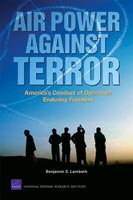 | RAND Corporation Air Power Against Terror by Benjamin S. Lambeth |
Synopsis
This report details the initial U.S. military response to those attacks, namely, the destruction of al Qaeda’s terrorist infrastructure and the removal of the ruling Taliban regime in Afghanistan.
It first outlines the efforts of the Bush administration to prepare for war, including pulling together an effective coalition, crafting a war strategy, moving forces and materiel to the region, forging alliances with indigenous anti-Taliban elements in Afghanistan, laying the groundwork for a target-approval process, and planning for humanitarian relief operations.
It then follows the unfolding of Operation Enduring Freedom from its beginning, starting with air strikes against Taliban early warning radars, airfields, ground force facilities, and other fixed targets. The author also explains how allied Special Operations Forces (SOF) were successfully inserted into Afghanistan and how those forces, enabled by U.S. air power, were eventually able to work with indigenous friendly Afghan fighters in defeating and routing the Taliban.
He then outlines problems that were later encountered in Operation Anaconda — an initiative by U.S. Army forces to push into the high mountains of Afghanistan where hard-core al Qaeda holdouts were known to be regrouping. This was to be a conventional ground force operation, but unexpected resistance and resultant fierce fighting required the emergency summoning of fixed-wing air power. This air involvement proved pivotal in producing a successful outcome and, in hindsight, pointed to the failure of Operation Anaconda’s planners to make the most of the potential synergy of air, space, and land power that was available to them.
The author describes some of the friction and conflicts that arose within U.S. Central Command (CENTCOM) over how best to use air power in the war. Perhaps the most serious inefficiency had to do with strict rules of engagement and a resultant target-approval bottleneck at CENTCOM that often allowed many important but fleeting attack opportunities to slip away.
The author emphasizes, however, several distinctive achievements in this war, including the use of SOF-enabled precision weapons that were effective irrespective of weather, the first combat use of Predator unmanned aerial vehicles armed with Hellfire missiles, and the integrated employment of high-altitude drones and other air- and space-based sensors that gave CENTCOM unprecedented round-the-clock awareness of enemy activity.
Update: Security Watchtower provides some excellent additional information on Lambeth and his work.
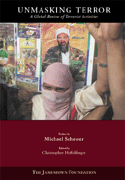 | The Jamestown Foundation Unmasking Terror A Global Review of Terrorist Activities, Volume II Christopher Heffelfinger, ed. |
Synopsis
The second volume of Unmasking Terror reviews trends and significant events in international terrorism, with selected articles from the journals Terrorism Monitor and Terrorism Focus.
Through concise and informative analysis, Unmasking Terror provides invaluable information on terrorist groups that is not often covered in the mainstream media. The book brings together leading experts on terrorism and security, with analysis on the inner workings of terrorist groups, their motives and aims, and their relationships with one another.
Written for both the specialist and the general reader, Unmasking Terror is an important resource for anyone serious about understanding terrorism.
 | CSIS Kashmir by Teresita C. Schaffer |
Synopsis
The Kashmir problem is the most intractable part of the 50-year dispute between India and Pakistan. While scholars and statesman have long analyzed the political dimensions of the problem, the economic dimensions have received much less attention.
This study is an effort to address this lack of economic content in thinking on Kashmir. Starting with an assessment of the current economic picture--in the regions administered by India and in those administered by Pakistan--it attempts to define how economics might help build peace. The study examines measures that could be taken in the near term, in the absence of major political change, to build peace constituencies and lay the groundwork for a peaceful future. And, it suggests measures that could reinforce a long-term settlement and leave a more prosperous Kashmir, integrated with the regional and world economies.
Recommendations range from proposals for working together on environmental problems, to suggestions for facilitating exports from Kashmir, to an ambitious plan for a free trade area centered on Kashmir. Although economic interventions are not a substitute for fundamental political decisions, the economic tools and recommendations addressed herein may facilitate the political changes that people in the region so badly need.









0 Comments:
Post a Comment
<< Home